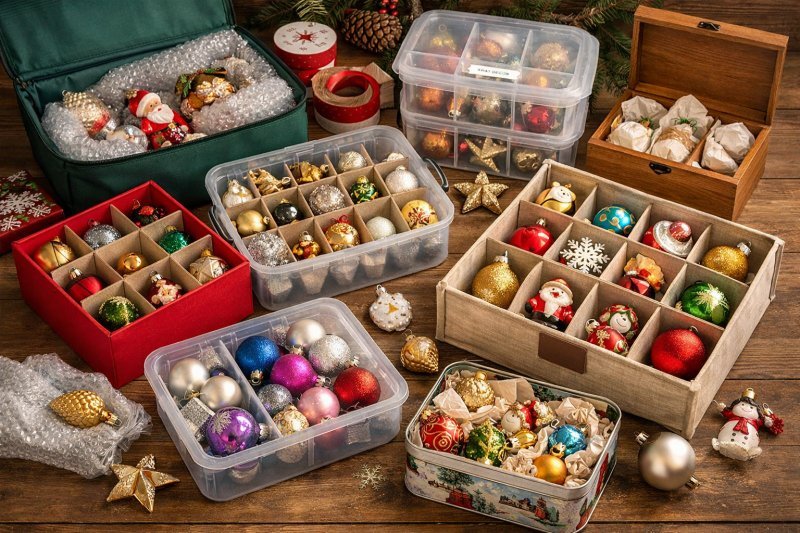
Next December, you will open the decoration bins — and what you find in them was decided entirely on take-down day. The tangled lights, the ornament found in pieces, the wreath crushed under the tree stand, the mystery bin nobody opens until the 23rd: none of these were storage accidents. They were packing decisions, made in January, by a tired person who wanted the holiday gone. Seasonal storage is therefore best understood as a process with a direction: the way decorations come down determines how they go up. Run the process in the right order — edit, clean, protect the fragile, pack into a strict bin system, store in the right place, and leave yourself notes — and next year’s decorating starts with everything found, whole, and working.
Phase one: the edit, while everything is still out
Take-down is the only moment the entire collection is visible at once, which makes it the only honest moment to edit it. Work the room with a donation bag and a bin for the dead before any packing begins. Test every light string now, while the tree is up and a failure costs nothing: a dead string packed away is just a December problem you have chosen to store. Retire the genuinely broken, the hopelessly tangled, and the decorations nobody has liked for three years. The donation station matters as much as the discard pile — seasonal items in good condition are exactly what charity shops want in January, when their own shelves have been cleared by the holidays. And keep a small “repair or decide” pile no larger than a shoebox: the ornament with the loose cap, the garland that needs one twist-tie. Anything bigger than a shoebox is not a repair pile; it is the collection sneaking back in. What survives the edit is what earns storage, and a collection edited annually stays the size of the storage you actually have.
Phase two: clean before anything sleeps
Decorations stored dirty come back worse; dust and grime given eleven months in the dark do not improve. The phase is quick if done at take-down rather than “later,” which in storage terms means never. Dust ornaments and figurines with a soft brush or cloth before they are wrapped. Shake out and, where the fabric allows, wash tree skirts, stockings, and table linens; store textiles clean because stains set permanently over a year and because stored fabric with food traces is an invitation to pests. Candles go somewhere cool — a hot attic turns a candle box into a wax event — and anything battery-powered gets its batteries removed, because a year is long enough for a forgotten battery to leak and take the item with it. Artificial greenery gets shaken out outside and allowed to dry fully if it encountered any moisture. This whole phase takes perhaps twenty minutes across a household’s collection, and it is the difference between opening bins that smell like a holiday and opening bins that smell like a cupboard.
Phase three: protect the fragile — ornaments, lights, wreaths
The breakables have known solutions, and all of them beat the traditional method (a bin, some hope). Ornaments want compartments: purpose-made ornament boxes with dividers run $15–$25 and hold dozens safely, or the home version — egg cartons for the small, divided wine boxes for the medium, or plastic cups glued in rows inside a bin for the large — achieves the same geometry for nearly nothing. Wrap only the genuinely delicate in tissue; wrapping everything is how packing takes four hours and quietly stops happening. Lights want the anti-tangle treatment: wind each string around a piece of stiff cardboard, a hanger, or a dedicated reel, because a light string thrown loose into a bin becomes next year’s forty-minute puzzle, and label any string that needs a specific bulb or has a known dead section. Wreaths keep their shape in wreath bags or boxes, or hung on a hook in the storage area under a garment bag — crushed flat in a bin, a wreath is a craft project, not a decoration. WikiHow’s guide to storing Christmas decorations has the visual walkthroughs for several of these constructions for anyone building the home versions.
Phase four: the bin system — one home per holiday
Now the containers, and the rule is totalitarian for a reason: one holiday, one set of bins, nothing shared, nothing homeless. Mixed bins are why the Easter box contains a skull and the Christmas shelf has an egg. Use uniform bins where you can — stackable, lidded, sized to what one person can carry down stairs safely — and label every bin on two sides and the top with the holiday and the zone it serves: “Christmas — tree,” “Christmas — mantel and table,” “Halloween — porch.” Pack by the order of decorating, not by material: the tree bin holds everything the tree needs, so next year’s setup opens one bin and finishes one job. Inside each bin’s lid, tape the contents list and a phone photo of the room as it looked decorated — that photograph is next year’s setup instructions, gift-wrapped by this year’s self. The same one-home logic, applied to the wardrobe’s seasonal rotation, is what makes the best way to store winter coats in summer work; seasonal things of every kind behave when each has exactly one home and a label on the door.
The small-space version: apartments and one-cupboard households
Not every household has a storage room, and the system scales down better than it first appears — because the bin system’s core is the labeling and the one-home rule, not the bin count. In a flat, the collection usually fits in two or three bins if the annual edit is honest, and the resting places become vertical: the top shelf of the wardrobe, above the kitchen cupboards in closed bins, under the bed in flat containers made for exactly that geology. Soft seasonal textiles — stockings, tree skirts, costume pieces — compress dramatically in vacuum bags, which also protect them from dust and moths better than loose folding does. Multi-holiday households should resist the shared mega-bin even harder at small scale: two labeled small bins beat one big one, because the cost of the system is paid in searching, and searching scales with mixing, not with square footage. If space is truly ruthless, the edit tightens to the final question — would I buy this again, at a January price, to store for eleven months? The decorations that survive that question are the collection. The rest were already donations; they were just being stored at your address.
The rest of the calendar: every holiday, the same physics
Christmas dominates the storage conversation, but the process is holiday-agnostic, and the households that run it for one festival should run it for all of them, because the failure modes are identical. Halloween’s animatronics and costumes die the same deaths (batteries left in, fabric stored unwashed, the porch items mixed into the Christmas bins), Easter’s baskets and egg kits multiply in the dark with the same enthusiasm, and birthday and party supplies — the reusable banner, the cake stand, the number candles — deserve a single labeled bin of their own rather than refugee status in everyone else’s. The rotation also has a direction worth respecting: when one holiday comes down, the next one’s bin is often coming up in the same session, and that swap moment is the natural audit point for the shared shelf — the time to catch the Halloween skull squatting in the Christmas bin and repatriate it. Keep each holiday’s bins adjacent but never merged, labels outward, heaviest at the bottom. The calendar turns; the shelves just turn with it, and a household that stores seasonally in this sense has quietly built a small warehouse with a very good manager: January you.
Phase five: the right resting place, and the note to next year
Where the bins sleep matters more than how they are packed. Decorations dislike heat, damp, and swings between them — which makes the attic (baking in summer) and the garage floor (damp, splash-prone) the two traditional worst choices, and a cool, dry interior closet, under-bed space, or a high shelf the best. If attic or garage is genuinely all you have, mitigate: bins raised off floors, the heat-sensitive exiles (candles, anything with batteries, delicate painted pieces) reassigned to an indoor cupboard, and the sturdiest categories — outdoor lights, plastic porch items — sent to the harsh seats. Finish the process with the step almost nobody takes and everybody wishes for: a single note, kept with the bins or in your phone, recording where everything is, what ran out (tape, hooks, a dead string), what to buy in the January sales at half price, and the one thing this year’s self swears next year’s self should do differently. That note converts storage from an annual act of archaeology into a maintained system. An hour spent this way in January is the whole price. December you, opening labeled bins of clean, whole, working decorations, will consider it the best hour the season contained.