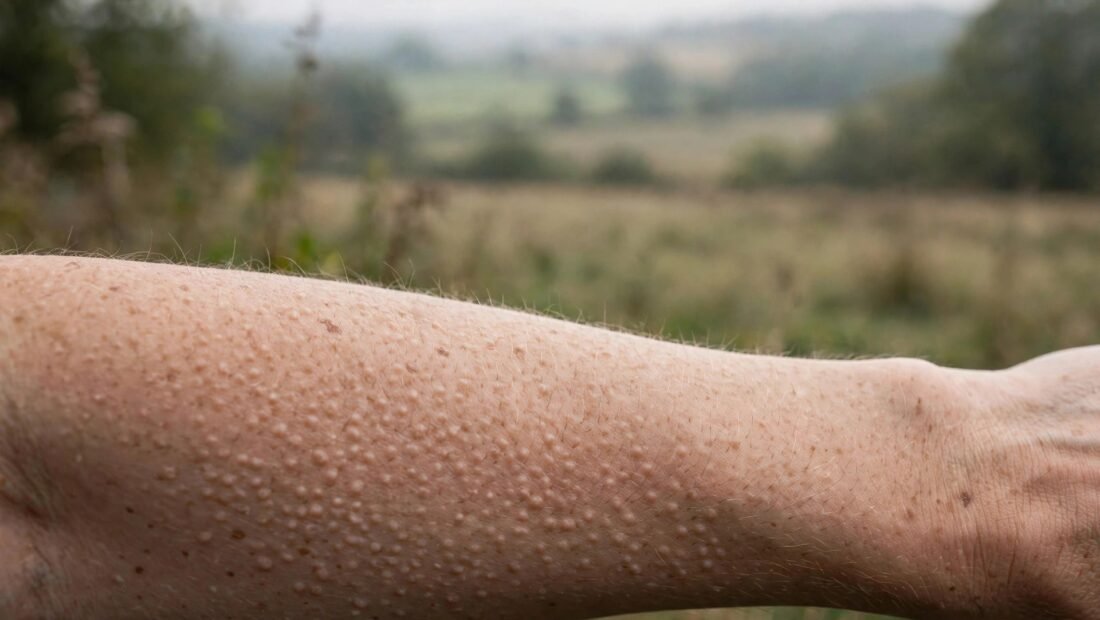
Goosebumps are a fur coat trying to happen on an animal that no longer has one. Each bump is a tiny muscle pulling a hair upright, exactly as it would on a cat or a dog, running software written for a much hairier ancestor. On us the coat never arrives. The hairs are too sparse to trap air or make us look larger. Yet the reflex fires faithfully — in cold, in a scare, in a song — connecting temperature, fear, reward, and evolution in one ripple across the skin.
The mechanism: arrector pili and a shared circuit
At the base of almost every hair follicle sits a small band of smooth muscle called the arrector pili. When it contracts, it tugs the follicle into a more upright position and dimples the skin around it. One muscle, one bump. Thousands firing together produce the familiar pebbled texture.
The order comes from the sympathetic nervous system, the branch that handles alert states — speeding the heart, tightening blood vessels, and preparing the body to act. The hypothalamus, a small region at the base of the brain that coordinates temperature and threat responses, sits near the top of this circuit. Signals travel out, adrenaline and related messengers reinforce the alert, the arrector pili contract, and the skin responds within seconds. The medical name for the whole event is piloerection.
The circuit is shared — cold, fear, and emotion feed the same sympathetic output, which is why different triggers give the identical response — and it is autonomic, like blushing. For standard reference background, see MedlinePlus’s medical encyclopedia resources on the skin and body responses.
Cold: the original trigger and its logic
Cold came first, in evolutionary terms. A mammal losing heat needs to slow that loss and, if needed, make more heat. Upright fur helps with the first job. When hairs stand, they hold a thicker layer of still air against the skin, and still air insulates. Think of a bird fluffed into a ball on a winter branch: the feathers are not warmer; the trapped air is.
Goosebumps sit at the mild end of the cold response, alongside blood vessels in the skin narrowing to keep warm blood closer to the core. If cooling continues, shivering joins in — rapid, involuntary muscle activity that generates heat directly. In that order, goosebumps can be read as an early signal. The thermostat has noticed. Stronger measures are available if the cold persists.
On a nearly hairless human, the insulation gain is negligible. The wiring, however, was never removed, because the rest of the cold response remains useful and the piloerection branch rides along with it. Thresholds vary: people who run cold often notice goosebumps sooner. A new, persistent cold sensitivity with fatigue is worth raising with a clinician, since thyroid and circulation problems can shift tolerance. Single signs rarely tell the whole story — the same caution applies to patterns like why some people get sick more often than others.
Fear: the same circuit, a different job
Fear fires the sympathetic system for another purpose, and piloerection comes along for that job too. On a furry animal facing a threat, upright hair does visual work. It makes the body look bigger and less easy to attack. A cat with its back arched and tail puffed to twice its normal width is running this display. So is a dog with raised hackles along the neck and spine. The signal says: I am larger than you thought, and I am aroused and ready.
Humans kept the arousal without the display value. A scare in a dark hallway, a sudden noise, the peak of a tense film scene — adrenaline rises, the arrector pili contract, and the arms prickle even though no predator is present and no one is impressed. The reflex persists because it is bundled with fight-or-flight responses that remain genuinely protective: faster heart, sharpened attention, blood redirected to large muscles. Evolution rarely rewires a shared circuit to remove one harmless passenger.
This bundling also explains the spillover triggers. Awe, dread in anticipation of bad news, and even disgust can raise goosebumps, because each state raises sympathetic arousal through its own route. The skin does not know which upstream emotion sent the signal. It only knows the signal arrived.
Music and the chills that feel good
The most pleasant version of the reflex has its own name: frisson, a French word for a shiver or thrill. A crescendo, an unexpected harmony, a voice cracking at exactly the emotional peak of a lyric — and a wave runs over the scalp and arms that listeners describe as chills, tingles, or skin “tightening.” Not everyone experiences it, and the same passage does not move everyone equally.
The working explanation links hearing to reward. Powerful musical moments involve pattern and prediction: the brain tracks what it expects the music to do next, and a striking fulfillment or violation of that expectation engages reward circuitry, including dopamine activity in regions also involved in other pleasures. That reward signal connects, in susceptible listeners, to the sympathetic output that raises goosebumps. Stronger functional connections between auditory areas and emotion-processing areas appear to make the effect more likely, which fits the everyday observation that frisson runs in patterns — frequent for some people across many genres, rare for others no matter the playlist.
Memory strengthens the effect. A song tied to a pivotal period carries an emotional tag, and hearing it years later can reactivate feeling and bodily response together. People who report musical chills also tend to score higher on openness to experience, though that is an association, not a diagnosis.
Other animals, same hardware
Watch the reflex where it still works and its purposes come into focus. Cats use it for insulation and for threat display. Dogs raise hackles in arousal that can signal fear, aggression, or intense excitement — context decides the meaning. Porcupines take the display furthest, erecting quills that serve as actual weapons once raised. Hedgehogs combine raised spines with rolling into a ball. Birds, working with feathers instead of hair, fluff for warmth and puff up in courtship and threat displays through a parallel arrangement of small muscles at the feather bases.
The exceptions teach as much as the examples. Whales, dolphins, and seals, which rely on blubber rather than fur, show little of this response; the insulation strategy changed, and the old display faded with the hair that supported it. Elephants, sparsely haired as adults, likewise gain nothing from it. Humans sit between the groups — enough hair remains for the reflex to be clearly visible, too little for either warmth or intimidation to result. That in-between state is why goosebumps feel strange. The signal is crisp. The payoff belongs to a different body.
Fever, withdrawal, and the less familiar triggers
Cold and fear do not exhaust the list. During a fever, the hypothalamus raises the body’s target temperature as part of fighting infection. Until the body reaches that higher target, it behaves as if it were too cold: you feel chilled in a warm room, seek blankets, shiver, and develop goosebumps. The bumps are not a malfunction. They are the cold program running on purpose, aimed at a new set point. As the fever breaks and the target falls, sweating replaces shivering and the skin smooths.
Withdrawal from opioids produces intense piloerection as the sympathetic system rebounds into overdrive — so characteristic that the phrase “cold turkey” is commonly linked to skin resembling a plucked bird. Certain tactile experiences raise chills in susceptible people as well: whispering close to the ear, light touch, particular textures or sounds gathered under the label ASMR. The pathways differ in detail, but they converge on the same small muscles. The skin has limited ways to express arousal, and piloerection is one of them.
Can anyone raise goosebumps on purpose?
For almost everyone, no. The response is involuntary, and effort alone does not produce it. A small number of people studied in laboratory settings report being able to trigger piloerection voluntarily, typically beginning at the back of the neck and spreading outward, without cold or emotion as a trigger. The ability appears to be rare and still not fully explained; it may involve unusual conscious access to autonomic pathways that most people cannot reach directly.
Indirect influence is more realistic. Slow breathing can lower sympathetic arousal, and warmth prevents the cold branch outright. Ordinary goosebumps need no management. Only a pattern change deserves attention — new, frequent episodes with palpitations, marked heat or cold intolerance, tremor, or anxiety belong in a medical conversation.
The Texas special: air conditioning to August heat
Texans know a version that puzzles visitors: step out of a fiercely air-conditioned theater, grocery store, or office — indoor air held around 68 degrees — into heat near 105 degrees, and feel goosebumps rise in the very moment you enter the heat. The reverse trip can do it too.
The explanation is shock and recalibration, not confusion in any mystical sense. Skin temperature sensors report a sudden, large change. The hypothalamic system, which was running a warming or cooling program suited to the previous environment, adjusts rapidly, and the transition itself can briefly fire piloerection before the new steady state settles. Strong contrast is the trigger, not heat alone. Anyone who moves repeatedly between refrigerated interiors and a Texas summer — delivery drivers, field workers, parents running errands with children — may notice it several times a day. It fades within moments and needs no action beyond the obvious heat care Texas already demands: water, shade, and respect for genuine heat illness, which is a separate and serious matter that goosebumps do not signal.
What a leftover reflex reveals
Goosebumps endure as a small, honest display of how humans are built. Emotion is not confined to thought. A chord change moves tiny muscles. Fear announces itself on the forearm before a person finds words for it. Temperature regulation, threat response, and reward share wiring because, in the ancestors who shaped us, they shared stakes: stay warm, stay alive, pay attention to what matters.
That is why the reflex, useless as insulation, still feels meaningful rather than merely broken. It is evidence — visible, brief, impossible to fake on command — that the boundary between mind and body was never a boundary at all. The fur coat fails to appear. The message underneath it still gets through, every time.