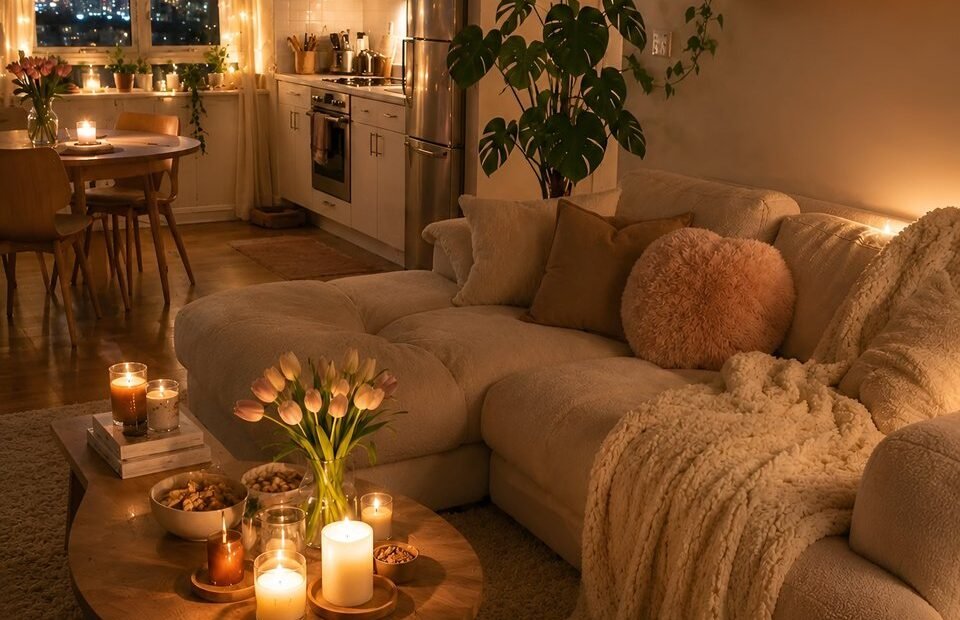
Take a typical small rental at 6 p.m. on a weekday. The ceiling light is on — the bright white one the landlord installed — and under it the room looks like what it measurably is: a box with a sofa, a television, and a rug that came with the flat. It feels like a waiting room. Nothing in the room is ugly, nothing is broken, and yet nobody would choose to spend an evening in it on purpose. Now walk the same room through two hours of small, cheap, renter-legal changes, and by 8 p.m. it feels like a cabin someone loves. This is that walk, step by step, in the order the changes actually work — because cozy is mostly a sequence, and the sequence starts with the light.
6:00 p.m. — Kill the big light
The overhead light is the enemy, and the first act in any cozy transformation is turning it off and never really turning it back on. Overhead light falls flat and even, like a shop or an office, and it makes every surface look harder and cheaper than it is. In its place, this room gets three points of low, warm light: a floor lamp in the corner by the sofa (a thrift-store lamp at about twelve dollars is the classic score), a small table lamp on the shelf, and a string of fairy lights or a couple of LED candles for the edges. Every bulb is warm white — around 2700K, the color printed on the box — because warm light reads as firelight to a human brain and cool white reads as a dentist’s office. If the landlord’s bright-white bulbs are in the lamps you own, swapping them is about a fifteen-dollar fix that you will feel every single night; it is the highest-impact money in this entire article. The effect is instant and slightly unfair: the same furniture, under low warm light from three sides, stops looking stored and starts looking arranged. Browse any collection of IKEA’s lighting ideas for warmer, softer rooms and you will see the same recipe at work — low, warm, and in threes.
6:20 p.m. — Dress the sofa like you mean it
Textiles are the shortcut because hard rooms are cold rooms, visually: every soft surface you add absorbs light and sound and tells the body to relax. Over the arm of the sofa goes a throw — a twenty-dollar one from a discount store is plenty — folded once, not arranged to within an inch of its life. Two or three cushions in different textures (one knitted, one plain, one with a pattern from the room’s colors) go where people actually sit. The trick is contrast of texture, not matching sets: matched sets look like a furniture showroom; mixed textures look like a home. A rug defines the sitting zone — and in a rental with a tired carpet, layering a smaller, better rug over a large cheap flat one gives you the pattern at a third of the price of one big good rug. Underfoot warmth is not a metaphor; a room you can walk barefoot in reads cozier than a prettier room you can’t.
6:40 p.m. — Turn the furniture toward each other
Most small rooms are arranged for the television: everything in rows, facing one wall, like a cinema for an audience of ghosts. Cozy rooms are arranged for conversation. In this walk, the sofa stays, but the armchair is pulled in at an angle to face it, and the coffee table closes the triangle — suddenly there is a place two people naturally sit and talk, which changes what the room is for. The television does not have to leave; it just stops being the altar. While the furniture is moving, the surfaces get their edit: everything that is not beautiful, useful this week, or loved leaves the tabletops. Visual calm reads as cozy — a clear surface next to a lit lamp does more for the feeling of a room than any purchase on this page.
7:00 p.m. — Height, curtains, and the walls
Now the cheap architecture. Curtains — even inexpensive panels — hung high and wide (the rail as close to the ceiling as it goes, the fabric falling past the window’s edges) make the window look bigger and the ceiling taller, and they soften the room’s hardest rectangle. Renters can do this with no-drill tension rods or adhesive hooks in many cases, and the landlord’s blinds can stay behind them. On the walls: a small gallery of frames from a thrift store, filled with free printable art, photos, a child’s drawing, a map of somewhere that matters — five dollars’ worth that turns a blank rental wall into evidence that a specific person lives here. Personal always beats expensive for coziness. A room with your grandmother’s photo and a postcard on the wall will out-cozy a styled showroom every time, because cozy is not a look. It is the feeling that the room knows you.
7:30 p.m. — Add life, scent, and one nest
The last layer is the living one. Three to five easy houseplants (a pothos forgives almost everything) go where the eye lands — shelf edge, windowsill, the corner the lamp does not reach — because green, alive shapes soften a room’s geometry in a way no object can. Scent follows: in this walk it is a pan of water on the stove with orange peel and a cinnamon stick, simmering for the price of nothing, though a candle or something baking in the oven does the same work — baking has the unfair advantage of ending in cake. And the room gets one deliberate nest: a reading chair with the lamp beside it, the throw within reach, a small table for a cup. Every cozy home has one spot that is somebody’s obvious favorite; building it on purpose, rather than waiting for it to emerge, is the whole secret in miniature. The bedroom version of the same thinking — low light, layers, calm surfaces — is laid out in how to make your bedroom more relaxing for sleep, and it is the natural next room to walk through once the living room has shown you the method works.
What this walk deliberately did not do
Notice the omissions, because they are what makes the whole thing rental-safe and cheap. Nothing was painted — landlords and deposits forbid it, and the light trick made it unnecessary. No furniture was bought; the room’s own pieces were edited and re-angled, which is free and reversible in an afternoon. No holes were drilled that a tension rod or adhesive hook could not avoid, and everything added could leave with you in two boxes on moving day. There is a principle hiding in these limits: constraints are why the room works. A homeowner with a renovation budget might have spent the two hours choosing paint colors and achieved less warmth than a lamp, a throw, and an edited tabletop. Work the sequence — light, textiles, arrangement, walls, life — in any room you are allowed to live in but not alter, and the deposit comes back with you when the feeling does.
Keeping it: the ten-minute drift back, and how to stop it
A cozy room decays by the same small increments it was built by: mail lands on the cleared surface, the throw migrates to the floor, a third lamp bulb dies and is replaced with whatever was in the drawer — bright white, naturally. The maintenance is as small as the build: a ten-minute reset once a week, ideally tied to an existing habit (before the Friday film, after the Sunday shop), that returns the throw, clears the surfaces, and checks the bulbs. Households that do this keep the 8 p.m. version of the room permanently; households that don’t will find themselves re-walking the whole transformation in three months, wondering why coziness never seems to last. It lasts exactly as long as it is maintained — which, at ten minutes a week, is the cheapest comfort in the home.
8:00 p.m. — Stand in the doorway
The walk ends where it began, in the doorway, under no ceiling light at all. The room has not gained a single piece of new furniture. It has gained three warm lights, a dressed sofa, a conversation, curtains that flatter the window, walls with a life on them, something green, something simmering, and one nest. The total spend, done with a thrift store and a discount shop, can stay under a hundred dollars, and most of the effect was free — arrangement, editing, and turning off the wrong light. That is the durable lesson of the walk: cozy is a practice, not a purchase. It is a set of small decisions — warm over bright, soft over hard, personal over perfect — repeated room by room, until the whole apartment feels like the 8 p.m. version of itself.