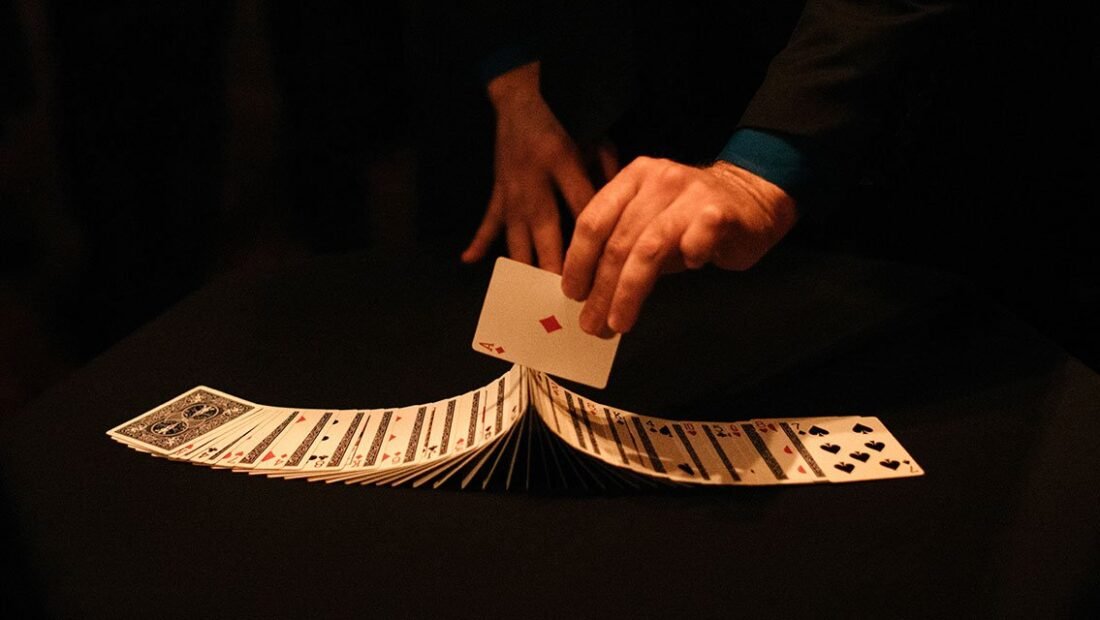
The strange secret of party magic is how backwards the effort feels. The trick that leaves a room shouting and grabbing your sleeve usually took about twenty minutes to learn. The complicated flourish that took a month of lonely practice gets a polite nod and a quick change of subject. Parties reward clarity, surprise, and ordinary objects, not difficulty hidden in your fingers.
That is good news if you are starting from zero. You do not need a trunk of props or years of training. You need a small set of reliable effects, each built around something already in a kitchen drawer or a pocket, and you need to present them like entertainment instead of a puzzle to solve. The 8 tricks below are chosen for exactly that job.
The 8-trick checklist
- 1. Key-card location — a card is chosen, lost in the deck, then found in an impossible way.
- 2. Rubber band penetration — one band appears to melt straight through another.
- 3. Coin vanish and reproduction — a coin disappears from one hand and returns where it should not be.
- 4. Coin through table — a solid coin seems to pass through a solid surface.
- 5. Jumping rubber band — a band leaps from two fingers to two different fingers in an instant.
- 6. Phone mentalism — a thought-of word or choice is revealed using a borrowed phone.
- 7. Which hand — you correctly find a hidden coin again and again, with a twist that makes the last round feel impossible.
- 8. The mentalism closer — a direct mind-reading finish that feels personal to one volunteer.
Learn them in that order. The first five build clean handling with cards, bands, and coins. The last three teach you how to slow down, talk, and let a moment land. Together, the 8 cover a full short set: a quick visual opener, a few middle effects people can touch and inspect, and a closer they will retell later.
Why these 8 work at parties
A party is noisy, crowded, and full of distractions. A trick has about ten seconds to earn attention. Each of these 8 starts with a familiar object and a simple promise. Find the card. Watch the band. Hold out your hands. Think of a word. There is no long setup to explain and no special box that makes people suspicious before you begin.
They also reset fast, in seconds, in your pocket. A trick that needs five minutes of secret setup gets performed once. A strong trick that resets instantly gets performed all night, and each performance teaches timing that practice alone cannot.
Between sets, pair the magic with fun party games for a group of 10 adults so you are not performing nonstop. Magic lands harder in short bursts.
Tricks 1 and 2: the fast openers
1. Key-card location
A volunteer picks a card, shows it around, and returns it. You shuffle in a fair-looking way, spread the deck, and pull out the exact card, or reveal it in a more dramatic spot, such as reversed in the middle or under a drink. The method rests on tracking one neighboring card, not on fast sleight of hand, which is why it can be learned in about 20 minutes.
The learning point is control of the story. Do not rush to the reveal. Ask the volunteer to picture the card. Build a small pause. Then reveal it cleanly and stop. The pause is what turns a clever location into something that feels like mind reading.
Common failure: shuffling so nervously that the tracking is lost, or doing the same location twice for the same group. Once is a miracle. Twice becomes a challenge, and people start watching your hands instead of enjoying the effect.
2. Rubber band penetration
Two bands are linked around your fingers, pulled tight so there is clearly no gap, and then one passes through the other. It is visual, instant, and uses a borrowed object, which removes the usual suspicion that the prop is rigged.
Practice the finger position until you can do it while talking. At a party, your eyes should be on the guests, not on the bands. Perform it close, let people pull on the bands first to confirm they are ordinary, then do the penetration once, slowly enough that everyone sees the before and after.
Tricks 3, 4, and 5: objects in your hands
3. Coin vanish and reproduction
A coin is placed in one hand, the hand closes, and when it opens the coin is gone, only to reappear behind an ear, under a watch, or in the other hand. This is the foundation of close coin work. The vanish itself can be learned in an evening, but making it look relaxed takes a few more evenings in front of a mirror.
Keep your hands open and loose before and after. Tension sells the secret. If your fingers curl and your shoulders rise, people sense something is hidden even if they cannot name it. Roll up showmanship in the reproduction: where the coin returns matters. A return in a surprising place gets a bigger response than a second vanish.
4. Coin through table
You tap a coin on top of a table, and it arrives underneath, caught in your other hand. The method is simple. The theater has to do the work. Tap in a steady rhythm, look at the top hand, and let the sound under the table arrive as a surprise.
Choose the right surface. A wooden kitchen table or a solid bar top works. A glass table where people can see underneath from the side does not. Angle matters here more than speed. Turn your body slightly so the clearest view is the one you want them to have.
5. Jumping rubber band
A band sits around your index and middle fingers. You close your hand for a blink, open it, and the band is now around your ring and little fingers. It is quick, clean, and perfect as a casual moment while drinks are being poured, rather than as a formal set piece.
Because it is so fast, use it as a bridge. Do it once, smile, and move to a stronger effect. If you repeat it five times, people stop reacting and start hunting. Short effects protect longer ones.
Tricks 6, 7, and 8: the mentalism finish
6. Phone mentalism
A volunteer thinks of a word, a city, or a simple choice, and the reveal appears on a borrowed phone, in a note, a search, or a photo taken earlier. Use a legitimate mentalism principle taught by a reputable source, not a gimmick app that does the work in an obvious way. Borrowed phones feel fair, and fair feels impossible.
Set this up before you need it, and test it twice. Phone tricks fail in public when a notification pops up, a screen locks, or the brightness is too low to read. Clear those problems in advance. Then keep the handling minimal. The less you touch the phone after the volunteer makes a choice, the stronger the effect feels.
For well-taught versions of phone effects and the other 8, Vanishing Inc’s magic shop and tutorials is a reliable place to learn methods that credit creators and explain presentation, not just secrets.
7. Which hand
A volunteer hides a coin in one fist while your back is turned. You turn around and find it, again and again. On the final round, you find it without asking a single question, or you predict the choice before the fists are even raised. The upgrade at the end is what lifts a guessing game into magic.
Watch body language without staring. Most people give tiny tells: one hand held a fraction higher, eyes flicking, shoulders uneven. Present those reads as part of the fun, but do not claim real psychic powers. Playful confidence beats fake seriousness at a party every time.
8. The mentalism closer
End with one direct effect for one person: a thought-of name, a freely chosen number that matches a prediction written earlier, or a drawing duplicated under test conditions. Keep it to a single volunteer and a single clear outcome. A closer should narrow the focus, not get bigger and messier.
Write the prediction in plain sight and do not touch it again. Let the volunteer open it or read it aloud. Then stop. The most common closer mistake is adding one more trick after the best moment has already happened. Leave while the room is still reacting.
Performance rules that matter more than method
Never repeat the same trick for the same audience on the same night. The first viewing is wonder. The second viewing is an investigation. If someone begs for a repeat, offer a different trick from the 8 instead and promise the first one another night.
Never explain a method when asked how it was done. A light line works: smile and say that part stays secret, then ask which moment surprised them most. It keeps the mood friendly and protects the next performer who tries the same effect.
Direct attention with your face. People look where you look. Look at the hand that should be watched, look at the volunteer during a reveal, and speak during any quiet secret moment. Silence pulls eyes straight to your fingers.
Handle a mistake without panic. If a card is wrong or a coin drops, laugh, set it aside, and move to the next trick. A calm performer keeps trust. A flustered performer makes the whole set feel shaky, even the tricks that worked.
How to practice the 8 without wasting weeks
Use a short cycle. Learn one trick fully before starting the next. Practice in a mirror until the moves feel boring, then record a phone video from the audience angle. Video catches flashes, stiff fingers, and awkward pauses that a mirror hides.
Perform early for one trusted person, then for a small group of three or four, then at a real gathering. Each step teaches something different: handling, patter, and crowd control. Ten short real performances will improve a trick more than a hundred solo repetitions.
Carry a simple kit: a normal deck, a few sturdy rubber bands, and two matching coins. That is enough for all 8 tricks. Replace worn bands often, since a snapping band ruins the effect.
Credit teachers, do not shout out methods at another performer, and buy a proper tutorial when a free clip leaves gaps. Three tricks performed with charm already put you ahead at most parties. All 8, in short, confident bursts, give you a full evening in one pocket.