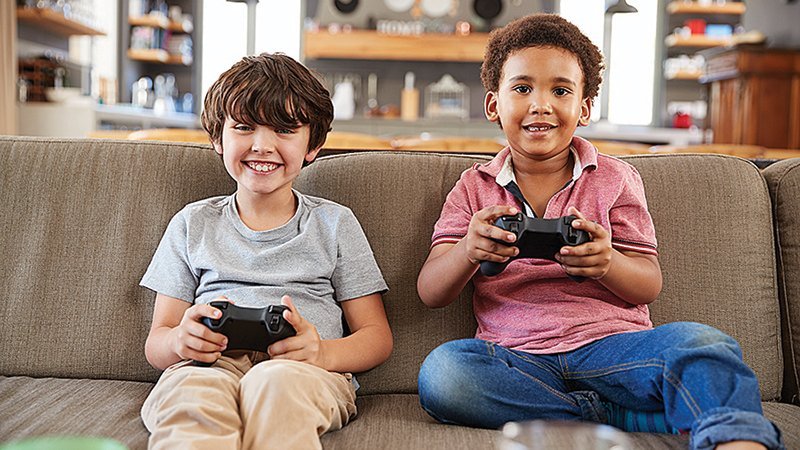
Which games can a seven-year-old and her grandfather both actually play, and both actually enjoy? Not tolerate while the other one has fun. Actually play, laugh at the same moments, and ask for one more round. That question is stricter than it sounds, and it rules out most of the game shelf at once.
A game that passes that test needs simple controls a new player can learn in minutes, no reading wall or fast reflex gate that locks out a child or an older adult, and enough real choice that the grown-up is not just pressing buttons to be kind. Very few games clear all three bars. The ones that do tend to fall into clear groups, and the right pick depends less on a single best title than on age, play style, and how the family wants to spend the hour.
Ages 4 to 6: gentle starters versus busy starters
For the youngest players, the comparison is between gentle exploration and cheerful chaos. On the gentle side, Kirby games and Yoshi games give a child a forgiving world, bright art, and help features that keep a mistake from ending the fun. A second player can often join as a helper, which suits a parent or grandparent who wants to guide without taking over.
On the busier side, the LEGO games, covering worlds such as Star Wars, Marvel, and Harry Potter, pack in slapstick humor, simple puzzles, and drop-in co-op. They are louder and more hectic, with more on-screen clutter, but they are almost impossible to truly fail. A character who falls apart just pops back together.
For a calm four-year-old, the gentle starters win. For a five- or six-year-old who loves jokes and playing side by side with an adult, LEGO wins. In both cases, avoid games built around voice chat, timers, or shopping prompts. At this age a game should feel like a toy box, not a store.
Ages 7 to 9: the co-op sweet spot
This is the age band where the grandfather test gets its best answers. Mario Kart 8 Deluxe is the clearest example. A child can use smart steering and auto-acceleration and still finish races. A grandparent can learn the controls in one lap. Yet the racing itself stays lively for skilled players, because item use, track knowledge, and well-timed drifts still matter. Nobody needs to pretend to have fun.
Super Mario Bros. Wonder offers the same balance in platform form. Levels are short, revival help keeps a fallen player in the action, and local co-op lets stronger players carry a tricky jump section without stopping the game. Compared with Mario Kart, Wonder asks for a bit more timing and patience. Compared with older Mario games, it is far kinder to mixed-skill groups.
Overcooked sits at the far end of this band. The kitchen teamwork game is hilarious for families who enjoy shouting friendly instructions and rescuing burning soup together. It is a poor fit for a child who gets upset under time pressure. Choose it for noise and laughter, skip it for a quiet afternoon.
Ages 10 to 12: open worlds versus guided adventures
Older children can handle bigger worlds, longer stories, and mild challenge, and here the comparison shifts. Minecraft gives open-ended building and exploration. In Creative mode, there is no losing, only making. In peaceful Survival, there is gathering and crafting without hostile pressure. The freedom is the appeal, and it is also the risk: a child with no goal in mind can drift, and an adult joining in needs a shared project, such as building a house or mapping a cave system, to stay engaged.
Guided adventures give that shared purpose for free. Recent Pokemon games offer a clear journey, turn-based battles that reward thinking over reflexes, and a collection drive that keeps sessions focused. The gentler Legend of Zelda entries suit patient readers who like puzzles and exploration with a story pulling them forward.
For a family that wants one game for months, Minecraft wins on sheer staying power. For a family that wants a beginning, a middle, and an ending to talk about at dinner, a guided adventure wins. Before buying either, check Common Sense Media’s age-based game reviews alongside the ESRB rating on the box. The letter rating tells you the floor. The detailed review tells you about reading level, scariness, and spending prompts, which matter more in practice.
Play style: builders, racers, puzzlers, and story players
Age alone does not settle the choice. Temperament does the rest. Builder children, the ones who line up blocks and invent rules for cardboard boxes, thrive in Minecraft and Animal Crossing: New Horizons. Animal Crossing runs at a stroll, with fishing, decorating, and visiting friends’ islands. It bores a child who wants action. It delights a child who wants a place of their own, and grandparents often take to its calm rhythm faster than anyone expects.
Racers and sports players want a result in five minutes. Mario Kart and simple sports collections give instant rounds, clear winners, and easy rematches. Puzzlers do better with cooperative puzzle games where two players hold different pieces of the answer and must talk. Story players, often the older children, want characters and chapters, which points back to Pokemon and Zelda.
Matching the style matters more than chasing the most praised title. A perfect game in the wrong style gathers dust. A good game in the right style gets played for a year. If free phone play enters the mix between console sessions, compare options against the best free mobile games with no ads so a quick game on a tablet does not turn into an ad break every thirty seconds.
Hardware: Switch, tablet, or a shared console and PC
The Nintendo Switch fits family play best for most homes. It connects to a TV for shared viewing, includes two small controllers in the box for instant two-player games, and holds the deepest bench of gentle co-op titles. Its weakness is price and power: games cost full price, and big multi-platform titles can look rougher than on stronger machines.
A tablet costs less to start and touches feel natural for young children. The trade-off is control and quality. Many tablet games lean on ads, energy timers, and in-app purchases, and precise platforming or racing feels clumsy on glass. Used carefully, with purchases locked, a tablet works well for puzzle and drawing games.
A PlayStation, Xbox, or family PC opens the widest catalog and the best sales. LEGO games, Minecraft, and many indie puzzlers appear everywhere, often cheaper. The trade-off is setup: accounts, downloads, and parental controls take more work, and the catalog includes far more teen and adult titles to filter. For a home that already owns one of these machines, there is no need to buy a Switch on day one. Start with the family titles already available there.
Cost and safety: full-price games versus free games
A full-price game with no in-game shop is usually the cheaper and safer choice over a year. The cost is known, the content is finished, and play does not pause for a sales pitch. A free game can be fair, but many free games earn money by selling currency, costumes, or shortcuts, and children feel that pressure most.
Whichever route a family takes, set the safety basics once per device. Create a child account. Require a password for every purchase, or turn purchases off. Turn off voice and text chat with strangers, and limit online friends to people the family knows. Turn on the built-in playtime reports so limits rest on facts rather than arguments.
Then play the first session together. One shared hour reveals reading demands, scary moments, and chat features faster than any store page. It also sends the right signal: games are something the family shares and talks about, not a sealed world adults only police from outside.
The recommendation
Start with the group, not the store chart. For most families with a child between five and ten, Mario Kart 8 Deluxe is the safest first buy: every age can play it on the same evening, rounds are short, and a grandparent can win a race without anyone going easy. Add a LEGO co-op game next if the child loves stories and jokes, or Super Mario Bros. Wonder if the family prefers exploring levels together.
For a child who builds, draws, and invents for hours, skip the racers and start with Minecraft in Creative mode, with a shared building project for the first sessions. For a calm child and a grandparent who likes an unhurried visit, Animal Crossing is the quiet winner, as long as nobody expects fast action.
Buy one game, play it together for two weeks, and watch what the child reaches for: speed, building, puzzles, or story. That pattern, not a ranking list, tells you the second game to buy. The families who enjoy gaming most treat the first title as a test of taste, keep purchases and chat locked down from the start, and protect the habit that matters more than any single game: playing side by side, talking through it, and stopping while everyone still wants one more round tomorrow.