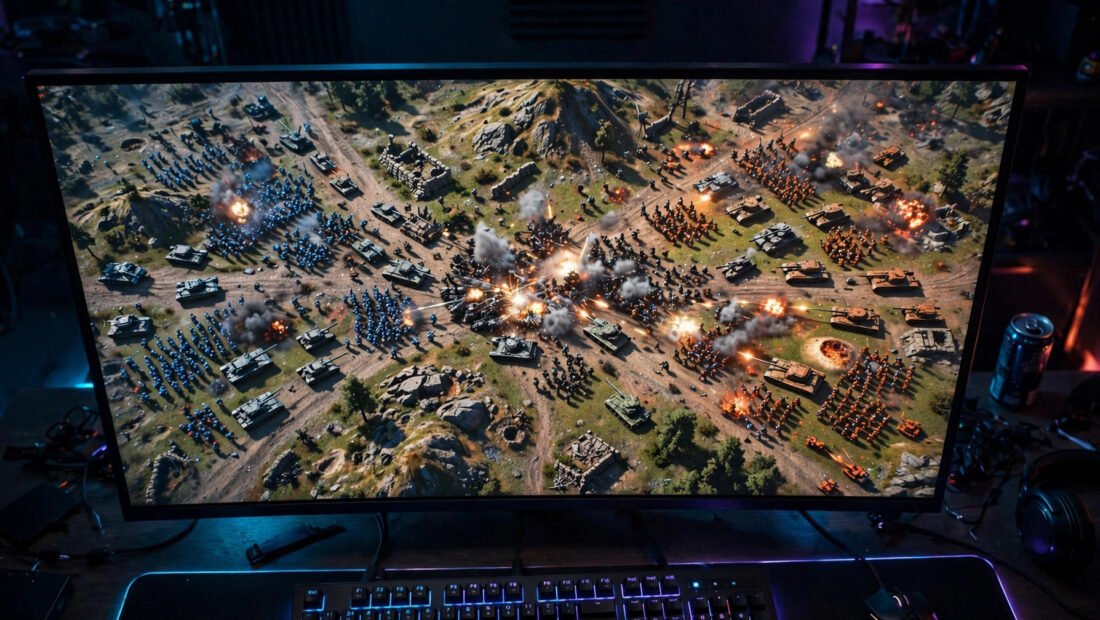
The usual advice for getting better at strategy games is to stop playing and start watching: hours of build-order videos, pro match breakdowns, and tier lists for a game you bought to enjoy. There is a better route, and it happens inside your own matches. The players who climb steadily are rarely the ones who consumed the most content. They are the ones who learned a few core principles cold, practiced one thing at a time, and paid close attention to their own losses.
The principles underneath every strategy game
Games that look nothing alike reward the same habits. A real-time battle in StarCraft, a long campaign in Civilization, an Age of Empires skirmish, and a tight puzzle fight in Into the Breach all turn on resources, information, and timing. Learn to see those three things and you have something that transfers every time you pick up a new title.
Start with economy. In a real-time game, economy means workers, income, and unspent resources sitting idle. If your workers stop being produced, your income stalls. If your bank grows while nothing is being built, that money is not helping you win. In a turn-based game the same logic wears different clothes: science, production, gold, and growth per turn. A city in Civilization that grows and produces steadily will outrun a clever plan built on a weak base. Before you chase fancy tactics, make the boring base automatic. Keep production running. Spend what you earn. Expand when the game gives you a safe chance to do it.
Next comes information. Scouting is not an advanced trick. It is the difference between reacting and guessing. In StarCraft or Age of Empires, seeing an opponent’s early building choice tells you whether to prepare for pressure or to grow in peace. In Civilization, meeting neighbors early and watching their military score tells you which border needs attention. Most surprising losses are not really surprises. There was a sign, and nobody looked for it. Build scouting into a rhythm rather than treating it as something you do once at the start.
The third principle ties the other two together: opportunity cost. Every choice in a strategy game is also a choice about what you are not doing. Building that unit means not building that upgrade. Sending your army across the map means not having it at home. Researching one technology means delaying another. You do not need to solve this perfectly. You just need to ask the question out loud for a while: if I do this, what am I giving up? That single habit sharpens decisions in every genre, because it forces you to compare options instead of grabbing the first one that looks useful.
There is a fourth point worth naming, even if it flows from the three above. Play toward the win condition the game actually scores. A beautiful empire that never moves toward victory in Civilization loses to a plain one that does. An army in Into the Breach that kills every enemy but lets the buildings fall has solved the wrong problem. Keep the real goal in view when the board gets busy.
Practice with one focus at a time
Deliberate practice sounds like homework, and it can feel that way if you try to fix everything at once. It does not have to. The workable version is simple: pick one focus for a session and let the rest of your game be ordinary.
One session might be about never letting worker production stop. Another might be about scouting on a timer, checking what your opponent is doing every couple of minutes instead of only when you remember. In a turn-based game, a focus could be checking every city’s production choice before you end the turn, or never letting a unit sit idle without a reason. The point is that one clear target is easy to hold in mind while you play. Five targets are just noise.
Keep sessions normal length and play real games. Shorter matches help here, because more games mean more openings, more early decisions, and more chances to repeat the focus. A twenty-minute game you play three times teaches your hands and eyes more than one long, sprawling match where the focus fades after the first half hour.
Openings deserve a special note. Learning one standard opening for your faction or civilization gives your early game a stable shape, so your attention is free for the focus you chose. You do not need a library of openings. One reliable start, practiced until it feels dull, is enough to carry you well past the beginner stage.
When a focus starts to hold without effort, pick the next one. That slow rotation is how a skill becomes automatic, and automatic skills are what free you to think about the interesting problems mid-game instead of the basics.
Replays are where the real learning hides
If one habit replaces guides almost entirely, it is this one: watch your losses. Not all of them, and not for long. Five minutes with a replay after a defeat teaches you things no general advice can, because it shows your game, your timing, and your blind spot.
Go in with one question: when did I actually lose this game? The answer is almost never the final battle. Look earlier. It might be the scout you skipped that would have shown an attack being prepared. It might be a stretch where your resources climbed while production sat idle. It might be a fight you took with half your army while the other half walked home. In Civilization, the losing moment might be the ten turns where you researched in three directions and finished nothing that mattered. In Into the Breach, it might be the turn where you solved the loudest threat and left a building exposed.
Once you find that moment, write down one line about it. Keep it plain: missed the early scout, floated resources during the mid-game, took a fight before reinforcements arrived. A short note after each session, looked over once a week, starts to show a pattern. Most players find the same two or three mistakes repeating. Those repeats are your real practice list, and they are far more useful than a stranger’s list of tips.
Recording helps too, especially for games without a strong replay system. If you capture your own sessions, you can skim back to the exact minute a game turned. You do not need special hardware for that. The method covered in how to stream and record games free without a capture card works just as well for saving private review copies as it does for broadcasting. Wins, by the way, are poor teachers. They mostly confirm what already worked. Losses point at the gap, which is why a short, honest look at them pays so well.
For broader context on how different titles handle these same ideas, PC Gamer’s strategy game coverage and guides can fill in a game’s specific systems once your own replays have told you what to look for.
Choosing opponents who actually teach you something
Who you play matters as much as how you practice. Roll over weak opponents and you learn nothing except how winning feels. Get crushed by someone far above your level and you learn little more, because the game ends before you can tell which mistake mattered.
The useful middle is an opponent who beats you 60-70% of the time. Against that player, your decisions carry weight. Hold your economy together and scout on time, and you can win. Slip, and you can feel exactly where the game got away from you. That feedback loop, win some and lose some for reasons you can name, is the fastest teacher available in any strategy game.
Against computer opponents, use difficulty the same way. Raise it when the current level stops punishing your mistakes. Lower it briefly when you want to rehearse a new opening without pressure. Then take the opening back to even matches, where it has to survive contact with a real plan.
Mindset, plateaus, and the ranked question
Improvement rarely climbs in a straight line. It moves in jumps, with flat stretches in between where nothing seems to change. Those plateaus are normal. Your brain is often locking in a skill during the flat part, and the jump shows up later, sometimes in a game you expected to lose. Quitting during a plateau is the most common way players stall for good.
Anger does the opposite of practice. A session played on tilt rehearses rushed scouting, careless fights, and stubborn plans. If you are queuing up angry, you are training habits you will later have to untrain. Shorter, fresher sessions beat long, tired ones. Two focused hours will do more for your rating over a month than six drained hours in a single night.
As for ranked versus casual: ranked has one real advantage, which is that it matches you against players near your level and makes both sides try. That is the sweet spot described above, delivered automatically. Casual games are better for testing a new opening or a new faction without the sting of a loss counting. Use both on purpose. Test in casual, prove it in ranked, and do not let a number on a ladder decide whether a session was useful. A loss where you held your focus and found the turning point in the replay was a good session, whatever the ladder says.
The one time a guide earns its place
Skipping guides does not mean guides are worthless. It means they work best last, not first. After a few weeks of focused practice and replay notes, your weakness will have a name. Maybe you always lose to early pressure. Maybe your late-game spending collapses. Maybe one matchup keeps beating you the same way. At that point, one targeted guide on that exact problem is worth more than fifty hours of general content watched before you knew what you needed.
That order of operations is the whole method. Principles first, one focus at a time, your own replays as the main teacher, opponents who stretch you without burying you, and outside help only when you can name the question. Focused practice commonly shows clear improvement in about 4-8 weeks, though the pace depends on the game and how often you play. No schedule is a guarantee. What is reliable is the direction: players who review their own losses and fix one leak at a time do not stay stuck for long.