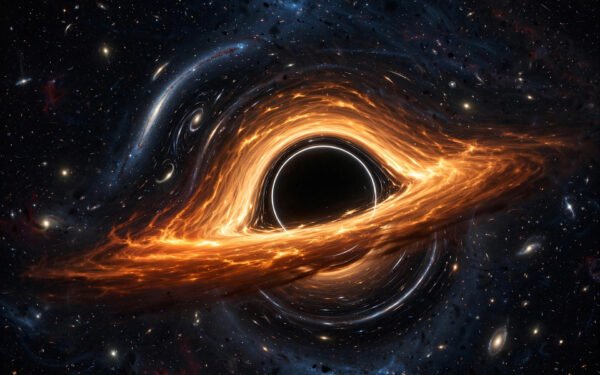
Some of the light arriving at a telescope tonight left its galaxy more than thirteen billion years ago. It set out before Earth existed, before the Sun existed, and crossed nearly the whole of cosmic history to end its trip in a detector built by the descendants of creatures it predates. Catching light that faint and that old sounds like magic. It is not. It is patience, size, cold, and one elegant trick: most of what the great telescopes collect is light no human eye could ever see.
Light buckets and the long stare
Every telescope, from a backyard tube to an orbital giant, does the same basic job. It collects light. Your pupil opens to about 7 millimeters in the dark. A large mirror spans meters, gathering hundreds of thousands of times more light per second than your eye can. That matters because distance is cruel to brightness. Light spreads as it travels, so a galaxy twice as far away looks four times fainter. Push that arithmetic out to billions of light-years and the faintest galaxies under study shine at a tiny fraction of what the naked eye can detect.
Size alone does not finish the job. The other half of the trick is time. A camera on a great telescope does not snap a picture. It stares. The shutter stays open for hours, sometimes across many nights, while a detector counts photons one sparse arrival at a time. Static and noise average out. Signal builds. A patch of sky that looks empty in a short exposure slowly reveals smudge after smudge, each one a galaxy whose light has been in transit for most of the age of the universe. Deep-field images, the famous ones crowded with thousands of galaxies in a speck of sky, are really portraits of patience.
Bigger mirrors, sharper eyes, and the wall of air
A larger mirror earns its keep twice. It collects more light, and it resolves finer detail, separating two close points of light that a smaller mirror smears into one. That double payoff is why each generation of telescopes has grown, and why the mirrors on new ground-based giants are assembled from segments fitted together to act as one vast surface.
Ground telescopes, though, look up through an ocean of air. The atmosphere churns and shimmers, bending starlight as heat haze bends the view across a Texas highway in August. That blur sets a ceiling no mirror polish can beat. Modern observatories fight back with adaptive optics. A laser creates an artificial star high in the sky, sensors measure how the air distorts its light hundreds of times per second, and a flexible mirror reshapes itself just as fast to cancel the distortion out. Paired with dry, high, still sites, the technique hands ground telescopes back much of the sharpness the air tried to steal. Even so, there are wavelengths the air blocks outright, and faintness the glow of the sky itself can swamp. The full answer had to leave the ground.
The escape to space, and what orbit bought
The Hubble Space Telescope settled the argument in 1990. Orbiting about 340 miles up, clear of the blur, its 2.4-meter mirror was modest beside the giants on mountaintops, yet its images came back sharper than anything the ground could match at the time. Above the atmosphere, stars stopped twinkling and started resolving. Galaxies showed structure. Distance measurements tightened. Hubble’s deep fields turned specks of darkness into crowds of galaxies and rewrote public understanding of how full the universe is.
The James Webb Space Telescope took the logic further out. It sits about a million miles from Earth at a stable gravitational point, behind a sunshield the size of a tennis court, with instruments chilled close to absolute zero. The cold is not a luxury. A warm telescope glows in infrared light, and a glowing telescope would blind itself to exactly the faint signals it was built to catch. Keeping the observatory colder than the objects it studies is what lets it listen at a whisper. For mission histories, images, and instrument details from both observatories, NASA’s telescope mission pages, including Hubble and Webb are the home source.
Infrared, the real lens of the time machine
The deepest reason Webb had to be cold sits in the physics of expansion. Space itself stretches as light crosses it, and the stretching pulls light waves longer. Visible and ultraviolet light from the youngest, farthest galaxies arrives at Earth shifted all the way into the infrared. That shift is called redshift, and it grows with distance, which makes it a measuring stick as well as an obstacle. The most ancient galaxies are not merely faint. Their light has been moved entirely out of the visible band. An eye, or a telescope built only for visible light, could stare at them forever and record nothing.
Webb was built infrared-first for exactly this reason. Its gold-coated mirror segments reflect infrared well, and its cooled detectors read the stretched glow of galaxies that lit up within the first few hundred million years after the Big Bang. Hubble, strongest in visible and ultraviolet light with some infrared reach, sees deep. Webb sees earlier. Between them, and with the great ground telescopes filling in detail and spectra, astronomers can now lay galaxies along a timeline and watch structure assemble across cosmic history, from the first ragged systems to spirals as settled as our own.
Assigned color and honest pictures
Those blazing orange and crimson Webb portraits raise a fair suspicion, and the honest answer is simple. Space is not that colorful, at least not to eyes like ours. The colors in telescope images are assigned. Scientists map invisible infrared wavelengths onto visible colors, often choosing the mapping so that longer wavelengths appear redder, which keeps real information about the light intact while making it readable. Short-wavelength data may be shown in blue, mid-range data in green, the longest waves in red.
Assigned is not the same as invented. Every shade in a released image traces back to measured photons at a specific wavelength, filtered and recorded by the instrument. The translation resembles a weather map, where colors stand for temperatures no eye could see directly. Nothing is painted in for drama, though the drama tends to arrive on its own. When you look at a deep field, the colors are a code, and once you know the code, the picture tells you which galaxies are near, which are far, and which were shining before Earth had a sky.
What a Texas backyard can honestly see
None of this machinery puts other galaxies out of amateur reach. Under a dark sky, the Andromeda Galaxy is visible to the naked eye as a faint smudge, its light about two and a half million years old. A modest telescope from a dark site reveals dozens of galaxies as soft gray ovals, and patient observers with larger instruments log hundreds. The view through an eyepiece will never match a long-exposure image, since your eye cannot stack hours of photons the way a detector can, but the photons landing on your retina left those galaxies in genuine antiquity. That is not a small thing.
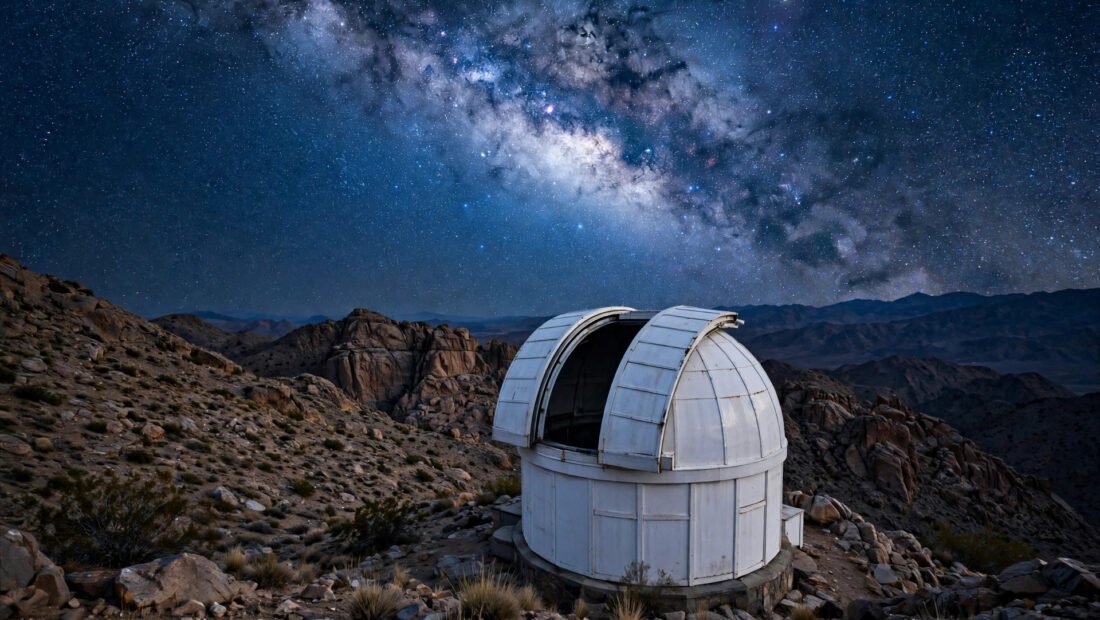
Texas helps. The Davis Mountains of West Texas hold some of the darkest, driest skies in the continental United States, which is why the McDonald Observatory works there and why its public star parties draw crowds willing to drive for hours. Dry air steadies the view, altitude thins it, and distance from city glow keeps the background dark enough for faint targets to stand out. Learning to find and track those targets is its own craft, and understanding how a GoTo telescope mount works and what it does for you is a practical first step for anyone setting up under those skies.
One more honest limit belongs in any backyard account. Light pollution is the amateur’s atmosphere problem, and it is getting worse near growing cities. A galaxy that stands out clearly from a ranch road near Fort Davis can vanish completely from a Houston suburb, not because the telescope shrank but because the sky behind the galaxy brightened. Filters help with some kinds of glow and do nothing for others. The practical answers are unglamorous: drive farther, shield your eyes from direct light for twenty minutes so they fully adapt, and aim at targets high overhead, where you look through the least air and haze. Dark sky is a resource, and West Texas still has more of it than almost anywhere else in the country.
The next glass
The frontier keeps moving outward. On a Chilean mountaintop, the Extremely Large Telescope is under construction around a mirror 39 meters across, assembled from hundreds of segments, designed to gather far more light than any telescope now working. Plans for it include photographing rocky planets around nearby stars directly, something no current instrument can do with real clarity. Successors to Webb are on drawing boards with an even bolder aim: reading the atmospheres of such planets for water vapor, oxygen, and methane, the chemical hints that life might be at work.
Treat those as plans and construction, not results, until first light proves them. That caution is the field’s own habit. Every generation of telescope was doubted at the faint end, and every generation answered by staring longer, building wider, and cooling better. Thirteen-billion-year-old light is arriving tonight, as it arrived last night, indifferent to whether anyone catches it. The whole history of telescopes is the story of learning, piece by piece, how to be there when it lands.