
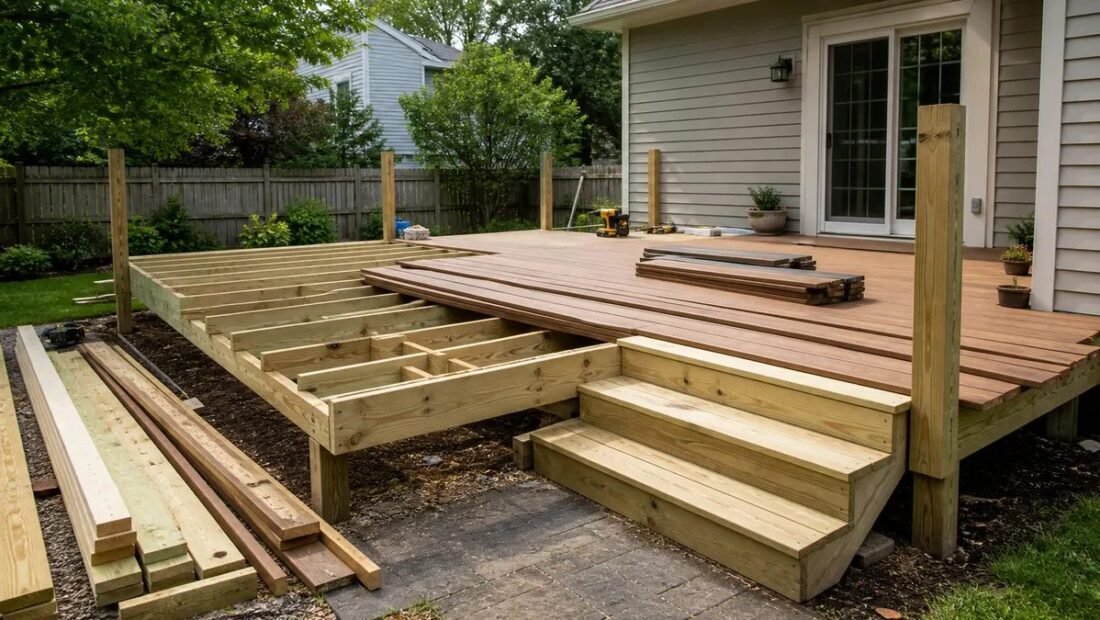
We priced our 16×20 backyard deck three ways: contractor quotes at $14,000 and $18,000, and DIY at $5,500 in materials. We built it ourselves over three weekends, and it is now the most-used room of our house for six months a year. The deck industry, like fencing, prices labor like it is made of gold, because the labor is genuinely hard.
How much does it cost to build a simple deck? The real numbers: $15 to $35 per square foot DIY, $30 to $60+ per square foot professionally built. A simple 12×16 deck therefore runs $3,000 to $7,000 DIY or $6,000 to $12,000 hired out.
How Much Does It Cost to Build a Simple Deck?
Material choice sets the budget. Pressure-treated pine decking is the economical classic at $2 to $5 per square foot for materials; it needs staining every 2-3 years but costs half of everything else. Cedar runs $4 to $8 per square foot, beautiful and naturally rot-resistant. Composite decking (Trex and similar) costs $8 to $15 per square foot in materials but needs virtually no maintenance for 25 years; the premium pays back in eliminated staining weekends. The framing lumber, concrete, hardware, and railings add $5 to $10 per square foot regardless of decking choice.
Size and complexity multiply everything. How much does it cost to build a simple deck versus a fancy one? A single-level rectangle at ground level is the cheapest per foot. Add a second story (structural engineering, taller posts, stairs), curves or angles (wasted material, skilled cuts), built-in benches, or elaborate railings, and costs climb 50 to 100%. Railings alone add $15 to $30 per linear foot; a deck that does not need railings (low to the ground, under 30 inches) saves thousands. Permits run $100 to $500 and are required almost everywhere; skip them and you risk stop-work orders and resale nightmares.
- Keep it rectangular and single-level. Every angle and elevation adds cost. Simple shapes build fast.
- Stay under 30 inches high if possible. No railings required by most codes. Railings are expensive.
- Price materials at multiple yards. Lumber prices vary 20%+ between suppliers. Get three material quotes.
- Rent the auger and the miter saw. $150 in rentals beats $1,000 in tool purchases for a one-time build.
- Use hidden fasteners for composite. Cleaner look, no popped screws later. Worth the extra cost.
- Flash the ledger board correctly. The ledger-to-house connection is where decks fail. Proper flashing prevents rot.
- Call 811 before digging footings. Free, legally required in most places, and non-negotiable.
- Get the permit. $100-$500. Unpermitted decks haunt resales and insurance claims.
The DIY reality check: a simple deck is an achievable DIY project, but it is not a beginner’s first project. You need to be comfortable with a circular saw, level, and drill; understand basic structural concepts (or follow prescriptive code tables exactly); and have at least one strong helper. Footing holes below the frost line, a level ledger, and square framing are the critical skills. If any of that sounds alarming, hire the framing and DIY the decking and railings; hybrid approaches save money while ensuring structural soundness.
Composite vs Wood: The 20-Year Math
The honest comparison: pressure-treated pine costs half upfront but demands staining every 2-3 years ($300-$500 in materials and a weekend each time) and lasts 15-20 years. Composite costs double upfront, needs only occasional washing, and lasts 25-30 years. Over 20 years, the total costs converge surprisingly closely, with composite winning on time saved. Choose wood if budget is tight now and you do not mind maintenance; choose composite if you value weekends over upfront savings. There is no wrong answer, only a wrong expectation.
Cedar sits between: prettier than pine, less maintenance than pine, more maintenance than composite. It is the choice for people who love real wood and accept its care schedule.
Quick Answers to Common Questions
How long does it take to build a deck?
A simple 12×16 deck: 2-3 weekends for experienced DIYers, 1 week for a pro crew. Permits and material delivery add lead time before work starts.
Do I need a permit to build a deck?
Almost always yes, for anything attached to the house or over 30 inches high. Freestanding ground-level platforms sometimes exempt; verify with your local building department.
How deep should deck footings be?
Below the frost line: 36-48 inches in northern climates, 12-24 inches where frost is minimal. Check local code; inspectors measure this.
What is the cheapest decking material?
Pressure-treated pine, at $2-$5 per square foot for materials. It requires regular staining but nothing beats it on upfront cost.
My Deck Build Checklist
- Design simple: rectangle, low, single-level. Complexity is the cost multiplier.
- Get permits and call 811. Before any digging. No exceptions.
- Price materials at three suppliers. Lumber varies 20%+. Shop it.
- Flash the ledger meticulously. Deck failures start at the house connection.
- Rent big tools, buy small ones. Auger and miter saw rented; drills and levels owned.
What I Would Do Next
Our deck just hosted its third summer of dinners, morning coffees, and one memorable thunderstorm watched from under the patio umbrella. The $5,500 and three weekends bought the equivalent of an extra room for half the year. If you have the yard and the weekends, a simple deck is the highest-joy-per-dollar project in home improvement.
How much does it cost to build a simple deck? $15 to $35 per square foot DIY, $30 to $60+ professionally. Keep it simple, get the permit, and respect the ledger flashing.
Three weekends from now, you could be drinking coffee on it. Start with the design and the permit office.
Related reading: How Can I Add Storage to a Small Laundry Room.
Related reading: What Should I Do About Mold in My Bathroom.
Related reading: How Much Does a New Water Heater Cost Installed.
For official guidance, check out This Old House how-to articles and EPA guidance on indoor air quality.



