A $14 necklace gets asked about as if it were inherited gold. Across the room, a genuinely expensive piece goes unnoticed. Jewelry is the category where price and appearance part ways most often, because what the eye actually reads is not karats — it is weight, finish, scale and condition. Cheap jewelry looks expensive when those four things are managed, and looks cheap when any one of them fails, whatever the tag said. There are five levers. Each has a real upside and a real catch, so they are weighed one by one before the verdict.
Lever one: buy weight and finish, not branding
The upside: the single most reliable tell of cheap jewelry is lightness. A hollow, feather-weight chain reads as costume at a glance, while a piece with some heft in the hand reads as substance before the eye even focuses. Finish is the second tell: a warm, soft-gold tone looks like metal, while a bright yellow-orange plating looks like a prize from a machine. Matte and brushed finishes forgive cheapness; mirror-shiny thin plating advertises it. The catch: within a budget line, choosing the weightier, better-finished version usually means fewer pieces — one good chain instead of four flimsy ones. That trade is the entire strategy, but it is a trade.
Lever two: layer delicate pieces
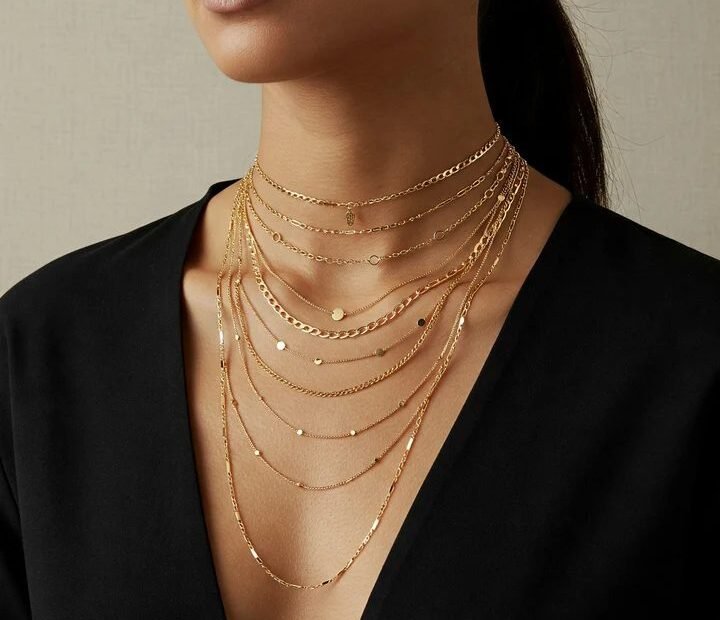
The upside: three thin gold-tone necklaces worn at staggered lengths look like a $300 styling decision, because layering is what stylists do with real gold. One chunky cheap necklace, by contrast, looks like exactly what it cost — chunkiness at a low price point means hollow forms and plated plastic shine. The same trick works on wrists (two or three fine bangles over one wide cuff) and ears (a small stack instead of one large statement). The catch: layers tangle, and tangled cheap necklaces announce themselves. Keep layered chains genuinely different lengths — an inch or two apart — and store them fastened, or the look unravels into a knot at the worst moment.
Lever three: one anchor piece upgrades everything near it
The upside: vermeil and gold-filled pieces cost more than plated ones — a single vermeil pendant might be $60 where the plated version is $12 — but one anchor piece transforms the ten budget pieces around it, because the eye averages the whole arrangement and the anchor pulls the average up. Gold-filled, with its mechanically bonded layer of gold, lasts years where thin plating lasts months; it is the cheapest point at which jewelry becomes durable rather than disposable. The catch: the anchor only works in the same metal family and tone as the rest. A rose-gold anchor among yellow-gold budget pieces does not lift them; it exposes them.
Lever four: protect the plating like it is the product
The upside: most cheap jewelry does not wear out — it is chemically dissolved. Perfume, lotion, sunscreen, sweat and water strip plating in weeks, and tarnish is the loudest cheap-signal there is. The discipline is simple: jewelry goes on last, after every product has dried, and comes off first, before washing, swimming or sleeping. Wipe each piece with a soft dry cloth after wearing, store pieces apart so they cannot scratch, and keep them out of bathroom humidity. Care specifics for plated and costume pieces are laid out in Rebag’s guide to cleaning and maintaining costume jewelry, and the rules there are the difference between a two-month piece and a two-year one. The catch: this lever asks for a daily habit, and habits are the one currency some people will not spend. Without it, the other levers decay on schedule.
Lever five: avoid the obvious fakes
The upside: nothing marks jewelry as cheap faster than imitation of a specific famous design — the copied luxury motif, the pretend-designer logo, the “inspired” piece everyone recognizes as a copy of something that costs forty times more. Plain, classic forms — a rope chain, a dome ring, simple hoops, a tennis-style bracelet in glass or crystal — carry no comparison and therefore fail no comparison. The catch: plain can tip into forgettable. The fix is scale and finish, again: one substantial plain piece, well finished, reads as quiet luxury where a small plain piece reads as nothing at all. The same judgment governs accessories generally — it is the logic behind the best affordable alternatives to luxury handbags, where construction beats resemblance every time.
Lever six: stones, sparkle and the plastic test
The upside: sparkle is where cheap jewelry most often betrays itself, and where a small discrimination pays most. Real-looking sparkle comes from faceted glass or crystal — materials with enough density to throw sharp, white flashes. Plastic and resin “stones” glow dully, with soft, colored, soapy light, and the difference is visible across a room. When a budget piece uses stones, choose small ones: a fine pavé-look band of tiny glass stones reads as delicate and real, while one enormous plastic solitaire reads as a toy. Settings vote too — prongs and bezels suggest a jeweler; obvious glue blobs around a stone announce a factory’s cheapest minute. The catch: crystal-set budget pieces are fragile in a specific way — stones shed. Buy them for occasions, check settings with a fingertip before wearing, and accept a shorter service life as the price of the sparkle.
The in-store checklist: sixty seconds before the till
All six levers compress into a one-minute inspection at the shelf. Heft the piece: does it have the weight of metal or the drift of plastic? Turn it over: backs and clasps are where cheapness hides, and a finished back with a secure clasp is the mark of a piece built to be looked at closely. Run a fingernail along the finish: plating that feels chalky or shows color variation will not survive the month. Hold stones to the light for the sharp-flash test, and eye the color of the metal against your own gold or silver — near-misses in tone look wrong on the body even when they pass on the shelf. Finally, the mirror test at conversational distance, three feet: if the piece reads as jewelry rather than as a price tag, it passes. Two of three budget purchases fail this minute; the one that passes is the one worth owning.
The outfit math: jewelry against necklines, sleeves and scale
Even perfectly chosen pieces fail in the wrong company, so the last skill is proportion against the outfit. A fine layered necklace set needs an open field — a scoop, a V, a bare shoulder — and disappears into a busy print or a high collar, where its delicacy reads as clutter. Chunky evening pieces, if you wear them, want the opposite: plain fabrics, solid colors, and room. Sleeve length votes as well: bracelets earn their visibility on bare wrists and three-quarter sleeves, and are wasted inside a long cuff. Earrings scale against hair — studs vanish under loose long hair, where a drop or hoop survives; pulled-back hair returns the advantage to the stud. None of these rules mentions price, because none of them is about price. They are why a $20 set, placed correctly, photographs like a styled editorial, and why a genuinely expensive piece, placed carelessly, can photograph like costume. The levers choose the pieces; the outfit math decides whether anyone can tell.
Care and storage: where affordable jewelry actually dies
The levers buy the look; care decides how long it lasts, and affordable jewelry’s enemy is not time — it is moisture, chemistry and tangling. Store pieces dry and separate: a lined box or individual small bags, because metal-on-metal contact scratches finishes and chains tie themselves into knots that break when forced. Perfume, hairspray and sunscreen go on before jewelry, never after — their alcohols and oils cloud stones and dull plating faster than wear does. Wipe each piece with a soft dry cloth after wearing; skin oils and the day’s humidity are the tarnish recipe, and ten seconds removes them. Faux pearls and crystal pieces especially should never meet water. None of this is precious-metal preciousness. It is the recognition that a well-chosen $30 set, stored dry and worn gently, can serve for years — while a careless drawer can ruin it by spring. Cheap jewelry asks to be chosen like expensive jewelry and stored like it too. Do both, and the price becomes the only inexpensive thing about it.
A word on plating and tarnish, honestly
Most pieces in this price class are plated — a thin skin of gold- or silver-tone over a base metal — and plating is a finish with a lifespan, not a fraud. It wears first where skin and friction meet it: ring bands, bracelet clasps, the backs of pendants. Expect a well-kept plated piece to look excellent for a few years of regular wear rather than forever, and judge it by that honest standard. When a beloved plated piece finally thins, the levers still apply to its replacement — and by then you will know exactly which style your life actually uses, because this piece taught you.
The verdict
Weighed together: spend on weight and finish first, layer second, anchor third, protect always, and imitate never. The order matters less than the completeness — cheap jewelry fails as a system, at its weakest signal, which is why a single tarnished clasp can undo four good decisions. Keep all five levers in place and the honest result is jewelry that nobody questions, because there is nothing in its weight, finish, arrangement or condition to question. That, and not the metal content, is what “looks expensive” has always meant.