“I want a haircut that slims my face” is the most common request stylists hear from round-faced clients — and the most misunderstood. A round face isn’t a flaw to hide; it’s a shape with specific geometry, and certain cuts work with that geometry while others fight it. The goal was never “make my face look oval” — it’s choosing lines, lengths, and volume that balance your proportions. Add Texas realities (humidity that collapses volume, sun that fades color) and the choice gets practical fast. Here’s the stylist’s framework.
First: Confirm Your Face Shape
Before choosing cuts “for round faces,” verify you have one. Pull hair back, look straight into a mirror: a round face has roughly equal width and length, full cheeks, a rounded jawline with no sharp angles, and the widest point at the cheeks. Common misidentifications: square faces (strong angular jaw — need softening, not slimming) and heart faces (wide forehead, narrow chin — need chin volume, not cheek minimization). If your face length clearly exceeds its width, you’re oval or oblong, and round-face rules don’t apply. When in doubt, ask your stylist at the consultation — a good one assesses shape before picking up scissors.
The Principles: What Flatters Round Faces
Forget “rules” — understand the geometry. Flattering cuts for round faces do three things:
- Add vertical lines: length below the chin, long layers, and center or deep-side parts draw the eye up and down, countering horizontal width.
- Create angles: textured ends, asymmetry, and piece-y layers introduce angularity that contrasts with soft curves.
- Control cheek volume: volume at the crown elongates; volume at the cheeks widens. The same hair does opposite things depending on where the fullness sits.
What fights the geometry: blunt cuts ending exactly at chin/jaw level (creates a horizontal shelf at the widest point), heavy straight-across bangs (shortens the face vertically), one-length bobs with no texture, and rounded, poofy shapes that mirror the face’s own curves.
The Best Cuts, Ranked by Impact
1. Long layers (the universal winner)
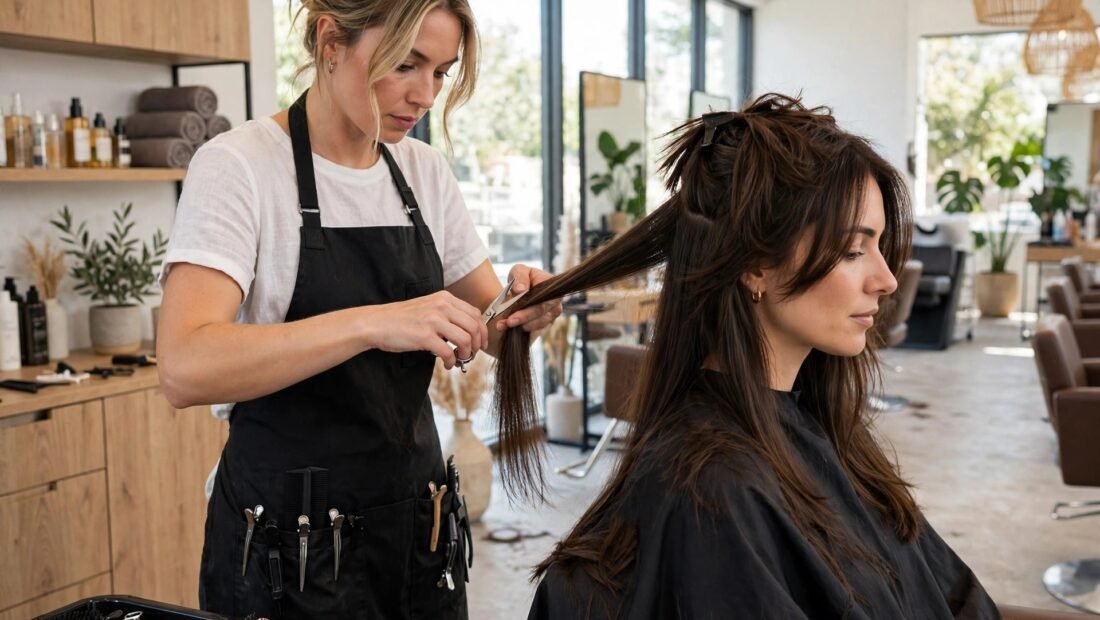
Shoulder-length or longer with face-framing layers starting below the chin. The length elongates, the layers add movement and angles, and it’s the most versatile cut for styling. Works with straight, wavy, and curly hair. In Texas humidity, ask for internal layers (texture cut into the interior, not just the perimeter) — they remove bulk that would otherwise triangle out in moisture.
2. The lob (long bob) with texture
Collarbone-grazing, textured ends, deep side part or center part. The lob ends below the jaw — critical — so it elongates rather than widening. Texture at the ends prevents the shelf effect. The most requested cut in salons for good reason: polished but effortless.
3. Curtain bangs + long hair
Curtain bangs (parted center, sweeping outward) frame the face with diagonal lines — the most slimming bang option for round faces. They grow out gracefully and work with ponytails and updos. Avoid: blunt micro-bangs and heavy straight bangs.
4. The shag / wolf cut
Heavy texture, choppy layers, volume concentrated at the crown. The shag’s deliberate messiness creates angles everywhere — extremely flattering on round faces and very Texas-appropriate (it looks better with humidity-induced texture).
5. Pixie with height
Short can work — but the pixie needs volume on top and tapered (not full) sides. A flat pixie with full cheeks emphasizes roundness; a pixie with crown height and piece-y texture elongates. This is the highest-maintenance option (trims every 4–6 weeks) but the boldest payoff.
Cuts to Approach With Caution
- Chin-length blunt bob: ends exactly at the widest point — the single least flattering choice for most round faces. If you love bobs, go lob-length with texture.
- Heavy straight-across bangs: shorten the face vertically. Curtain or side-swept bangs give fringe benefits without the shortening.
- One-length, no layers: the curtain effect — hair hangs like drapes, emphasizing width. Even subtle layers help enormously.
- Slicked-back styles: expose the full roundness with no framing. Fine for oval faces; unforgiving on round ones.
Texas-Specific Hair Realities
- Humidity: Texas humidity is the enemy of sleek blowouts and the friend of texture. Choose cuts that work with your hair’s humidity behavior — shags, textured lobs, and layered cuts — rather than fighting it daily with heat tools.
- Color and face shape: strategic color enhances the cut — face-framing highlights add vertical brightness, balayage draws the eye downward. Discuss color with the cut, not after. Our guide to colors for warm skin tones covers the shade side of the equation.
- Sun damage: Texas sun fades color and dries ends fast. UV-protectant products and trims every 8–10 weeks keep any cut looking intentional.
- Stylist communication: bring photos of cuts on people with your face shape and hair texture — not just the cut you want. “Textured lob on a round face with fine hair” is a different cut than the same name on an oval face with thick hair.
Hair health underpins every cut — stressed, shedding hair limits your options. If you’re noticing increased shedding, stress-related hair loss is worth ruling out before blaming the cut. The American Academy of Dermatology notes that most adults shed 50–100 hairs daily normally — but sudden increases deserve attention, and Cleveland Clinic’s dermatology resources cover when shedding signals something treatable. A great cut on healthy hair always beats a perfect cut on struggling hair.
Conclusion
The best haircut for a round face isn’t one specific cut — it’s any cut that adds vertical lines, creates angles, and keeps volume at the crown rather than the cheeks. Long layers are the safest bet, textured lobs the most versatile, curtain bangs the smartest fringe, shags the most humidity-friendly, and pixies the boldest option with crown height. Avoid chin-length blunt cuts and heavy straight bangs, work with Texas humidity instead of against it, and bring your stylist photos matched to your face shape and texture. Your face shape isn’t a problem to solve — it’s a parameter to design around, and the right stylist will see it that way too.
Frequently Asked Questions
What is the best haircut for a round face shape?
Long layers are the universal winner, followed by textured lobs, curtain bangs with long hair, shags, and pixies with crown height. All add vertical lines and angles while keeping volume away from the cheeks.
Are bangs good for round faces?
Curtain bangs and side-swept bangs — yes, they add flattering diagonal lines. Heavy straight-across bangs — usually no, they shorten the face vertically and emphasize width.
Does short hair suit round faces?
Yes, with the right shape: pixies need volume on top and tapered sides. Chin-length blunt cuts are the risky choice — they end at the face’s widest point. When in doubt, go slightly longer than chin length.
How do I know if I have a round face shape?
Equal width and length, full cheeks, rounded jawline with no sharp angles, widest at the cheeks. If your face is clearly longer than wide, you’re oval/oblong and round-face guidance doesn’t apply.
What haircut makes a round face look slimmer in humidity?
Textured cuts that work with humidity — shags, textured lobs, long internal layers. Avoid sleek styles that collapse in moisture; choose cuts whose deliberate texture looks better, not worse, with natural wave.