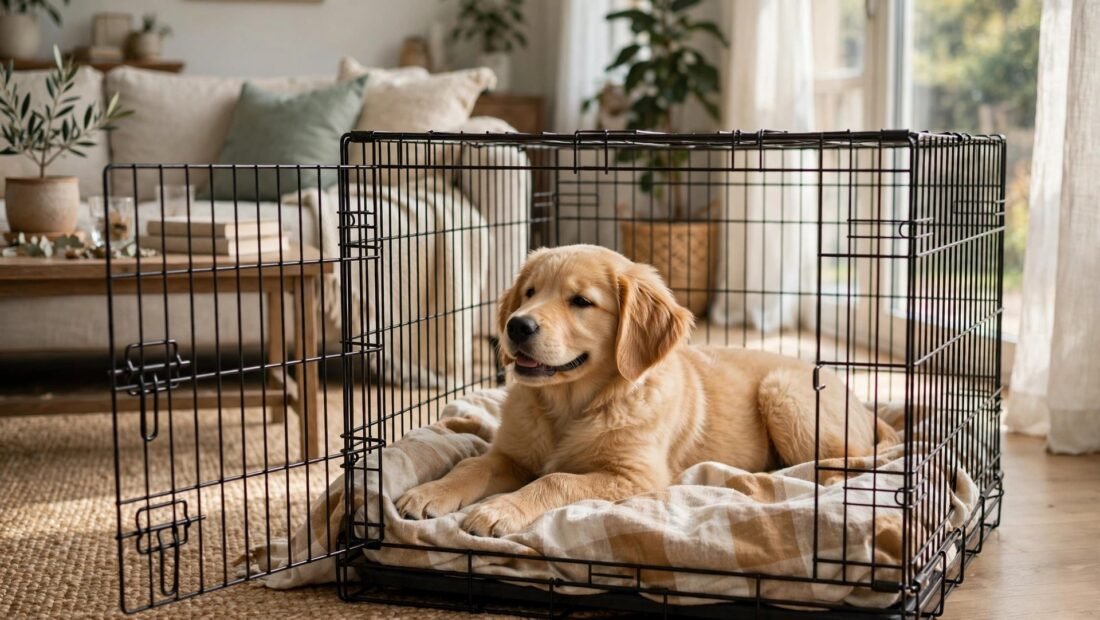
The puppy screams the moment the crate door closes. You’ve read that crate training is essential — for housetraining, for safety, for sanity — but right now it feels like you’re torturing a baby animal, and the neighbors are starting to notice. Here’s the truth: crate training a puppy fast isn’t about speed, it’s about sequence. Done in the right order, most puppies accept the crate happily within a week. Done in the wrong order — shutting a scared puppy in a crate on night one — you can create weeks of resistance. This is the sequence that works, adapted for Texas realities.
Why the Crate Works (When Done Right)
Dogs are den animals. A properly introduced crate becomes a bedroom, not a cell — a small, safe space where the puppy sleeps, chews, and decompresses. The crate accelerates housetraining (puppies avoid soiling their sleeping space), prevents destructive chewing when you can’t supervise, and prepares the dog for real life — vet stays, travel, and evacuations all go smoother with a crate-trained dog. The American Kennel Club’s crate training guidance covers the same fundamentals: positive association first, duration built gradually.
What the crate is not: punishment, storage, or a substitute for exercise and companionship. A puppy crated all day while you work and all night while you sleep is a puppy living in a box — that’s not training, it’s neglect with equipment.
Choosing the Right Crate
- Type: wire crates (ventilation, visibility, divider panels) suit most puppies; plastic airline crates feel more den-like for anxious pups. In Texas heat, wire crates ventilate better — plastic crates can trap warmth.
- Size: big enough to stand, turn around, and lie down — no bigger. Excess space defeats housetraining because the puppy sleeps in one corner and soils the other. Buy a crate with a divider panel and expand as the puppy grows.
- Location: where the family actually is — living room or bedroom, not an isolated laundry room. Puppies are social; isolation breeds panic. At night, many trainers recommend the crate in your bedroom initially so you can hear whimpers that mean “I need to pee” versus “I’m lonely.”
- Setup: comfortable bedding (washable — accidents happen), a safe chew, and water if crating more than a couple of hours. Covering the crate with a light blanket creates den coziness, but in Texas ensure airflow — never cover fully in summer. Set the crate on durable, puppy-proof flooring rather than carpet, because the area around the crate will see accidents during training.
The Fast-Track Protocol: Days 1–7
Days 1–2: The crate is a treat dispenser
Leave the crate open in the living area. Toss high-value treats inside — let the puppy wander in and out freely, zero pressure. Feed meals inside the crate with the door open. Goal: the puppy forms the association crate = amazing things happen here. Sessions of 5–10 minutes, several times daily. Never push the puppy in, never close the door yet.
Days 3–4: Door closed, briefly
Once the puppy enters happily, close the door for 30 seconds while feeding treats through the bars, then open. Gradually extend: 1 minute, 5 minutes, always with something good happening inside (a stuffed Kong, a chew). Practice while you’re visible — the puppy learns the closed door is temporary and boring, not abandonment. If the puppy panics, you’ve gone too fast: back up a step.
Days 5–7: Building duration and distance
Extend closed-door time to 30 minutes, then an hour, while you move around the house — briefly out of sight, then back. Start leaving the puppy crated while you do chores, always returning before distress. By day 7, most puppies enter the crate on cue and settle with a chew.
Night One Through Night Seven: The Crying
Night crying is the make-or-break moment. A young puppy (8–10 weeks) genuinely needs nighttime potty breaks every 2–3 hours — some waking is biological, not behavioral. PetMD’s puppy training resources emphasize the same distinction: respond to genuine need, don’t reward fussing.
- Last outing right before bed, then crate with a safe chew. Keep bedtime calm and boring.
- Respond to genuine need: crying 2–3 hours in likely means “I need to pee.” Take the puppy out silently — no play, no excitement, dim lights — straight back to the crate after. You’re a vending machine for potty breaks, not a party.
- Don’t reward fussing: crying 20 minutes after being put in is protest, not need. Wait for a pause in the crying before any interaction — even opening the door mid-wail teaches that screaming works.
- Keep the crate near you the first week. Your presence (breathing, scent) dramatically reduces panic. Move it gradually to its permanent spot over weeks, not nights.
For thin-walled Texas apartments where nighttime crying stresses neighbor relations, budget soundproofing for the bedroom buys goodwill while the puppy learns — a heavy blanket over the crate (with airflow), rugs on hard floors, and white noise all help.
Housetraining + Crate: The Combined Schedule
The crate only accelerates housetraining when paired with a relentless schedule. For an 8–12 week puppy: out immediately upon waking, after every meal, after every play session, after every nap, and every 1–2 hours in between. Each successful outdoor potty earns calm praise and a treat outside, immediately. Accidents indoors get zero reaction — clean with enzymatic cleaner, adjust the schedule.
Texas-Specific Crate Considerations
- Heat: never crate a puppy in a garage, car, or sun-facing room in Texas — temperatures become lethal with shocking speed. The crate belongs in the air-conditioned living space, always.
- Wire over plastic in summer for ventilation, and skip heavy crate covers during the hot months.
- Hurricane season: a crate-trained puppy evacuates calmly; an untrained one panics in a shelter full of strangers. Texas’s storm season is reason alone to finish crate training early.
- Water: attach a small crate water bowl or offer water at every break — Texas puppies dehydrate faster than you expect.
Common Mistakes That Slow Everything Down
- Too much too soon: closing a new puppy in the crate for hours on day one creates a phobia that takes weeks to undo. The “fast” method is paradoxically the gradual one.
- Using the crate as punishment: “go to your crate, you’re in trouble” poisons the association permanently. The crate must only ever predict good things.
- Crating too long: the rule of thumb — one hour per month of age, max, during the day. A 3-month-old puppy gets 3 hours, not 8. Longer stretches need a puppy pen with a potty area, not a crate.
- Inconsistent responses to crying: sometimes opening the door, sometimes not, teaches the puppy that persistence eventually pays — the hardest pattern to break.
- Skipping the exercise: a puppy that hasn’t played and pottied before crating will not settle. The crate works on a tired, empty puppy; it’s torture for a wired, full one.
Conclusion
Crate training a puppy “fast” means following the right sequence without skipping steps: two days of the crate as a treat dispenser, two days of brief closed-door sessions, then building duration — paired with a relentless potty schedule and calm, boring nights. Most puppies are happily crating within a week when owners resist the urge to rush day one. The crate you build this week becomes the den your dog loves for life, the tool that housetrains in weeks instead of months, and — in Texas — the skill that keeps your dog safe when evacuation orders come. Slow is fast. Trust the sequence.
Frequently Asked Questions
What is the best way to crate train a puppy fast?
Follow the gradual sequence: 2 days of open-door treat association, 2 days of brief closed-door sessions with rewards, then build duration over days 5–7. Most puppies accept the crate within a week. Rushing day one with long confinement backfires and takes longer overall.
How long can a puppy stay in a crate?
About one hour per month of age during the day — a 3-month-old puppy maxes out around 3 hours. Overnight, puppies can stretch longer once they can hold it, with young puppies needing 1–2 nighttime potty breaks.
Should the puppy crate be in my bedroom?
Yes, for the first week or two. Your presence reduces panic crying and lets you distinguish “I need to pee” whimpers from protest fussing. Move the crate to its permanent spot gradually over the following weeks.
Is it cruel to crate a puppy?
No — when introduced properly, the crate becomes a den the puppy seeks out voluntarily. It becomes cruel only when misused: excessive hours, punishment, or crating instead of meeting the puppy’s exercise and social needs.
My puppy screams in the crate — what do I do?
First rule out genuine needs (potty, hunger, heat). For protest crying, wait for a pause before responding, keep departures boring, and back up the training steps — screaming usually means you advanced too fast. Persistent panic despite slow training warrants a vet or trainer consult.