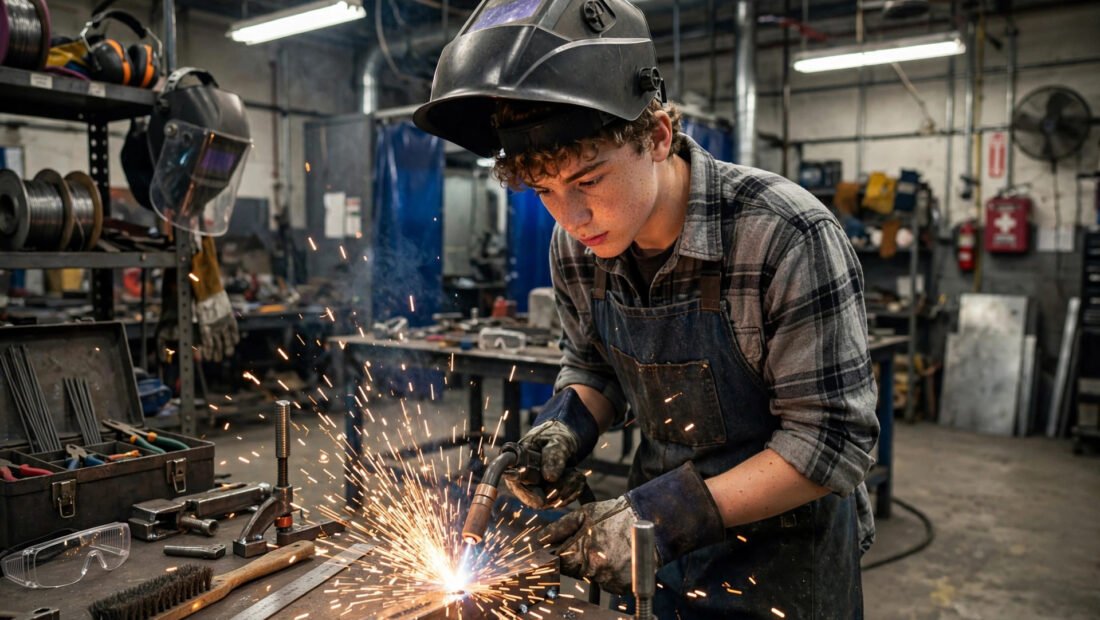
The default American script says: graduate high school, go to a four-year college, get a degree, get a job. But for a growing number of Texas families, that script is not working — tuition keeps climbing, student debt now exceeds $1.7 trillion nationally, and meanwhile electricians, welders, and HVAC technicians are naming their price in a state building faster than it can staff the trades. So is trade school actually a better option than college for your teen? The honest answer: for the right teen, it is not just better — it is dramatically better.
The Economic Case: Numbers That Surprise Most Parents
Start with the math. Average trade-school programs in Texas cost $5,000–$20,000 total and take 1–2 years. Average four-year public university: roughly $11,000 per year in tuition alone for in-state students (before room, board, and fees), with private schools multiples higher. A trade-school graduate can be earning $45,000–$65,000 by age 20 with zero debt; a college graduate often starts earning at 22 carrying $30,000+ in loans.
The earnings data backs this up. The Bureau of Labor Statistics reports median pay of roughly $60,000+ for electricians and plumbers, with experienced Texas tradespeople in oil, commercial construction, and specialized welding routinely clearing six figures. Meanwhile, Georgetown University’s Center on Education and the Workforce found that a significant share of bachelor’s degree holders earn less over their lifetimes than workers with strong trade credentials. The wage premium of “a degree” is really the wage premium of the right degree — and generic degrees from expensive schools are often the worst investment of all.
Texas: Built for the Trades
Few states reward trade skills like Texas. The state’s construction boom, energy sector, manufacturing growth, and perpetual housing demand create chronic skilled-trade shortages. Texas community colleges and technical schools — from Texas State Technical College’s multi-campus system to local community college workforce programs — offer welding, electrical, HVAC, diesel mechanics, plumbing, and instrumentation programs with direct employer pipelines. Many include paid apprenticeships, meaning students earn while learning. And Texas’s lack of state income tax means trade paychecks stretch further here than in most states.
When Trade School Is Clearly the Better Choice
Your teen learns by doing. Some kids light up in a shop and shut down in a lecture hall. For hands-on learners, trade school is not a consolation prize — it is the environment where they will actually excel.
They want income fast. An 18-year-old who wants financial independence, not four more years of classrooms, will thrive in an 18-month program with a job waiting.
College would mean crushing debt. If the college option requires $80,000+ in loans for a degree with uncertain earnings, the trade route’s near-zero debt is life-changing. Debt constrains every subsequent choice — where to live, when to marry, whether to take career risks.
They have entrepreneurial instincts. Trades are among the most accessible paths to business ownership. The electrician who starts a shop at 25, hires crews, and builds a local brand often out-earns every white-collar peer by 35. Our guide to getting a small-business loan with no credit history is surprisingly relevant to ambitious young tradespeople.
When College Still Wins
Intellectual honesty requires the other side. College remains the better choice when: the teen aims for professions that legally require degrees (medicine, law, engineering, teaching); they are genuinely academically inclined and would thrive in that environment; they have scholarships or family resources making college low-debt; or they are undecided and want four years to explore (though community college explores far cheaper). Also note the hybrid path: many successful tradespeople later earn business degrees to run their companies — trade first, college later, on the employer’s dime.
How to Evaluate Programs (Avoid the Traps)
Not all trade schools are equal, and for-profit programs deserve scrutiny. Check: accreditation and state licensing-board approval; job placement rates (ask for audited numbers, not marketing claims); employer partnerships (the best programs have companies recruiting on campus); total cost vs. expected starting wage; and hands-on hours (beware programs heavy on classroom theory, light on shop time). Public community-college and TSTC programs are usually the best value in Texas. Talk to recent graduates — not just the ones the school introduces you to.
The Conversation to Have With Your Teen
Do not frame it as college vs. trade school — frame it as which path fits who you are and where you want to be at 25. Visit a technical college together. Talk to working tradespeople (most love discussing their craft). Run the actual numbers: program cost, years to income, realistic starting wages in your Texas metro. And kill the stigma explicitly: the master electrician earning $120,000 debt-free at 30 made a smarter financial decision than most degree-holders. Prestige does not pay mortgages. Understanding employment structures helps too — our explainer on 1099 contractor vs. W-2 employee differences matters for tradespeople weighing self-employment.
Apprenticeships: The Earn-While-You-Learn Path
Before committing to any classroom program, investigate registered apprenticeships — arguably the best deal in workforce education. Apprentices work full-time under master tradespeople while completing classroom instruction, earning progressive wages from day one (typically starting at 40–50% of journeyman pay and rising with skill). Many Texas apprenticeships in electrical, plumbing, HVAC, and ironwork are sponsored by unions or trade associations, meaning little to no tuition cost — the employer invests in your training because they need the workers. Completion yields a nationally recognized credential plus years of paid experience, the combination employers prize most. The Department of Labor’s apprenticeship finder lists registered programs by location and trade, and the Bureau of Labor Statistics publishes detailed outlooks — projected growth, median pay, and entry requirements — for every major trade. Compare apprenticeship versus classroom routes on three axes: total cost, time to full journeyman wages, and placement rates. For many Texas teens, the apprenticeship path wins on all three — earning while learning, zero debt, and a job waiting at graduation. Even if you choose a technical college, ask whether it partners with apprenticeship programs; the hybrid (classroom theory plus paid apprenticeship hours) is often the strongest preparation available.
Conclusion
For hands-on teens who want income without debt, trade school is not the fallback — it is often the optimal choice, especially in trade-hungry Texas. For academically driven teens targeting degree-required professions, college remains right. The mistake is defaulting to either without examining the teen in front of you. Run the numbers, visit the programs, talk to graduates, and choose the path — not the prestige.
Frequently Asked Questions
How much does trade school cost in Texas?
Public programs typically run $5,000–$20,000 total for 1–2 year programs. Texas State Technical College and community-college workforce programs are among the most affordable, and many students qualify for federal aid or workforce grants.
Can you make six figures in the trades?
Yes — experienced electricians, plumbers, welders (especially pipeline/industrial), and HVAC technicians in Texas routinely earn $80,000–$120,000+, with business owners earning more. It takes years of experience and often licensing, but the ceiling is high.
Is trade school looked down upon by employers?
In the trades, no — employers care about skills, certifications, and work ethic, not pedigree. The stigma is largely a cultural artifact of high schools, not the labor market, where skilled tradespeople are in chronic shortage.
Can my teen go to college later after trade school?
Absolutely, and it is a common path. Many tradespeople earn business or management degrees in their late 20s — often with employer tuition assistance — to move into ownership or management. Trade skills plus a degree is a powerful combination.