
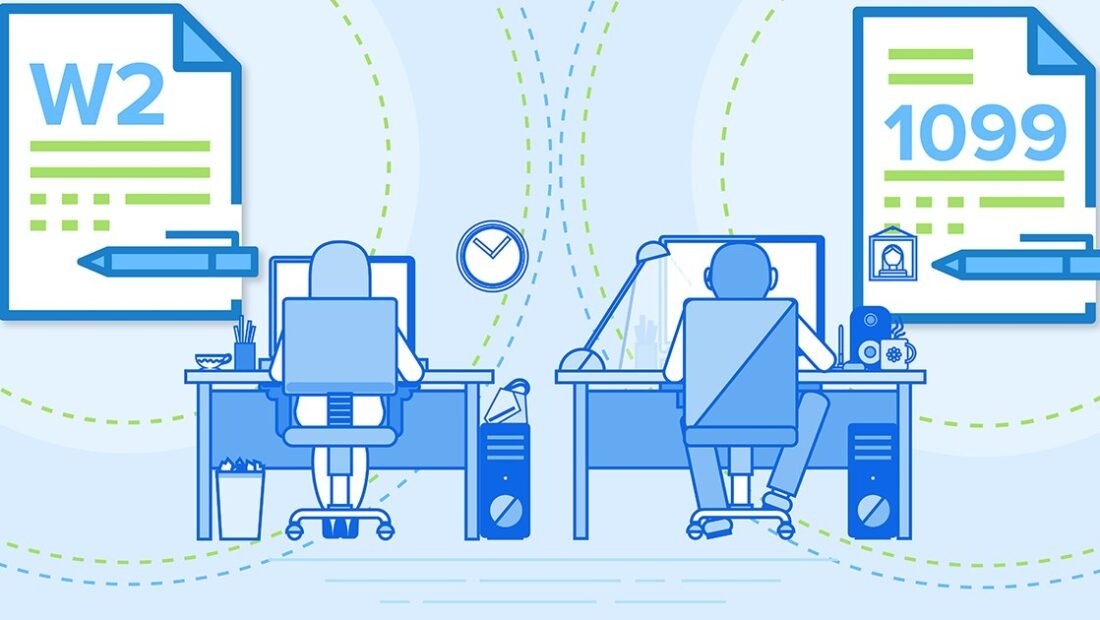
Let’s be honest — what is the difference between a 1099 contractor and a W-2 employee isn’t something most people think about until they’re staring at the problem in real life. That’s exactly when bad decisions happen: you’re rushed, you’re stressed, and the first option looks good enough. I’ve put together this guide so you don’t have to learn the hard way.
What follows is the practical stuff: what to expect, what it should cost or take, the steps that actually work, and the pitfalls I see people fall into over and over. Read it once and you’ll handle this like someone who’s done it ten times.
What is the Difference Between a 1099 Contractor and a W-2 Employee: What You Need to Know
The 1099 vs W-2 distinction determines who pays what taxes, who gets benefits, and how much control the business has — and getting it wrong triggers some of the most painful penalties in small business. Here’s the complete breakdown for both workers and businesses.
The core difference is the relationship. A W-2 employee works FOR the company: the business controls when, where, and how they work, provides tools and training, and the relationship is ongoing. A 1099 contractor runs their OWN business and sells services TO clients: they control their methods and schedule, usually work for multiple clients, and the engagement is project-based. The IRS cares about the reality of control, not what you call it — labeling someone a contractor while treating them as an employee is misclassification, and it’s illegal. For more on this topic, see Is it Worth Paying Extra for an Extended Warranty on a Tv — it pairs well with what you just read.
What Actually Affects the Outcome
Taxes diverge sharply. W-2: the employer withholds income tax, pays half of Social Security/Medicare (7.65%), and pays unemployment insurance — the employee’s paycheck arrives with taxes handled. 1099: no withholding at all — the contractor receives gross pay and owes the FULL 15.3% self-employment tax plus income tax, paid quarterly. This is why contractors must charge more: a $50/hour contractor nets roughly what a $35–$40/hour employee does after the tax differential. Businesses: misclassifying employees as contractors to dodge payroll taxes risks back taxes plus penalties of 20–100% of the unpaid amounts. You can also check IRS guidance for small businesses for the authoritative details.
Benefits are the W-2’s quiet superpower: health insurance (employers pay ~70–80% of premiums on average), retirement matching, PTO, sick leave, workers’ comp coverage, unemployment eligibility, and legal protections (overtime, anti-discrimination, FMLA). Contractors get none of this — they buy their own insurance ($300–$600/month on ACA marketplaces), fund their own retirement, and take unpaid time off. When comparing offers, add ~25–30% to W-2 salary for benefits value; a $70k employee job ≈ $90k in contractor pay.
What to Do About It
- Core: W-2 = works FOR the company (controlled); 1099 = own business selling services (independent).
- Taxes: W-2 has withholding + employer pays half of FICA; 1099 pays full 15.3% SE tax + quarterly estimates.
- Benefits (~25–30% of salary): health, retirement match, PTO, workers’ comp, unemployment — W-2 only.
- Misclassification penalties: back taxes + 20–100% penalties; IRS judges reality of control, not labels.
- IRS 3-factor test: behavioral control, financial control, relationship type (CA’s ABC test stricter).
- Contractors: charge 25–40% above equivalent salary; save 25–30% for taxes; buy your own safety net.
Here’s What Really Matters
Control and flexibility cut both ways. Employees get stability, legal protections, and simplicity — but fixed schedules, limited clients, and less autonomy. Contractors get freedom, variety, and upside — but income volatility, self-employment admin (quarterly taxes, insurance shopping, finding clients), and zero safety net. Neither is universally better; they’re different risk-reward profiles for different life stages.
The IRS uses a three-factor test, and businesses should know it cold: Behavioral control (do you dictate how/when/where work happens?), Financial control (do you control expenses, provide tools, pay hourly vs. by project?), and Relationship type (benefits? indefinite? core business function?). Score ’employee’ on most factors and they’re an employee — regardless of the contract title. States like California (ABC test) are even stricter. When in doubt, the IRS Publication 15-A worksheets and a $300 employment attorney consult beat a $50,000 misclassification audit. Related: our breakdown of Is it Safe to Use Public Wifi for Online Banking covers the numbers in detail.
For workers choosing: take W-2 for stability, benefits, and simplicity — especially with families or mortgages. Choose 1099 for autonomy, upside, and variety — but charge 25–40% more than the equivalent salary rate, save for taxes religiously (25–30% of every check), and buy your own safety net (insurance, Solo 401(k), emergency fund). For businesses hiring: classify honestly, document contractor relationships properly (project scope, multiple clients, their own tools), and when the role looks like employment — set hours, core function, indefinite — just hire the employee.
Common Mistakes to Avoid
- Calling someone a contractor while controlling their schedule, methods, and tools — textbook misclassification.
- Hiring 1099 to ‘save money’ without realizing the legal exposure dwarfs the payroll tax savings.
- Contractors not saving for quarterly taxes — the April surprise that ruins year one.
- Comparing W-2 salary to 1099 rate dollar-for-dollar without the 25–30% benefits adjustment.
Questions People Ask
Can a contractor become an employee later?
Absolutely — common as businesses grow. Formalize with an offer letter, start payroll withholding, and enroll in benefits. The reverse (employee → contractor doing the same job) draws IRS scrutiny.
Do contractors get overtime?
No — overtime laws protect employees. Contractors negotiate project fees or hourly rates that account for long hours upfront.
What form do I get as a contractor?
Form 1099-NEC for $600+ in annual compensation from a client. Keep your own records too — clients sometimes file late or incorrectly.
How do I keep business and personal finances separate?
Open a dedicated business checking account on day one — it’s free at most online banks — and run ALL business income and expenses through it. Pay yourself with regular transfers to your personal account instead of spending directly. This separation makes taxes dramatically easier, looks professional to clients, and is legally essential if you formed an LLC and want its liability protection to hold up.
The Bottom Line
W-2 means control, withholding, and benefits; 1099 means independence, full self-employment tax, and no safety net — price the difference at 25–40%. Businesses: the IRS tests actual control, not labels, and misclassification penalties are brutal. When the role looks like employment, hire the employee.
Related: our breakdown of What Happens if I Never Update my Phone Software covers the numbers in detail.
The takeaway is simple — know your options before you’re forced to pick one under pressure. Bookmark this guide, follow the action plan, and you’ll handle it like a pro.



