
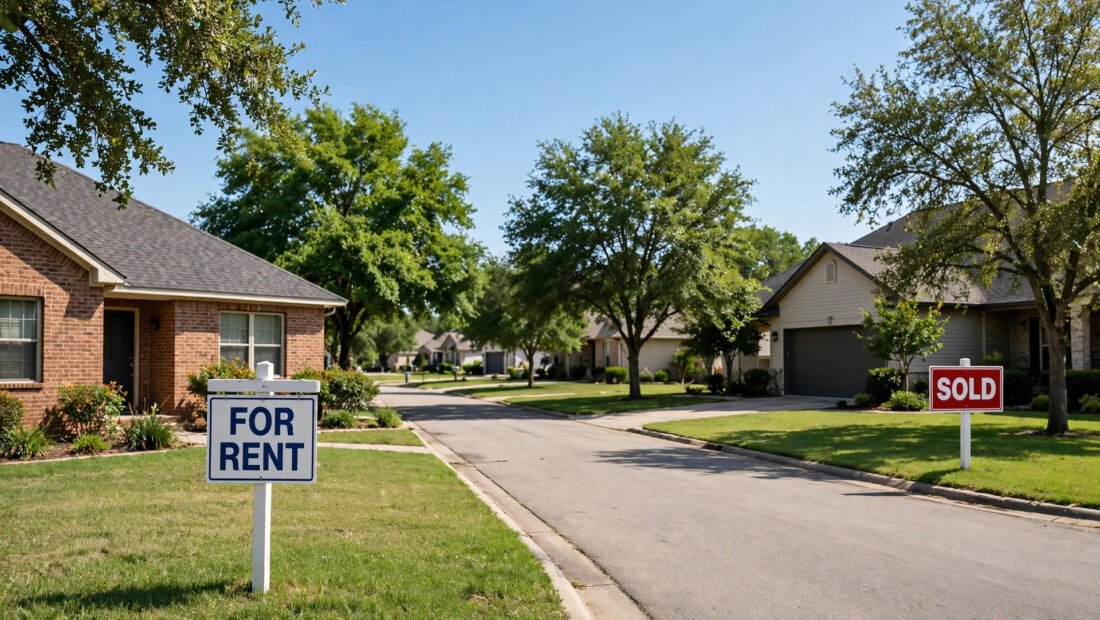
Rent is just throwing money away. Someone says it at every family gathering, usually with total confidence, and usually without ever having added up closing costs, property taxes, or a roof repair. Renters do hand over money that never comes back. So do owners, in large amounts, especially in the first years of a loan. The honest comparison is not rent versus ownership as a slogan. It is your rent versus the full, unrecoverable cost of owning a similar Texas home for the number of years you will actually stay, plus what each choice does to the rest of your life.
Option One: Renting, Counted Honestly
What renting costs is clear. You pay rent each month, plus renters insurance, and none of that rent builds equity in the property. If a comparable home rents for $2,000 a month, that is $24,000 a year out the door. At the end of a lease you own no part of the building, and your payment can rise at renewal. Rent also buys things with real value that the slogan pretends are worth nothing. You buy housing in a place you may only need for two years. You buy the ability to take a job in another city without selling anything. You buy a landlord who pays for the air conditioner when it dies in August, the hail damage after a Texas storm, and the plumbing leak at 2 a.m.
Renting also keeps your cash free. The down payment and closing costs that a buyer locks into one house can stay invested, stay liquid for an emergency, or fund a career move. That freedom has a price only if the freed money gets spent. A renter who invests nothing extra is in a weak spot, because rent alone builds no asset. A renter who invests the difference between renting and owning on purpose is running a real strategy, covered below. The two renters look identical from the street. Their bank accounts ten years later do not.
Where renting is weak is control and long-run cost. You cannot renovate, you may face pet limits or a landlord who sells the property, and over decades rent almost always rises. If you stay in one city for twenty years, renting the whole time usually costs more in total than buying a home early and holding it, because the owner eventually slows or ends the mortgage payment while the renter never does. Renting wins on flexibility and early-year cash flow. It loses on permanence.
Option Two: Buying, Counted Honestly
Buying splits every payment into two piles. One pile builds equity: the principal you pay down, plus any rise in the home’s value. The other pile never comes back: mortgage interest, property taxes, homeowners insurance, maintenance, and the costs of buying and selling. In the early years of a 30-year loan, the second pile is big. Most of each early payment is interest, not principal, so equity grows slowly at first even as the total bill stays high.
Put Texas numbers on it. On a $350,000 home, year-one unrecoverable costs can total roughly $25,000 to $30,000 once you count interest plus about $6,000 in property taxes, about $2,500 in insurance, and about $3,500 in maintenance. That is comparable to, and often more than, a full year of rent on a similar place. The owner in year one is not clearly ahead of the renter in year one. The owner is paying for a position that pays off later, as principal payments grow, the payment stays fixed while rents climb, and the transaction costs get spread over more years.
Buying has costs renters never face. Expect a round trip of about 6 to 10 percent of the home’s value in agent fees, closing costs, and moving when you buy and later sell. That is $21,000 to $35,000 on a $350,000 home before any repair. It also concentrates your money in one illiquid asset in one neighborhood. If the job moves, the area softens, or the home needs a $15,000 roof, the loss is yours alone. Anyone leaning toward buying should also weigh the loan itself carefully, starting with 15-year vs 30-year mortgages for first-time buyers, because term choice changes both the monthly cost and how fast equity builds.
The 5 Percent Rule as a Shared Yardstick
A simple test lets you compare the two options on the same scale. Estimate the unrecoverable cost of owning at about 5 percent of the home’s value per year. That rough figure bundles the cost of tying up capital, taxes, and maintenance. If 5 percent of the price is more than a year of rent for a comparable home, renting is likely cheaper. If a year of rent is more, buying is likely cheaper.
Run it on a $400,000 Texas home. Five percent is $20,000 a year, about $1,667 a month. If a comparable place rents for $1,400 a month, renting wins clearly. At $1,800 a month, the two are close. At $2,200 a month, buying pulls ahead. Then adjust for Texas. Property taxes here run about 1.6 to 2.2 percent of value, higher than the national pattern built into the simple rule, so many Texas buyers should test 5.5 to 6 percent instead. At 6 percent, that same home carries $24,000 a year in unrecoverable costs, and renting looks better for longer. Working the other way, Texas has no state income tax, and homes in strong growth corridors have often appreciated, which helps owners. Do not let either adjustment become a guess. Run your own address-level numbers with the CFPB’s home buying and mortgage resources before you treat the rule as a verdict.
The rule has limits. It does not price stability for kids in one school, the value of painting a wall any color you like, or the stress of a forced move at lease end. It also does not price the risk of buying at a local peak. Use it to settle the money question first. Then weigh the life question with open eyes, rather than letting a slogan settle both.
Option Three: Rent and Invest the Difference
This is the version of renting that actually competes with ownership, and it only works with automation. First, work out the true monthly cost of buying the home you would buy: mortgage, taxes, insurance, and a maintenance reserve of about 1 percent of value per year. Subtract your current rent. That gap is the amount to invest every month, on payday, into a diversified index fund in a taxable brokerage account, without skipping months when money feels tight.
The math shows why discipline matters. A renter who invests $600 a month for ten years at a 7 percent return builds about $103,000. That is real wealth, built while renting. A renter who plans to invest the difference but spends it has built nothing, and for that renter the family slogan turns out to be right. If you know you will not automate the transfer, be honest about it. For many households, the mortgage works partly because it is forced saving. Rent and invest demands that you force the saving yourself.
Option Four: Buy and Offset the Cost
There is also a middle path that changes the ownership math directly. Buy a home and rent out part of it. A spare bedroom in Texas metros can bring in about $600 to $900 a month. A duplex where you live in one side and rent the other goes further. Roommates for the first few years do the same job in a single-family home. If a $2,200 monthly ownership cost is offset by $800 in rent from a housemate, the home behaves like a $1,400 cost to you, which can beat renting a separate place while still building equity.
This path is not free money. You become a landlord, with screening, repairs, privacy trade-offs, lease rules, and tax reporting. Some loans, cities, and homeowners associations limit renting part of a home, so check the rules before you count the income. It suits a flexible buyer who will stay several years and tolerates sharing space. It suits almost no one who needs quiet, total privacy, or a fast exit.
Side-by-Side on Timeline, Risk, and Control
Timeline decides more than any other factor. Sell within 3 to 5 years and the 6 to 10 percent round-trip cost usually makes buying lose to renting, even if prices rise a little. Stay 5 to 7 years or more and those costs spread out, principal paydown speeds up, and buying gains ground each year. Stay put for a decade or more in a stable area and buying usually wins on cost, provided the purchase price was sane.
Risk cuts both ways. Renters risk rising rents, nonrenewal, and building no equity over a long stay. Owners risk price drops, major repairs, job moves that force a bad sale, and Texas property tax and insurance bills that climb even when the mortgage does not. Control also cuts both ways. Owners control the home but cannot control the market or the tax appraisal. Renters control their next move but not the home itself. Neither option is safe. Each one trades a different set of risks.
Life stage ties the comparison together. Early career, uncertain city, a relationship still forming, or a job that may move you: renting protects your options at a fair price. Settled job, chosen schools, roots you want to keep, and a stay measured in many years: buying turns a monthly bill into a long-term asset and locks your housing cost against rent inflation. A condo needs extra care in either case, since association fees belong in the owning cost before you compare it with rent.
Recommendation
Start with your honest stay length, not with the slogan. If you will likely move within five years, rent, invest the difference automatically, and treat anyone who calls that waste as someone who has not run your numbers. If you will stay seven years or more, your job and city are stable, and the 5 percent rule, adjusted upward for Texas taxes, still favors buying, buy a home you can afford without stretching, and keep an emergency fund after closing instead of spending it on furniture. If you are in between, price the middle paths seriously: rent and invest for two more years while you save a larger down payment, or buy a place you can partly rent out. The only clear loss is choosing under family pressure without doing the math for your own street, your own tax bill, and your own timeline.