The email looks harmless. It says informal chat, about thirty minutes, with an alumnus who lives nearby. That word informal is the trap. The conversation may feel like coffee with a friendly graduate, but the report that follows still goes into your admissions record. Treat the meeting as relaxed in tone and serious in purpose. The steps below get you ready for both parts, in the order that gives each hour of prep the most value.
Step 1: Learn what the interviewer is really scoring
Before you rehearse a single answer, get clear on the three questions running in the interviewer’s mind. Can this student handle the work? That is about curiosity and follow-through, not just grades. Will this student add something to campus life? That covers energy, perspective, and the habit of joining things and sticking with them. Does this student truly want this school? Generic enthusiasm fails here. Specific, informed interest passes.
Notice what is missing from that list. Nobody expects a polished adult. Interviewers, especially alumni volunteers, expect a nervous teenager and grade on honesty and warmth as much as content. A student who lights up while describing a robotics build or a creek cleanup will leave a stronger mark than one reciting smooth lines about a passion for learning. Your goal is a real conversation that leaves the interviewer picturing you on that campus, not a flawless performance.
Duration helps you plan. Most college interviews run 20 to 45 minutes. Alumni interviews often land near 30 minutes, while interviews with admissions staff for competitive programs can run longer. Prepare as if you have 45 minutes of material. Running out of things to say hurts. Having a little extra never does.
Step 2: Research the school until your answers get specific
Research is the highest-return prep you can do. Aim to know two or three programs, professors, labs, or special opportunities at the school, and be able to say why each one fits you. Skim recent campus news as well, and learn how this school differs from the similar ones on your list.
Specifics change the whole interview. Saying you are excited about a named professor’s water policy research because your Eagle Scout project involved creek restoration connects a real person, a real program, and your own history in one breath. Saying the school has a great environmental science program could be said to anyone, and interviewers hear it that way. This work also arms you for the question that sinks unprepared students, why this college. If your answer could be pasted onto three other applications, rewrite it until it cannot.
Texas students should research the local wrinkles too. At UT Austin, automatic admission under the top 6 percent rule does not remove interviews for honors programs, which do interview. Texas A&M’s Corps of Cadets and competitive majors run their own processes. Private schools such as Rice, SMU, and TCU weigh demonstrated interest heavily, and the interview is one of the clearest signals of that interest. Scholarship interviews are a separate format again, more focused on leadership and results, so bring concrete examples of impact for those.
Step 3: Build answers to the five questions you will hear
Five prompts show up in nearly every college interview. Draft a short, honest answer to each one.
- Tell me about yourself. Keep it near 90 seconds. Cover where you are now, what drives you, and where you are headed. End looking forward, with a thread the interviewer can pull on with a follow-up question.
- Why this college? Use your research. Name programs, people, and opportunities, and tie each one back to something you have done or want to do.
- What will you contribute to campus? Think past grades. Name the club you would join or start, the perspective you bring, or the community you would help build. Colleges admit communities, not just test scores.
- Tell me about a challenge you overcame. Use a simple structure: the situation, what you had to do, what you did, and what came of it. Pick something real. Interviewers spot manufactured hardship fast. Spend most of your time on what you learned.
- What questions do you have for me? Prepare three or four. Ask about the interviewer’s own experience, such as what surprised them most in their first year, or about campus culture and details you could not find online. Never say you have no questions. That reads as low interest. Never ask what a ten-second search would answer.
One more answer to prepare is the honest gap. When a question catches you off guard, say so plainly and think out loud. A calm response that admits you have not considered something, then shares your instinct, earns more respect than bluffing. Interviewers are trained to notice the difference.
Step 4: Practice out loud, then fix what you hear
Thinking through answers in your head is not practice. Your mouth needs the rehearsal your brain does not. Run two or three mock interviews with a parent, teacher, or counselor, and choose someone who will give straight feedback instead of only praise.
Record one mock on your phone and watch it back. You will spot filler words, fidgeting, and answers that wander, all of which stay invisible while you are speaking. Time your self-introduction. If it passes two minutes, cut it. Short answers that invite follow-up questions beat long answers that close every door. For extra practice frameworks, College Board’s BigFuture college planning resources include interview guidance alongside the rest of the application timeline.
Step 5: Lock down the logistics early
Small details decide more interviews than families expect. Dress in business casual: neat, clean, and comfortable. A blazer is fine. A full suit is more than most undergraduate interviews need, and stiff clothes make stiff conversation.
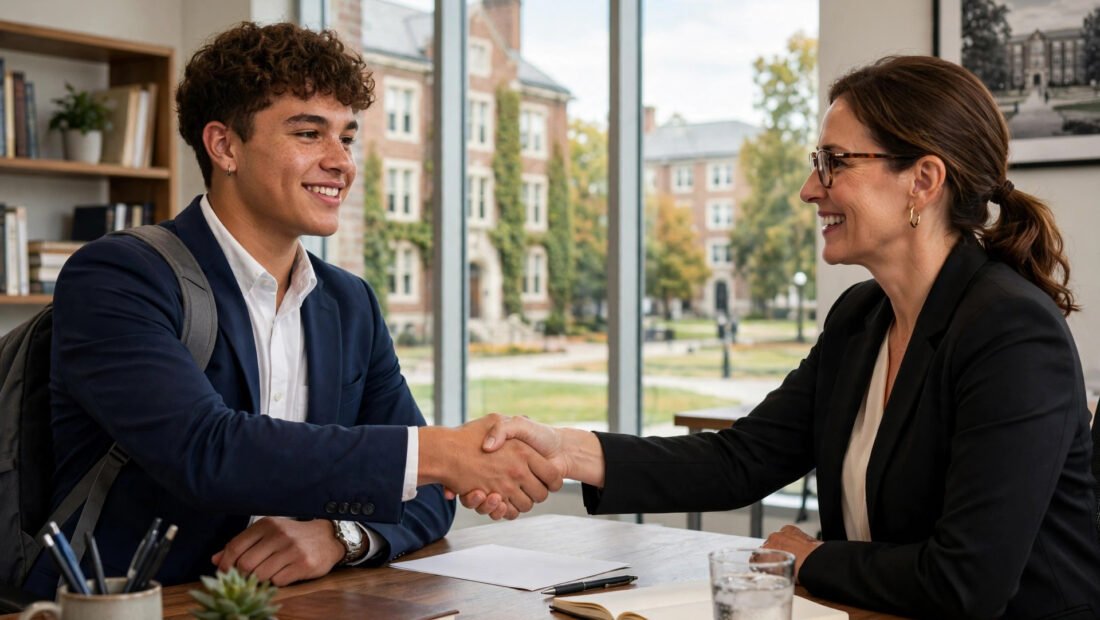
Arrive 10 to 15 minutes early for an in-person meeting. Bring a copy of your resume or activities list, since the interviewer may not have one, plus a notebook with your prepared questions and a bottle of water. The meeting starts before the first question. How you greet people, handle the wait, and make brief small talk all register.
For a virtual interview, treat the setup as part of the test. Test your camera, microphone, and connection a full 24 hours ahead, not 24 minutes. Set the camera at eye level, even if that means stacking books under a laptop. Face a window or a lamp so light falls on your face, and never sit with a bright window behind you. Log in and settle 10 minutes early, close every other tab, and pick a quiet room with a plain background. Plan to bring about 10 percent more energy than you would in person, because screens flatten expression. Sit upright, gesture naturally, and smile where it fits.
Step 6: Manage your presence during the conversation
Confidence shows up in the body before it shows up in words. Sit upright but relaxed. Make natural eye contact without turning it into a stare. Use your hands the way you normally would; holding yourself completely still tends to read as tension. Match the interviewer’s energy level roughly, a little calmer if they are formal, a little livelier if they are casual.
Listen as carefully as you speak. Let the interviewer finish each question. A short pause before answering is fine and often helps. If a story from earlier in the conversation connects to a new question, refer back to it. That thread is what turns a set of answers into a conversation, and a conversation is what gets remembered. Students also worry about related choices, such as whether using AI for your college essay is cheating, and the same rule applies there as here: honesty about your process beats a polished story that is not true.
Step 7: Plan for the curves and the awkward moments
A few moments rattle students even when the main answers are ready, so rehearse them on purpose. The long pause is one. An interviewer may take notes or think before the next question. Silence for five seconds feels endless from your chair and completely normal from theirs. Resist filling it with nervous chatter. Take a breath, sip water, and wait.
The weakness question is another. Asked about a low grade or a gap in your activities, keep the answer short, honest, and forward-looking. Name what happened, say what changed, and point to the evidence since then, such as a stronger semester or a teacher who can speak to your work now. Do not blame a teacher, a counselor, or a family member. Ownership reads as maturity, and maturity is often the trait the whole interview is quietly testing.
Money and sensitive topics deserve a plan too. You do not need to discuss family finances in an alumni chat, and you can steer gently back to your interests if a question drifts somewhere personal. A simple line works: you would rather talk about what you hope to study and do on campus, said with a smile, closes most detours without any friction.
Finally, decide in advance how the meeting ends on your side. Close by thanking the interviewer by name, naming one thing you learned from the conversation, and restating in one sentence why the school fits you. A clean ending is the last impression the report will carry, so make it deliberate rather than drifting out on small talk.
Step 8: Send the follow-up most students skip
Within 24 hours, send a short thank-you email. Thank the interviewer for their time, name one specific point from the conversation that stayed with you, and restate your interest in the school in a single sentence. Keep the whole note brief. Generic thanks get forgotten. A specific detail proves you were listening.
Right after the interview, while it is fresh, write down what went well and what felt weak. If you have more interviews ahead, each one should improve on the last, and those notes are how that happens. Confidence in this process is mostly preparation wearing a calm face. Do the research, rehearse out loud, handle the details early, and the thirty informal minutes will work in your favor.