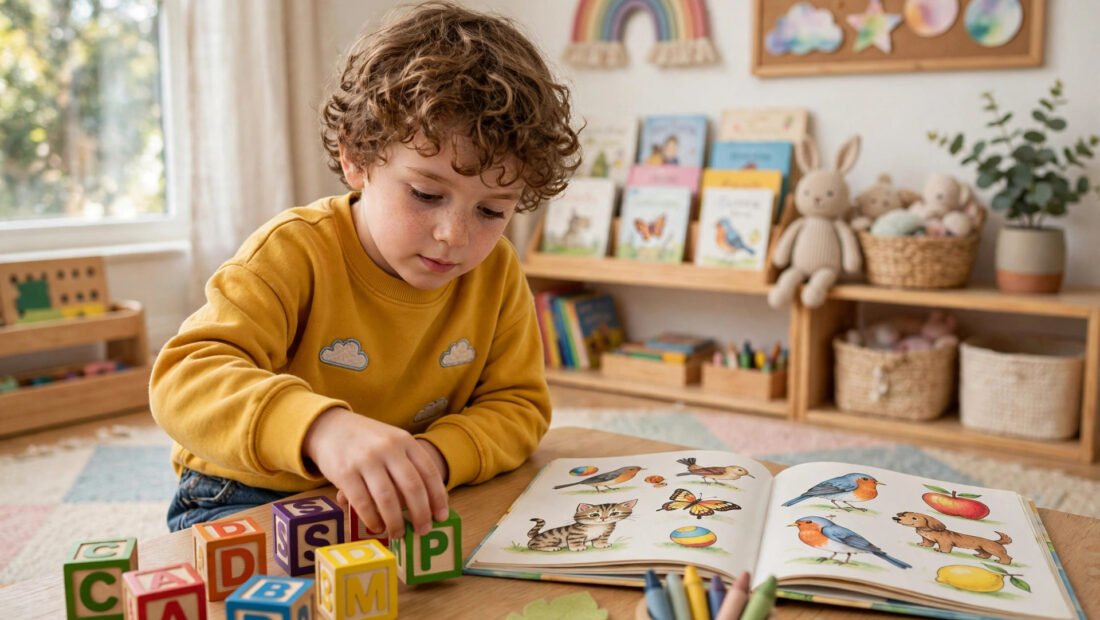
A child sits with a favorite picture book and reads it out loud, word for word, without a single mistake. Then the child opens a new book, one never seen before, and stops cold on the first line. The words will not come. Nothing is wrong with the child’s memory. In fact the memory is doing all the work. The first book was recited, not read. The gap between those two things, reciting from memory and reading a new page, is the exact gap that phonics fills.
What phonics actually is, in plain words
Written English is a code for spoken English. Letters stand for sounds. Phonics is the teaching of that code: which letters make which sounds, and how to put those sounds together to form a word.
Take a simple word. A child learns that the letter c makes a hard sound, a makes a short vowel sound, and t makes its closing sound. Said separately, they are just noises. Blended in order, they become cat. That act of blending is called decoding, and decoding is the engine of early reading. Once a child can decode, an unfamiliar printed word stops being a mystery shape and becomes something the child can work out alone.
The code has layers, and good teaching takes them in order. First come single letter sounds. Then come blends, where two letters sit side by side and both can still be heard. Then come digraphs, where two letters make one new sound, such as sh, ch, and th. Next come patterns such as the silent e that changes a short vowel into a long one, and vowel teams where two vowels work together. Later still come the parts of longer words: prefixes, suffixes, and roots. Each layer builds on the one before it, which is why the order of teaching matters so much.
Why memorizing and guessing fail
Young children are strong memorizers, and that strength can hide a problem. A child can memorize a short book after a few readings, turn the pages at the right moments, and appear to read fluently. Pictures help the act along, and so does a pattern where each page changes only one word. None of that transfers to a new book.
Guessing has the same flaw, only worse. Some approaches teach children to look at a picture, think about what would make sense, check the first letter, and take a stab at the word. On an easy book that can look like reading, but English has far too many words for guessing to hold up as books drop their pictures and words grow longer. Guessing also steals practice: every word a child guesses is a word the child did not decode, and decoding grows only through use.
What the research settled on
Reading research is one of the more heavily studied areas in education, and its central finding on this question has held up for decades. Phonics works best when it is systematic and explicit. Systematic means it follows a planned sequence, from simple patterns to harder ones, rather than teaching a pattern only when it happens to appear in a book. Explicit means the teacher states the pattern clearly and shows how it works, rather than hoping children will absorb it on their own.
The National Reading Panel’s 2000 federal review is often named here because it pulled together a large body of studies and reached that same conclusion: children taught with systematic, explicit phonics read better than children taught with little or unsystematic phonics, with the clearest gains in kindergarten through second grade and for children who were struggling. Later reviews have pointed the same way. Schools can still argue about programs, pacing, and books. The need to teach the code directly is not where the real argument lives anymore.
The five pillars phonics sits inside
Phonics is one part of a larger set. Reading instruction is often described as resting on five pillars, and a child needs all five.
Phonemic awareness comes first, and it lives in sound alone, with no letters at all. It is the ability to hear and work with the separate sounds in spoken words: to hear what sound sun starts with, to clap the parts of a longer word, to say a word with its first sound removed. Children who can play with sounds in speech find letter sounds easier to learn.
Phonics is the second pillar, the bridge from those sounds to print. Fluency is the third: reading accurately, at a natural pace, and with expression, which matters because a child who spends all their energy sounding out words has little left for meaning. Vocabulary is the fourth pillar, the store of word meanings a child brings to the page. Comprehension is the fifth and the point of the whole exercise: building meaning from text and thinking about what was read.
What good instruction looks like day to day
Strong phonics teaching is easy to spot once you know the signs. Lessons are explicit: the teacher names the new pattern, says the sound, shows words that use it, and has children read and spell those words. Lessons are daily, often 20 to 30 minutes in the early grades, because short and frequent beats long and rare for a skill built on repetition. Lessons are sequential: a new pattern is taught only after the earlier ones are secure, so children are not asked to read patterns they have never been shown.
The books matter as much as the lessons. Beginning readers need decodable texts, books written to use mainly the patterns a child has already been taught. A decodable book lets a child practice the exact skill from the lesson and succeed by decoding rather than by guessing from a picture. As the child’s code grows, the books open up, and trade books and library books take a larger role.
For practical ways to support all of this outside school hours, see how to improve your child’s reading skills at home, which covers the home side of the same work.
Phonics at different ages
In preschool, the work is playful and oral. Rhymes, songs, clapping out the parts of words, and games about first sounds build phonemic awareness. Formal letter teaching is light at this stage, and that is fine.
Kindergarten through second grade are the core years. Single letter sounds, blending, short vowels, digraphs, silent e patterns, and then vowel teams and longer words arrive in a planned order. By the end of this stretch, decoding should be close to automatic for most children, freeing attention for meaning.
Older children who still struggle need phonics too, and this is where schools sometimes go wrong. A fourth or fifth grader who cannot decode does not need more grade-level passages to fail at. That child needs the missing patterns taught directly, with materials written for an older reader so the work does not feel like baby work. Shame is a real risk at this age, so the tone matters: a specific skill was missed, not that the child is a poor reader for life. With the gaps filled, older students often move fast, because their vocabulary and thinking are already ahead of their decoding.
The Texas science-of-reading push
Texas has moved, along with many other states, toward requiring evidence-based reading instruction in the early grades. Districts are expected to use reading programs grounded in the science of reading, with systematic phonics as a core part, and early-grade teachers are expected to complete training in how reading develops and how to teach it. Quality of delivery still varies by district and classroom, which is why a state requirement is a floor, not a guarantee.
Parents can use the Texas Education Agency’s reading instruction resources to see what the state expects schools to teach and to find plain-language material on early reading. Knowing the expectation helps you ask better questions at school, and it helps you tell the difference between a school that has adopted a label and a school that has changed its daily teaching.
Red flags worth acting on early
Certain signs should move a parent from watching to asking. A child who cannot rhyme or play with first sounds by age 5 or 6 deserves a closer look. So does a child who, well into kindergarten, still knows few letter sounds. A child who guesses at words from the picture or the first letter instead of trying to sound them out is showing you a strategy problem, not a lazy streak. Strong avoidance, tears, or dread around reading are signals too, especially when a child is bright and verbal in every other setting. So is a lack of progress over several months despite regular instruction, and a family history of dyslexia, which is worth telling the school about early rather than late.
None of these signs is a diagnosis. All of them are reasons to ask the school, in writing, what it is seeing and what it plans to do. Early help works far better than late help, because the gap is smaller and confidence is still intact.
What parents can do at home
Home support works best when it matches the school’s sequence rather than racing ahead of it. Sound games are the easiest place to start: ask what sound a word begins with, take turns naming words that start the same way, clap the beats in names. Read decodable books that use patterns your child has been taught, and let your child do the reading while you stay patient through the sounding out. Resist supplying the word the moment a child pauses, and resist telling a child to look at the picture and guess. Prompt the child back to the letters instead: say the sounds, then blend them.
Ask the school three plain questions: which phonics program it uses and in what order, which patterns your child has mastered, and what happens step by step if your child falls behind. A school with a real program can answer all three.
Keep read-alouds going at the same time, with books well above your child’s decoding level. That is where vocabulary, knowledge, and a love of stories grow while the code catches up. Phonics gives a child the keys to print. Everything else in reading is what those keys open.