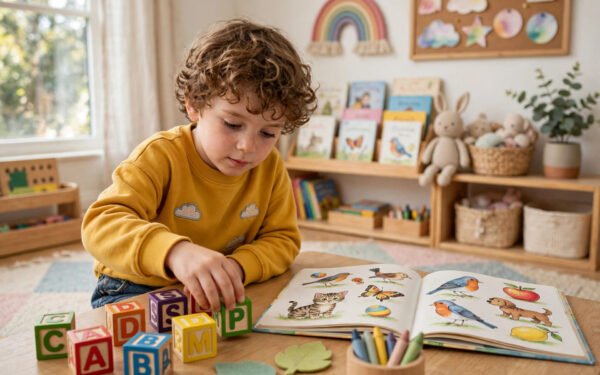
What actually builds a reader at home? The answer changes with a child’s age, so it helps to think of the work as a timeline rather than a single trick. The read-aloud years run from birth to about five. The code-cracking years run from six to eight, when letters turn into words. The fluency years run from nine to twelve, when reading becomes a tool for learning everything else. Each phase has its own job, its own daily habits, and its own warning signs. Get the phase right and the next one gets easier.
One plain piece of arithmetic explains why home carries so much weight. Children spend roughly 15 percent of their waking hours in school. The other 85 percent is home territory: mornings, evenings, weekends, summers. A teacher can do excellent work inside that 15 percent and still be outnumbered by a home where books are rare and screens fill every gap. The reverse is also true. A modest daily habit at home, kept up for years, adds up to a large head start that no single school program can match.
Phase One, Ages 0 to 5: The Read-Aloud Years
The job of this phase is not decoding. A three-year-old does not need to sound out words. The job is language: words heard, stories understood, and the simple discovery that books are enjoyable. Children who enter kindergarten with a large spoken vocabulary learn to read faster, because once they decode a word they already know what it means.
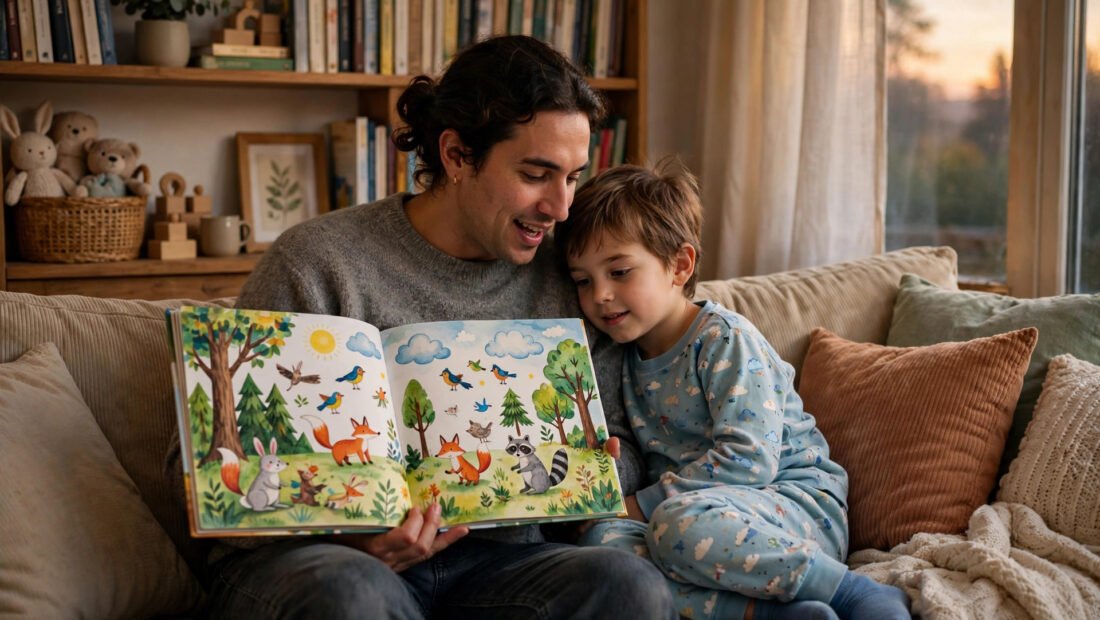
Read aloud every day for 15 to 20 minutes. That is the core habit, and it works best when it is interactive rather than a performance. Point at the pictures. Ask what a character might do next. Let the child turn pages, finish rhymes, and interrupt with questions. Interruptions are not a problem to manage; they are the learning happening out loud. A child who comments on a story is building comprehension, which is the whole point of reading later on.
Talk is the second habit, and it costs nothing. Narrate ordinary tasks: cooking, folding laundry, driving to the store. Name things precisely. A spoon, a ladle, and a spatula are three different words, and a child who hears all three owns all three. Ask open questions that cannot be answered with yes or no, then wait for the answer. Silence feels awkward to adults, but young children need those extra seconds to put a thought into words.
Play with sounds, too. Rhyming games in the car, silly songs, clapping out the parts of a name, spotting words that start with the same sound. This sound play builds phonological awareness, the ability to hear that words are made of smaller sounds. That skill sits underneath phonics, and children who have it tend to crack the code faster in the next phase.
Make books physically easy to reach. A basket in the living room, a small stack by the bed, a few board books in the car. Library trips work well as a routine outing, and letting a small child choose books, even badly, builds ownership. Never force reading at this age. A child pushed into drills at four may learn the letters and lose the appetite, and appetite is the harder thing to rebuild.
Phase Two, Ages 6 to 8: Cracking the Code
Now the work changes. Children in this band are learning that letters stand for sounds and that sounds blend into words. School carries most of the formal phonics teaching, and the home job is to support it rather than run a rival program with different rules.
Ask the teacher which letter sounds and patterns the class is working on, then play with those at home. If the class is on short vowel sounds, a ten-minute game sorting word cards by their middle sound reinforces the lesson. If a school uses a different method or order than the one you learned as a child, follow the school’s version for homework. Two competing methods confuse a beginner far more than either method alone.
Decodable readers are the right practice books for this phase. These are simple books written with only the sound patterns a child has already been taught, so a beginner can read every word honestly instead of guessing from pictures. Ask the teacher or a children’s librarian which sets match your child’s stage. Success matters here: a child who finishes a small book alone, word by word, gets proof that reading is something they can do.
Shared reading keeps the load shared. Take turns by page or by paragraph. When your child stalls on a word, give time first, then a hint about the sounds, and only supply the word if the struggle turns to distress. Praise the effort in specific terms: naming the hard word they worked out tells them exactly what good reading looks like.
Keep reading aloud to them even after they can read simple books alone. A seven-year-old’s listening level is well ahead of their decoding level. The chapter book you read at bedtime carries richer vocabulary and longer story arcs than anything they can yet manage solo, and that gap is where vocabulary grows. Families looking for stage-by-stage ideas can also browse the National Association for the Education of Young Children’s family resources for activities matched to young children.
Phase Three, Ages 9 to 12: Fluency and Appetite
Somewhere in this band the task flips. Children stop spending most of their effort on decoding and start reading to learn: science chapters, history, instructions, stories with real length. Children who stall here often look fine, because they can read the words. The problem shows up as slow, effortful reading and a quiet dislike of books.
Protect 20 to 30 minutes of independent reading a day, and let the child choose the material. Choice is not a soft extra at this age; it is the mechanism. Comics and graphic novels count. So do sports biographies, joke books, magazines, and the same series read for the third time. Volume is what builds fluency and vocabulary, and children only produce volume with books they actually want to open.
Series books deserve special mention. Once a child bonds with a set of characters and a familiar world, each next book is easier to start and easier to finish. Keep feeding a series while it lasts, and have the next author or series ready before the current one runs out. Librarians are excellent at this kind of matching, so ask.
Talk about books the way adults talk about shows. Ask what is happening, who is annoying, what might happen next. Avoid turning every chat into a quiz with right answers, which teaches children that reading ends in a test. Parents who read themselves send the clearest signal of all. A child who sees a parent with a novel most evenings absorbs the idea that reading is a normal adult pleasure, not school work that escaped the building.
Audiobooks are a legitimate part of this phase, especially for reluctant readers. Listening builds vocabulary, story sense, and background knowledge. Pairing audio with the printed book, following along while listening, can help a struggling reader bridge the gap.
The Struggling-Reader Detour
Some children move slowly through phase two or three despite steady practice at home and school. Slow progress alone is not an emergency; the normal range for reading milestones is wide, and children develop at different speeds. Certain signs do call for prompt action rather than patience.
Watch for a family history of dyslexia, letter reversals that persist well past age seven or eight, trouble hearing rhymes, extreme avoidance of reading, or months of flat progress despite regular practice. In Texas, parents can request a school evaluation for dyslexia in writing, and putting the request in writing matters because it creates a record and starts timelines. Ask what intervention the school uses and whether it is a structured, phonics-based approach, since that style of teaching has the strongest track record for struggling readers.
Tutoring can help when it is systematic instruction in sounds and patterns, not just supervised homework. Whatever route you take, separate the skill from the child. A reader who decides they are simply bad at this stops trying, and effort is the one input every method depends on. The same calm, structured approach helps at homework time in other subjects too, as covered in how to help your child with math homework without frustration.
Screen Rules That Protect the Timeline
Screens cause trouble mainly by displacement. An hour of decent educational programming does little harm. An hour that replaced the bedtime book, every night for a year, costs real ground. A few workable household rules handle most of it: keep the 20 minutes before bed for books, not devices; co-view when you can, because talking about a show builds language much like book talk does; and use technology as a bridge where it genuinely helps, such as library ebook apps for a child who resists print or decodable-text apps for a beginner. The aim is a child who reads and handles screens sensibly, not a household at war over a tablet.
Keeping the Phases Moving
Habits survive when they attach to routines that already exist. Bedtime reading works because bedtime happens every day. A weekly library day works because it lands on the calendar. A reading chair with good light, book gifts on birthdays, and a few minutes of book talk at dinner all do the same quiet job: they make reading a normal feature of the house rather than a special event. Start wherever your child is on the timeline, hold the daily minutes for that phase, and let the years do the compounding.