
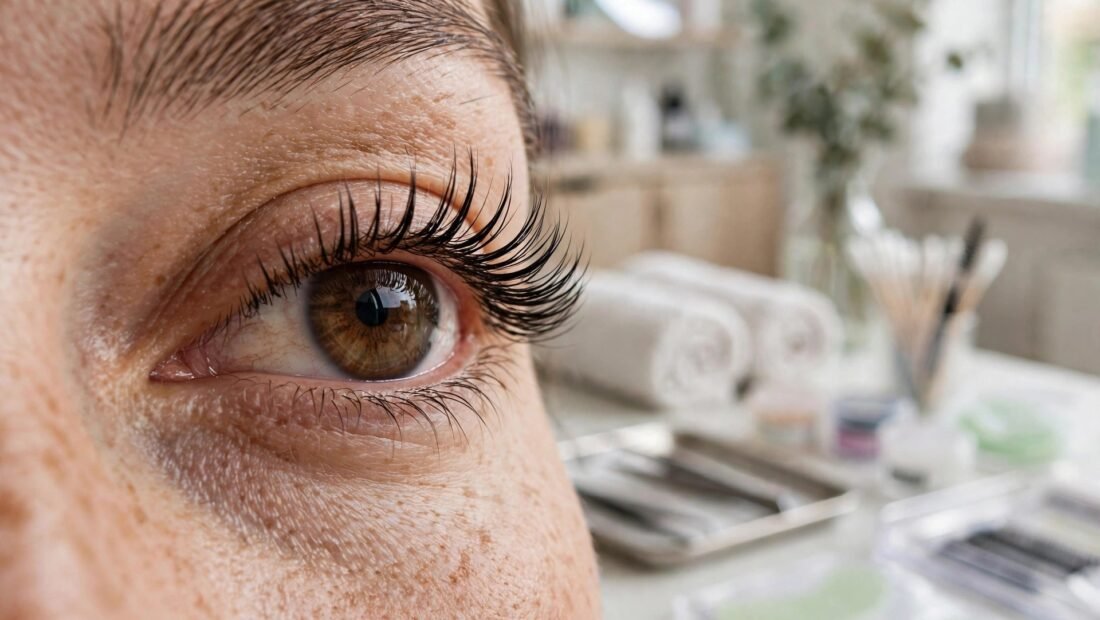
Both appointments promise the same morning: wake up, look in the mirror, and find the lashes already done. Behind that promise, the two services could hardly be more different. A lash lift works with what is already growing there — it curls the natural lashes upward and tints them darker, so they look longer and more visible without anything being added. Lash extensions take the opposite approach: individual synthetic fibers are glued, one by one, onto the natural lashes, adding length, thickness, and density that were never there. Choosing between them is really choosing between enhancing and adding, and the right answer depends on the lashes a person starts with and the upkeep they will honestly tolerate.
What Each Service Actually Involves
A lift is a chemical treatment. The natural lashes are curled from the base over a silicone shield with a perming solution, then usually finished with a tint. The whole appointment takes about 45 to 60 minutes, costs typically $75 to $150 in Texas, and the result lasts six to eight weeks — one full natural lash growth cycle — fading gradually as treated lashes shed and new, straighter ones grow in. There is no harsh grow-out line and nothing to remove.
Extensions are construction. A technician isolates each natural lash and bonds a fiber to it with adhesive. A classic set places one extension per lash for a defined, natural look; volume sets attach fans of several fine fibers per lash for real drama. The first appointment runs one and a half to two and a half hours and costs $120 to $300 or more in Texas. Because natural lashes shed continuously, the set thins from the day it is applied, and fills — $50 to $100 each — are needed every two to three weeks to keep it looking full.
Lash Lift: The Pros
- Almost no upkeep. After the first 24 to 48 hours, during which both services need to stay away from water and steam, a lift asks for nothing. No fills, no special products, no appointments for six to eight weeks.
- It survives real life. Swim, sweat, rub tired eyes, sleep face-down — the curl does not care. Texas summers, pool days, and allergy season pass over a lift without consequence.
- It costs far less over time. Three to four lift appointments across six months run roughly $300 to $600 total, with no spending in between.
- It grows out gracefully. There is no ragged stage and no removal appointment. The effect simply softens week by week.
- Lower reaction risk. Lift solutions use different chemistry from extension adhesive, and reactions are less common — a real consideration for sensitive eyes, though a patch test still comes first.
Lash Lift: The Cons
- It can only enhance what exists. Short, sparse, or very fine natural lashes get a modest result. A lift cannot create length or density that is not there.
- The drama ceiling is low. Nobody will ask whether those are extensions. The look is polished and awake, not glamorous.
- Chemistry sits close to the eyes. Over-processing by a careless technician can leave lashes dry or frizzed until they grow out, so technique still matters even on the simpler service.
Lash Extensions: The Pros
- Real length and volume. Extensions deliver what no lift, curler, or mascara can: density and length beyond the natural lash line, shaped to the eye — natural with a classic set, dramatic with volume.
- Custom and immediate. The result is built lash by lash at the first appointment, which makes extensions the strongest choice before weddings, photographs, and events where the lashes are meant to be noticed.
- Mascara becomes optional. For people whose main goal is skipping the daily makeup step entirely, a full set does that more completely than a lift does.
Lash Extensions: The Cons
- The maintenance is permanent. Fills every two to three weeks, forever, or the set turns patchy and grown-out. In a Texas summer, heat, sweat, and oil break adhesive down faster, and many wearers find fills creeping closer to every two weeks.
- The six-month math is heavy. An initial set plus eight to ten fills totals roughly $600 to $1,500 or more across six months — two to three times the cost of lifts over the same period.
- Daily life comes with rules. Oil-free products only, because oils weaken the adhesive. No rubbing. Careful sleeping. Chlorine and saltwater are allowed after the initial cure period but shorten retention, so pool-heavy summers cost fills.
- Damage and allergy risks are higher. Extensions that are too heavy for the natural lash, poor application, or picking at the set cause breakage and thinning. The adhesive itself triggers red, itchy, swollen lids in some people. Bad extensions also need professional removal — pulling them off takes natural lashes with them.
- Texas allergy season is miserable with them. Cedar and oak pollen mean itchy, watery eyes that beg to be rubbed, and rubbing is the one thing extensions cannot tolerate.
Start With the Lashes Already There
The single best predictor of satisfaction is not the salon. It is the starting lash line. Long, reasonably thick natural lashes are ideal lift material: curling and tinting them reveals length that was always present but pointed downward, and the before-and-after can be startling. Straight, downward-pointing lashes also respond well, because the change in direction is exactly what makes lashes visible from the front. Very short or sparse lashes are where lifts underdeliver — the treatment polishes what exists, and if what exists is minimal, so is the polish. For that lash line, extensions are not vanity; they are the only one of the two services that can actually change the picture.
Eye shape and daily habits refine the answer further. Hooded eyes and deep-set eyes often benefit more from a strong lift, which opens the eye area without adding weight to the lid. People who wear glasses should mention it at either appointment, since very long extensions can brush lenses. Contact lens wearers can have both services, though lenses usually come out during the appointment itself. And anyone whose mornings genuinely contain no spare minute should weigh the lift’s zero daily effort heavily, because an extension set that is never cleaned or brushed out as instructed ages badly and sheds unevenly.
Texas Conditions, Taken One at a Time
Heat and humidity cut both ways. Humidity actually helps extension adhesive cure properly, which surprises people who assume Texas weather is purely the enemy. The real enemies arrive afterward: sweat and the skin’s own oil, both produced generously through a Texas summer, work into the bond line and shorten how long each extension holds. That is why summer retention drops and fill intervals shrink toward two weeks for many wearers, while a lift — being the wearer’s own hair, chemically set — has no bond to weaken. A lift wearer walks out of the same heat with nothing to protect.
Water draws the clearest line between the services. After the initial 24 to 48 hour cure window, a lift is fully swim-proof with no restrictions at all. Extensions can be swum in after that window too, but chlorine and saltwater steadily weaken adhesive, so a summer built around pools, lakes, and the Gulf quietly converts into more frequent fills. Sunscreen habits matter as well: oil-based products migrating toward the eyes are a routine summer event in Texas, and oil is precisely what extension adhesive cannot tolerate. None of this makes extensions impossible in Texas — thousands of people wear them through August. It makes them a commitment with a climate surcharge, and the lift the service that ignores the forecast entirely.
The Technician Decides More Than the Service Does
Both columns above assume competent work. In practice, the person holding the tweezers matters more than the menu choice. Look for a licensed technician with a portfolio of healed, grown-in work rather than only fresh sets, clean single-use tools, and detailed aftercare instructions given without being asked. A good technician will also talk a client out of the wrong service — refusing extensions on lashes too weak to hold them, or warning that a lift will disappoint on very sparse lashes. That honesty is worth more than a discount, in the same way it does when weighing gel versus acrylic nails compared at another salon station: the material matters, but the hands matter more.
Safety deserves one blunt paragraph. These are chemicals and adhesives used millimeters from the eye, and the FDA’s eye cosmetic safety guidance exists because eye-area products carry specific risks when they are unregulated or badly applied. The cheapest lash deal on a coupon site, done by an unlicensed operator with unknown adhesive, can trade a small saving for an infection or months of damaged lashes. Patch tests, licenses, and hygiene are not upsells. Anyone with chronic eye conditions should check with an eye doctor before either service.
The Verdict, by Lifestyle
Choose the lash lift if the goal is to look put-together with the least possible effort: decent natural lashes, a schedule with no room for standing appointments every two weeks, a summer built around pools and workouts, sensitive eyes, or a budget that prefers one payment every couple of months. For most people in Texas, most of the year, the lift is the practical winner — cheaper, tougher, and forgotten about the moment it is done.
Choose extensions if the goal is the lashes themselves: length and density that nature did not provide, a big event on the calendar, or a daily look that a lift has already been tried on and found too subtle. Choose them with eyes open about the contract being signed — fills on the calendar indefinitely, oil-free everything, gentler habits around water and sleep, and roughly double to triple the yearly spend.
Put plainly: a lift is the better service for a busy life, and extensions are the better service for a deliberate one. Match the choice to the calendar and the tolerance for upkeep, not to the photograph of someone else’s first day, because day one is the only day the two services look equally effortless.


1 Comment