Pickleball is the fastest-growing sport in America, and Texas is one of its strongholds, with courts filling up in parks from Houston to El Paso. If you have been invited to play and nodded along while having no idea what the “kitchen” is, this guide is for you. Here are the complete rules of pickleball for total beginners, explained simply, plus the unwritten etiquette that keeps you welcome.
We will cover the court and equipment, scoring (the confusing part, made simple), the serve, the kitchen rule, common faults, and five etiquette rules beginners need.
The Court and Equipment: The 30-Second Setup
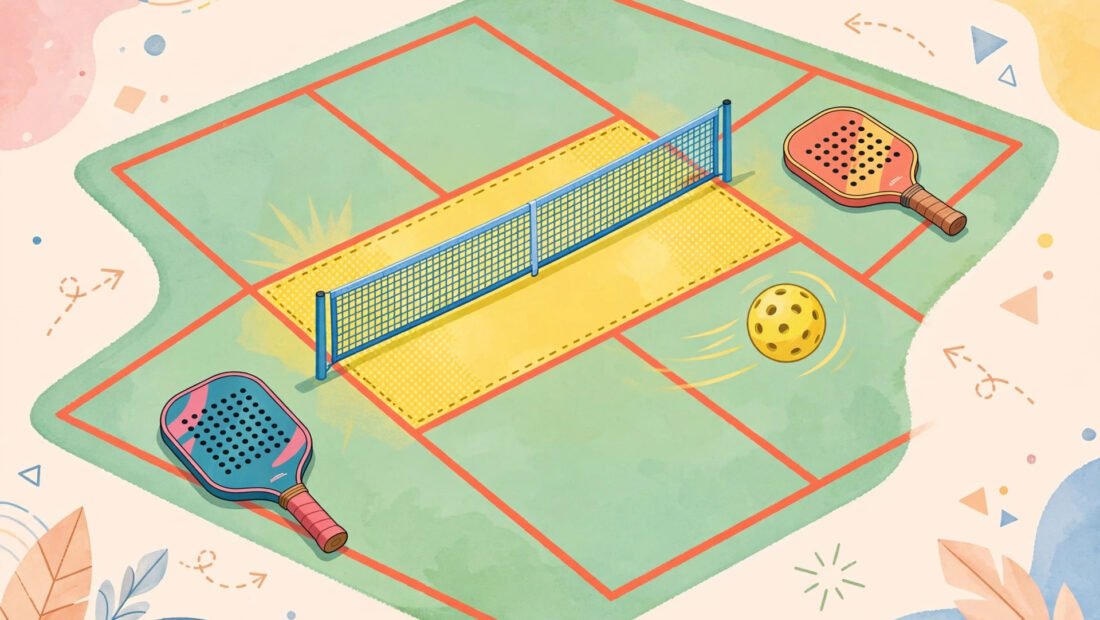
A pickleball court is 20 feet wide by 44 feet long, the same size as a badminton court, about a quarter of a tennis court. It is divided by a net (36 inches high at the sidelines, 34 inches in the center) into two sides. Each side has a 7-foot “non-volley zone” (the kitchen) in front of the net, then the service areas behind it.
Equipment is minimal: a paddle (larger than table-tennis, smaller than tennis, solid face, no strings), a plastic ball with holes (like a Wiffle ball, but engineered), and court shoes. Most parks have free courts; many recreation centers lend paddles. The barrier to entry is wonderfully low, which is half the sport’s appeal.
Scoring: The Confusing Part, Made Simple
Pickleball uses side-out scoring: only the serving team can score points. Games go to 11, win by 2 (tournament games sometimes to 15 or 21).
The score is called as three numbers: serving team’s score, receiving team’s score, then the server number (1 or 2). “4-2-1” means: serving team has 4, receiving team has 2, and this is the first server. In doubles, both partners serve (except the very first serve of the game) before the serve passes to the other team, hence server 1 and server 2.
Singles is simpler: one serve per side-out, and the score is just two numbers. But most beginners play doubles, so learn the three-number call. It clicks after two games, promise.
Key scoring quirk: because only servers score, long games feature many side-outs with no points. Do not be confused when the score stays 4-2 through six rallies; that is normal.
The Serve: Underhand and Diagonal
Serves must be underhand, with the paddle below the waist, and go diagonally into the opposite service box, clearing the kitchen. The serve must bounce on the receiving side before the return (see the two-bounce rule below).
Beginner serving tips: aim deep, not hard. A deep, soft serve is more effective than a fast one that sails long. The serve is not a weapon in pickleball the way it is in tennis; it just starts the point. Consistency beats power completely.
One serve attempt only, no second serves like tennis. But faults on the serve are low-stakes: you just lose the serve, not a point (remember, only servers score, so losing a serve costs opportunity, not points).
The Two-Bounce Rule and the Kitchen Rule
The two-bounce rule: each side must let the ball bounce once on their first shot. Serve bounces, return bounces, and then the third shot can be volleyed (hit in the air). This single rule prevents serve-and-volley dominance and is the most commonly violated rule by tennis converts.
The kitchen rule (non-volley zone): you cannot volley (hit the ball in the air) while standing in the 7-foot zone in front of the net, and your momentum cannot carry you into it after a volley. You can stand in the kitchen anytime; you just cannot hit a volley from there. Groundstrokes from the kitchen are fine (though rarely useful).
Why does the kitchen exist? Without it, tall players would camp at the net smashing everything. The kitchen forces the soft game, dinks, drops, and resets, that makes pickleball strategic rather than just athletic. Learning to love the kitchen game is learning to love pickleball.
The USA Pickleball official rulebook has the complete rules with diagrams for when you are ready for the details.
Common Faults That Lose the Rally
A fault ends the rally and (if you are serving) costs the serve. Common beginner faults: volleying from the kitchen, violating the two-bounce rule, serving into the net or out of the service box, hitting the ball out of bounds, hitting the net and failing to cross, and catching the ball (it must be hit with the paddle).
Line calls: balls landing on the line are in (except the serve, which must clear the kitchen line; a serve landing on the kitchen line is a fault). When in doubt on a line call, the benefit goes to your opponent. This is both the rule and the culture.
For general sports safety as you start playing, the CDC on staying active safely covers the basics, and the American Heart Association on racket sports notes the cardiovascular benefits.
5 Unwritten Etiquette Rules
1. Call the score clearly before serving. Every time. It prevents the most common beginner arguments.
2. Give line-call benefit to opponents. If you did not clearly see it out, it was in. Nobody likes playing with someone who steals line calls.
3. Do not target beginners with slam shots. In recreational play, crushing balls at weaker players is bad form. Match the rally to the group. Save the aggression for competitive games.
4. Rotate fairly. On busy public courts, games rotate: winners stay, losers rotate off (or everyone rotates, depending on local custom). Learn the local system and follow it. Paddle stacking (lining paddles up for next game) is the universal queue.
5. Introduce yourself and be welcoming. Pickleball’s culture is famously friendly. Experienced players expect to help beginners; asking questions is welcomed, not annoying. The sport’s growth depends on this welcoming culture, so pay it forward when you are the experienced one.
If joint impact is a concern, low-impact exercises that protect knees pair well with pickleball’s relatively gentle profile, and watching live sports without cable is how many fans follow the pro game.
Frequently Asked Questions
What equipment do I need to start?
A paddle ($30-60 for a good beginner paddle; avoid the cheapest wood ones), court shoes (running shoes work initially; court shoes are better), and a ball (usually provided). That is it. Do not overthink the paddle; upgrade after a few months when you know your preferences.
Is pickleball good exercise?
Yes. Studies show pickleball provides moderate-to-vigorous activity, with matches burning 300-500 calories per hour. It is easier on joints than tennis or running, making it ideal for beginners, older adults, and anyone returning to activity.
How is pickleball different from tennis?
Smaller court, underhand serve, no-volley zone, slower ball, and much shorter learning curve. Tennis players often dominate athletically but struggle with the soft kitchen game initially. The sports reward different skills.
Where can I play in Texas?
Nearly everywhere: city parks, YMCAs, recreation centers, and dedicated pickleball facilities. Apps like Pickleheads map courts by location. Most Texas metros have dozens of free outdoor courts.
How long until I am decent?
Most athletic beginners rally competently within 2-3 sessions and play real games within a month. Reaching intermediate level (consistent dinks, third-shot drops) typically takes 3-6 months of regular play. The learning curve is the friendliest in racket sports.
The bottom line: learn the serve, respect the kitchen, remember the two-bounce rule, call the score, and be kind on line calls. Do that and you will be welcomed on any court in Texas. The rest, the dinks, the drops, the strategy, comes with play, which is the fun part anyway.