Your checking account is the Grand Central Station of your money: paychecks arrive, bills depart, and a balance sits in the middle earning essentially nothing. Too little and you risk overdrafts; too much and you are donating interest to your bank. So what is the right number? Here is the practical answer for 2026.
We will cover the one-month buffer rule, the overdraft math, the sweep system that puts idle cash to work, and the special cases that change the answer.
The One-Month Buffer Rule
The standard recommendation: keep one month of essential expenses in checking as a buffer, plus enough to cover upcoming bills before the next payday. For most people, that means a checking balance fluctuating between $2,000 and $6,000 depending on spending.
Why a full month? Because bills and income arrive on different schedules. Your mortgage hits on the 1st, your paycheck lands on the 15th, insurance auto-drafts on the 22nd. The buffer absorbs the timing mismatches so you never have to think about whether a bill will clear. It is shock absorption, not savings.
Calculate yours: add up one month of regular outflows (housing, utilities, insurance, loan payments, typical variable spending). That is your target floor. Anything consistently above the floor plus the next two weeks of bills is idle cash that should be working harder elsewhere.
The Overdraft Math: Why the Buffer Pays for Itself
A single overdraft fee runs $30-35 at most banks, and one mistimed bill can trigger several. Keeping a $3,000 buffer to avoid two overdrafts a year “costs” you the interest that $3,000 could earn elsewhere, roughly $135/year at 4.5%. Two overdrafts cost $70. The buffer wins unless you overdraft constantly, in which case the problem is cash flow timing, not the buffer size.
Better yet, link your checking to savings for overdraft protection (usually free or a small transfer fee versus a full overdraft fee). The buffer plus the link means overdrafts become nearly impossible, which is the entire point.
The CFPB on managing checking accounts explains overdraft rules and your right to opt out of overdraft “protection” programs that are really fee generators.
The Sweep System: Putting Idle Cash to Work
Here is the system that optimizes checking automatically:
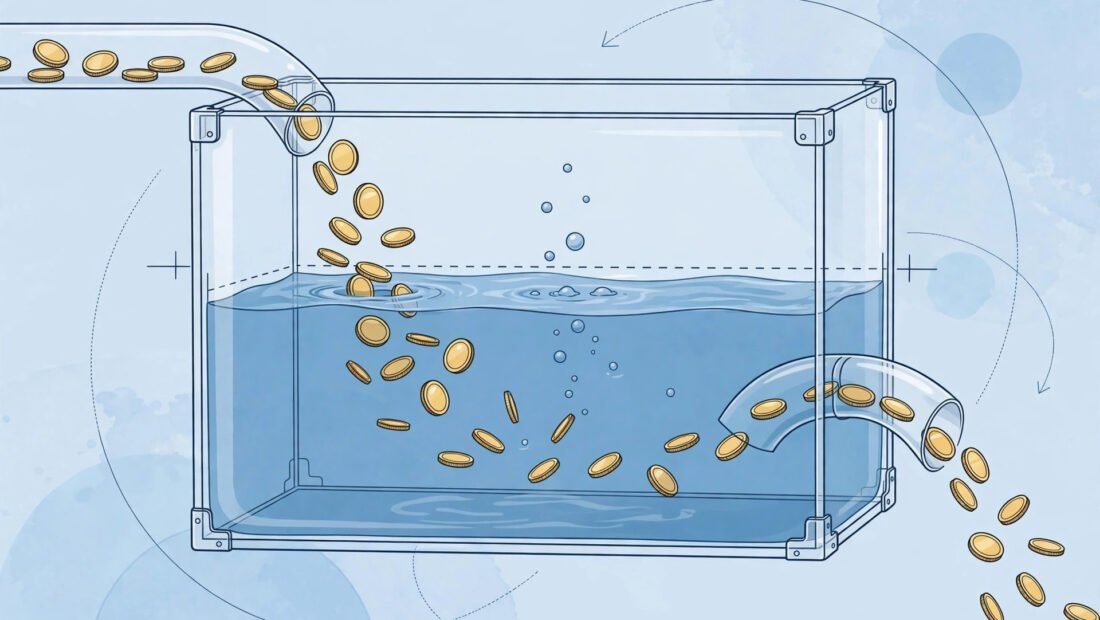
Set a ceiling and a floor. Floor: your one-month buffer (say $3,000). Ceiling: floor plus a comfort margin (say $5,000). Once a month, on a fixed date, sweep everything above the ceiling into high-yield savings or investments.
Automate it. Most banks allow automatic transfers on a schedule. Set the sweep for the day after your last monthly bill clears. The checking account then oscillates between floor and ceiling, never accumulating idle cash, never risking overdraft.
Handle the inflows. Paychecks, by definition, push the balance up; the monthly sweep pushes the excess out. Irregular income (bonuses, tax refunds, side hustle) should bypass checking’s orbit: route windfalls directly to savings or investments rather than letting them inflate the checking balance temporarily.
This is the same automation philosophy behind NerdWallet on checking account balances: decide the number once, automate the maintenance, stop thinking about it.
What “Too Much” Costs You
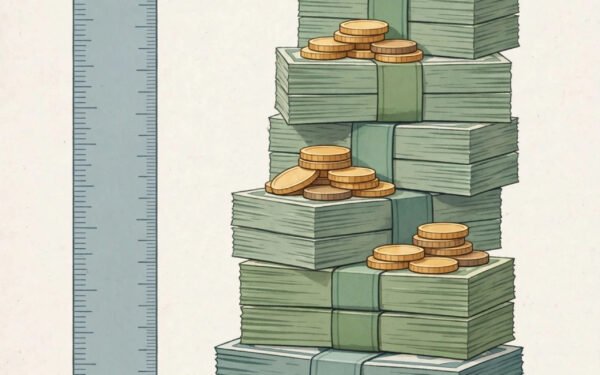
Every $10,000 sitting in checking instead of a high-yield savings account costs roughly $450/year at current rates. A $20,000 checking balance maintained “for safety” donates $900 annually to your bank’s profits. Over a decade, that is $9,000+ of lost interest, before compounding.
The psychological trap: a big checking balance feels safe. But safety comes from the buffer plus the linked savings, not from the checking balance itself. Money in a high-yield savings account is nearly as accessible (1-2 day transfers) and actually grows. The feeling of safety from a fat checking balance is expensive nostalgia.
Check your actual average balance over the last six months. If it is consistently double your monthly outflows, you are overfunded. Sweep the excess this week; it takes five minutes.
Special Cases That Change the Answer
Irregular income. Freelancers and commission workers should keep 6-8 weeks of expenses in checking rather than four, because income timing is unpredictable. The sweep ceiling rises accordingly, but the principle holds: cap it, sweep the rest.
Upcoming large bills. Property tax due next month? Insurance premium in six weeks? Temporarily raise the floor to cover known large outflows, then drop it back after they clear. The buffer flexes with reality.
Multiple checking accounts. Some people run separate checking for bills versus spending. If you do, the buffer applies to the bills account; the spending account can run leaner since it holds only discretionary money.
Business owners. Keep business and personal checking strictly separate (see the best business bank accounts for freelancers), and apply the buffer rule to each independently. Business checking often needs a larger buffer due to irregular receivables.
For the security side of account management, review keeping your bank accounts secure, and understand FDIC on deposit insurance coverage if your combined balances are large.
The Monthly Money Review: Keeping Checking Honest
Add a five-minute checking review to your monthly routine. Look at three numbers: the lowest balance the account hit (was the buffer ever threatened?), the average balance (is idle cash accumulating?), and any fees (are you paying for avoidable mistakes?).
If the average balance keeps creeping above your ceiling, raise the sweep amount or lower the ceiling. If the low point keeps dipping near zero, raise the floor; your buffer is undersized for your actual cash-flow pattern. The system should be recalibrated twice a year or after any major income or expense change.
This review pairs naturally with your broader financial checkup. While you are looking at checking, glance at savings growth and investment contributions too. Five minutes monthly prevents the slow drift that turns optimized systems into neglected ones. The accounts that get reviewed stay healthy; the ones you ignore develop problems quietly.
Frequently Asked Questions
Should I keep my emergency fund in checking?
No. The emergency fund belongs in a separate high-yield savings account. Checking holds the one-month buffer; everything beyond that earns more elsewhere. Mixing them means emergency money gets spent on non-emergencies.
What is the minimum to avoid fees?
Many banks waive monthly fees with minimum balances ($1,500 is common) or direct deposit. If your bank charges fees you cannot avoid, switch banks; free checking is widely available and there is no reason to pay for the privilege of holding your own money.
How do I handle months with unusual expenses?
Temporarily raise the floor for that month, or make a one-time transfer from savings to cover it. The system flexes; the key is returning to normal the next month rather than letting the higher balance become permanent.
Is it safe to keep the buffer at a different bank?
The buffer should stay in checking for instant bill-pay access. It is the longer-term savings that benefit from separation. Keep the buffer where the bills are.
What about check-cashing and cash deposits?
If you regularly handle cash, factor in deposit logistics. Online banks often lack cash deposit options; a local credit union account for cash handling, swept regularly to your main setup, solves this cleanly.
The bottom line: keep one month of expenses as a buffer in checking, set a ceiling, sweep everything above it monthly into high-yield savings, and link savings for overdraft protection. Your checking account is a transit hub, not a parking lot. Keep traffic flowing and put idle cash to work.