You’re 30, you’ve always regretted never learning piano, and a voice in your head says the window closed somewhere around age 12. That voice is wrong — and it’s costing you one of life’s great pleasures. The science is clear: adults can absolutely learn piano, and 30-year-olds have specific advantages over children (focus, discipline, musical taste, the ability to practice deliberately). What you won’t become is a concert pianist — but that was never the goal. The goal is playing the songs you love, and that’s entirely within reach. Here’s the honest adult beginner’s guide. For more detail on a related topic, see our article on can ai help me learn a new language faster.
Why 30 Is Actually a Good Age to Start
- You practice deliberately: children noodle; adults can focus 30 minutes on a specific problem. Deliberate practice is the actual driver of skill — and adults are better at it.
- You know what you want to play: motivation sustains practice, and nothing motivates like learning your songs. A 30-year-old learning to play their wedding song practices harder than a 10-year-old drilled on scales.
- Brain plasticity persists: the “critical period” for music is real but overstated — adult brains learn motor skills and music theory just fine. Studies show adult beginners reach satisfying playing levels within 1–2 years of consistent practice.
- You can afford good tools: a decent digital piano and a few months of lessons are budget-feasible for most 30-year-olds in a way they aren’t for kids.
The one genuine disadvantage: less free time. The fix is efficiency — 25 focused minutes daily beats 3 hours on Sunday. Exploring music you love also keeps your repertoire goals inspiring enough to protect that practice time.
What to Buy: The Instrument Question
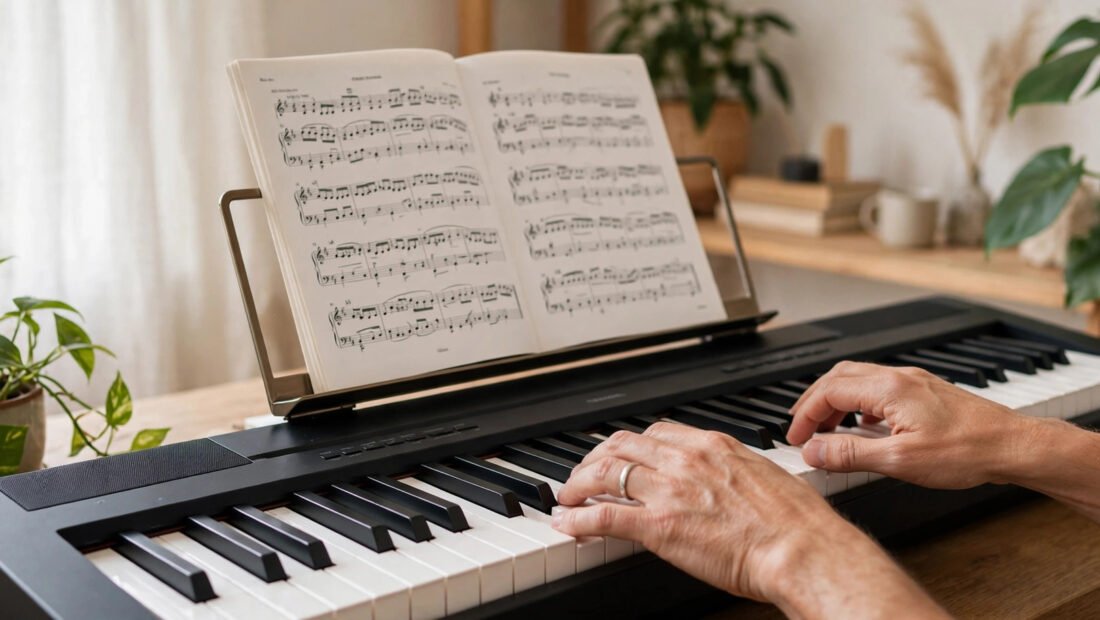
- Digital piano (recommended for beginners): $400–$800 gets a quality instrument with 88 weighted keys (Yamaha P-125, Roland FP-30X, Casio PX-S1100). Weighted keys matter — they build the finger strength and dynamics an unweighted keyboard can’t. Headphone jack = practice at midnight in an apartment.
- Avoid: 61-key unweighted keyboards. They’re fine for exploring, but you’ll outgrow them in months and develop technique that doesn’t transfer.
- Acoustic piano: wonderful if you have space, budget, and tolerant neighbors — but unnecessary to start. Many adult beginners start digital and upgrade later.
- Used market: digital pianos depreciate fast; quality used instruments at 40–60% of retail are common on Facebook Marketplace in Texas metros. Test every key and pedal before buying.
The Learning Path: What Actually Works for Adults
- Months 1–3: Foundations. Proper posture and hand position, reading treble and bass clef basics, simple 5-finger pieces, basic rhythms. A method book (Alfred’s Adult All-in-One or Faber’s Adult Piano Adventures) provides structure — work 15–20 minutes daily. Goal: play simple songs with both hands.
- Months 3–6: Coordination. Hands-together playing, basic scales (C, G, F major), simple chord progressions. This is the hardest phase — hand independence feels impossible until suddenly it isn’t. Goal: play easy pop songs from chord charts.
- Months 6–12: Repertoire. Learn songs you actually love — simplified arrangements are fine. Add basic music theory (what chords are, how keys work) as it becomes useful, not before. Goal: a small repertoire you can play for friends.
- Year 2+: Fluency. Intermediate pieces, playing by ear, improvisation basics. You’re now “a person who plays piano” — the identity shift is the real milestone.
What Progress Feels Like (Milestones to Expect)
Adult beginners often can’t tell if they’re improving. Watch for these markers: Week 2: you can find notes without hunting — the keyboard geography clicks. Month 2: hands-together playing stops feeling like patting your head while rubbing your stomach. Month 4: you play a full song recognizably, and someone in your house notices. Month 8: you learn new pieces in days instead of weeks — reading fluency compounds. Year 1: you have a repertoire, you play for pleasure, and practice feels like a break rather than homework. If you hit these markers, you’re on track. If you’re behind, the fix is almost always practice frequency, not talent — add 10 minutes before troubleshooting anything else.
Lessons vs. Self-Teaching: The Adult Answer
- Best value: biweekly or monthly lessons ($30–$60 per half-hour in Texas) + daily self-practice. A teacher catches posture and technique errors that become painful habits, and accountability doubles practice consistency.
- Self-teaching works if: you follow ONE structured method (not random YouTube videos), record yourself regularly, and get occasional check-ins (even quarterly) with a teacher.
- Apps (Simply Piano, Flowkey, Pianote): good for engagement and basics, weak on technique feedback. Use as supplements, not sole teachers — they can’t see your collapsed wrists.
- The non-negotiable: whatever the format, practice must be daily. Piano is a motor skill; it decays without repetition. Even 15 minutes maintains momentum.
Adult-Specific Pitfalls
- Perfectionism: adults quit because they sound bad at first. Every pianist sounded bad at first — the recording of your month-one playing is supposed to be rough. Embrace the suck; it’s temporary.
- Comparing to child prodigies: irrelevant. You’re learning for joy, not Juilliard.
- Skipping fundamentals for favorite songs: jumping straight to Bohemian Rhapsody builds frustration, not skill. Earn the song through the method — you’ll play it better, sooner.
- Inconsistent practice: the number one adult killer. Anchor practice to an existing habit (after morning coffee, before bed) and protect it like a meeting.
- Ignoring theory entirely: you don’t need much, but understanding chords and keys unlocks playing by ear and improvisation — the fun stuff. Learn it as questions arise.
Conclusion
Is it too late to learn piano at 30? The question answers itself once you reframe it: too late for what? For Carnegie Hall, sure. For playing the songs you love, accompanying singalongs, composing your own pieces, and experiencing the deep satisfaction of making music with your own hands — 30 is a fine age, arguably a good age, to begin. Get an 88-key weighted digital piano, follow one method book, practice 25 minutes daily, and get a teacher’s eyes on your technique periodically. In one year you’ll play real music. In two, you’ll wonder why you waited. The window didn’t close at 12. It’s open right now. For structured free theory alongside your practice, musictheory.net remains the best free resource. The National Association for Music Education supports music learning at every age, with resources aimed at adult beginners.
Frequently Asked Questions
How long does it take an adult to learn piano?
Playing simple songs with both hands: 3–6 months of daily practice. Comfortable intermediate playing: 1–2 years. The timeline depends almost entirely on practice consistency, not age.
Is 30 too old to develop finger dexterity for piano?
No. Adults develop fine motor skills for piano readily — the exercises that build dexterity (scales, Hanon, repertoire) work at any age. Arthritis or injuries are individual considerations, not age-30 ones.
Should I learn on a keyboard or a real piano?
An 88-key weighted digital piano is ideal for adult beginners — proper key feel, headphone practice, no tuning costs. Avoid unweighted 61-key keyboards for serious learning; upgrade to acoustic later if you wish.
Can I teach myself piano with YouTube?
Partially — YouTube is great for song tutorials and inspiration but poor as a primary curriculum (no structure, no technique feedback). Combine one method book with occasional teacher check-ins for best results.
How much do piano lessons cost in Texas?
Typically $30–$60 per half-hour in major metros, less in smaller towns. Many teachers offer adult-specific scheduling (evenings, biweekly). Even monthly lessons dramatically improve self-study outcomes.