
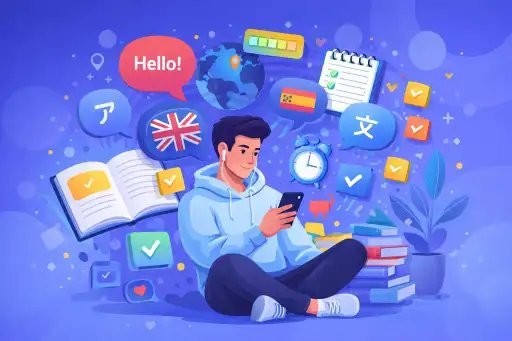
Can an AI actually get you speaking a new language faster? Yes — but probably not in the way the app ads suggest. AI is very good at giving you unlimited, patient conversation practice and instant feedback, and those two things used to be the expensive, hard-to-schedule parts of learning. What it cannot do is put in the hours for you. The speedup is real; the shortcut is not.
The short answer, honestly
Think of language learning as needing three things: hearing and reading a lot of the language, speaking and writing it yourself, and getting corrected when you get it wrong. Traditional self-study was strong on the first, weak on the second, and hopeless on the third unless you paid a tutor. AI flips that. It is a conversation partner that is awake at 6 a.m., never gets bored of your mistakes, and never makes you feel embarrassed for asking the same question eleven times. For most learners, that removes the single biggest bottleneck: not enough actual speaking.
Where AI genuinely speeds things up
Speaking practice on demand. Confidence in a language comes from having survived many small conversations, and an AI voice chat lets you have three a day instead of one a week. Fifteen minutes of real speaking beats an hour of tapping through multiple-choice exercises, because speaking forces your brain to build sentences instead of merely recognizing them.
Corrections in the moment. A good AI tutor will fix your sentence, explain why, and hand it back for you to say again. That loop — try, get corrected, retry — is how errors stop becoming habits.
Explanations pitched at your level. Grammar rules read very differently when someone explains them with examples drawn from your own sentences, at the speed you actually learn. Ask the AI to explain like you are a beginner, or to compare a structure with your own language, and it will.
Vocabulary in context. Words stick when you meet them inside situations you care about. Tell the AI you are traveling to Mexico City, or preparing for a job interview in German, and it can drill the exact phrases your real life is about to need. Services built for language learning describe similar approaches — the Duolingo blog’s posts on how people learn languages are a useful read on why practice design matters more than study marathons.
Where AI slows you down if you let it
The translation crutch. If every hard moment ends with you asking for the English version, you are training yourself to translate, not to speak. Struggling for ten seconds to find a word is not failure; it is the exact rep your memory needs.
Over-polite correction. Some chatbots are so encouraging that everything you say is “great!” — including sentences that are wrong. Set the terms yourself: ask it to correct every error, to be strict, and to make you repeat the fixed version.
Confidently wrong lessons. AI occasionally explains a grammar rule that sounds convincing and is not quite true, especially in languages with less training material behind them. For widely taught languages like Spanish, French, and German the risk is small; for smaller languages, treat explanations as a helpful first draft and check anything important against a textbook or teacher.
All input, no output. Watching the AI produce perfect sentences teaches you to recognize the language, the way watching cooking shows teaches you to recognize food. At some point you have to talk.
Make the AI behave like a tutor, not a translator
The difference between a frustrating session and a useful one is usually the instructions you give at the start. General chatbots default to being helpful in the laziest way: you write a broken sentence, they reply with a perfect translation and move on. That feels smooth and teaches little. You have to set the ground rules explicitly.
Start sessions with something like: “You are my Spanish tutor. Speak to me only in Spanish unless I type HELP. Correct every mistake I make, show me the corrected sentence, and make me say it again before we continue. Keep your sentences at my level — short and common words.” That one paragraph changes everything. The AI stays in the language, the corrections become systematic instead of random, and you are forced to produce the fixed version yourself, which is where the learning actually happens.
Two more settings worth asking for: ask it to track your repeated mistakes and quiz you on them at the end of the week, and ask it to introduce just a handful of new words per session, inside sentences about your own life. Five words attached to your real routines — your commute, your dog, your job — will survive in memory long after a fifty-word list has evaporated.
Do not neglect listening and pronunciation
Speaking practice gets the attention, but two quieter skills decide whether real people can understand you. The first is listening: real speech is fast, mumbled, and full of shortcuts that tidy AI voices do not use. Balance your chatbot sessions with real audio — series, podcasts, and videos in the language, with subtitles in that language rather than your own — so your ear learns the messy version too.
The second is pronunciation. Many AI tools can now score how you say a word and flag the exact sound that went wrong, which is genuinely useful for the handful of sounds your native language does not have. Spend a few minutes a week on those sounds alone. Being understood is mostly a matter of a dozen difficult sounds, not a thousand vocabulary words — and it is the part of “learning faster” that learners most often skip because word lists feel more productive.
A daily routine that actually uses the speedup
Keep it small enough to survive busy days. Fifteen to twenty minutes: five minutes reviewing words the AI has saved from your past mistakes, ten minutes of voice conversation on one everyday topic (ordering food, describing your weekend, directions, your job), then finish by asking the AI for the three worst mistakes you made and saying each corrected sentence out loud twice. Once a week, make one session harder on purpose — a phone call role-play, a complaint at a hotel desk, a story about your childhood. The students who use study tools this way tend to be the same ones who get value from the best AI apps for students studying for exams: short, active sessions aimed at a real test, which in this case is a real conversation.
Questions people ask
Can AI replace a human teacher completely? For casual and travel goals, mostly — you can reach solid conversational level with AI plus media in the language. For exams, professional fluency, or stubborn pronunciation problems, a human ear still catches things software waves through, and a teacher who knows you will push you in ways a polite chatbot will not.
Which languages does AI teach best? The ones with the most material behind them: Spanish, French, German, Italian, Portuguese, and English are strong. Support gets thinner for smaller languages, where the AI may mix dialects or invent forms. The more widely spoken your target language, the more trustworthy your tutor.
How long until I can hold a conversation? With daily speaking practice, most people can handle simple, slow conversations — introductions, directions, ordering, small talk — within a few months. That is noticeably faster than the old textbook-only route for the same hours, mainly because so much more of your time is spent actually speaking.
Is it cheating to practice with AI before a trip or test? Practicing is the opposite of cheating; it is studying with a very patient partner. It only becomes a problem if the AI does the assessed work itself — writing your exam essay or your homework — which is a different question entirely.
What should my first week look like? Keep it deliberately small. Day one, set the tutor rules and learn greetings and introductions until you can do them without reading. Days two and three, talk about your daily routine and your family — the topics every real conversation starts with. Days four and five, practice survival situations: directions, food, prices, and problems. By the weekend, have one ten-minute conversation with no English safety net at all. You will make a glorious mess of it, and that mess — survived, corrected, and retried — is worth more than a perfect week of flashcards.
The bottom line
AI speeds up language learning the way a good training partner speeds up fitness: more reps, better feedback, no scheduling excuses. It will not learn the language for you, and it will occasionally teach you something slightly wrong with total confidence. Speak with it daily, make it correct you strictly, and spend your saved tutor money on a few human conversations to keep yourself honest — a real waiter, tour guide, or colleague will not slow down, enunciate, and wait patiently the way your chatbot does, and that gap between practice conditions and real ones is the last thing to close. That combination — machine for volume, humans for reality — is genuinely faster than either one alone.



2 Comments