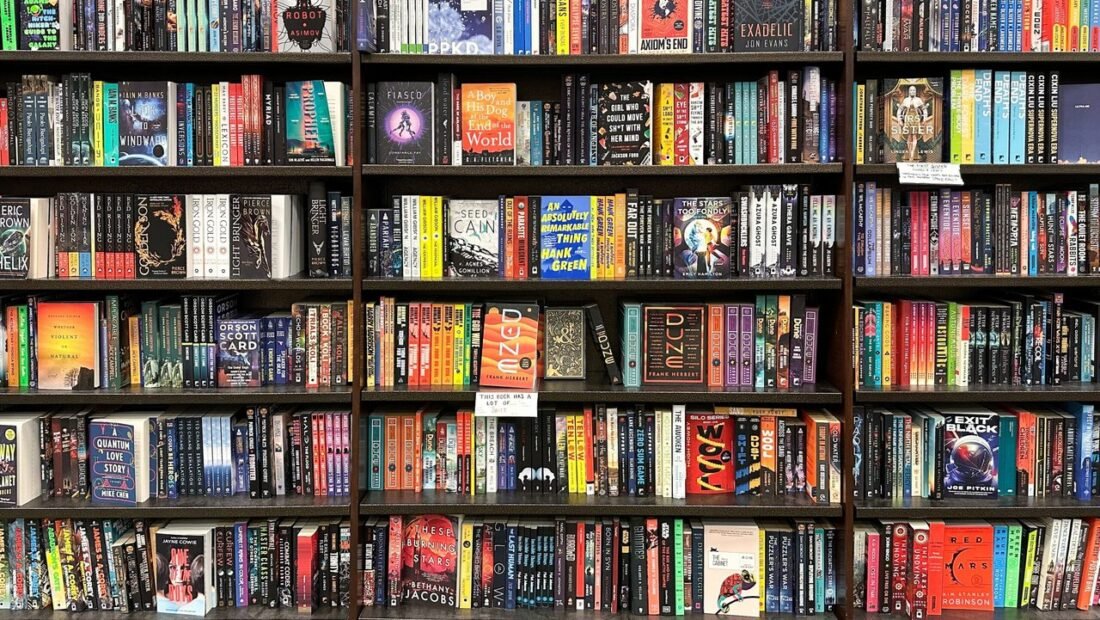
Science fiction is the literature of the ‘what if’ — the genre that asks the biggest questions in the most entertaining packages. What if we could travel between stars? What if machines could think? What if society collapsed, or transcended, or turned out to be a simulation? Every great SF novel is a thought experiment you can’t put down.
But the genre spans a century and ten thousand novels, and ‘where do I start?’ is the most common question in science fiction. The best science fiction books of all time aren’t just the famous ones — they’re the entry points that convert readers into lifelong fans. Here are fifteen, spanning the genre’s full range, with a reading order that actually works.
The Foundations: Best Science Fiction Books of All Time to Read First
Start with Dune — yes, it’s long, and yes, it’s worth it. Frank Herbert’s desert-planet epic is really about ecology, politics, religion, and power, dressed as an adventure. It’s the best-selling SF novel ever for a reason, and the recent films have made it newly accessible. Read it before the discourse; experience it fresh.
Then Ender’s Game: a military school in space that’s really about empathy, manipulation, and the cost of genius. It’s short, propulsive, and the rare classic that young readers and adults love equally. Follow with The Hitchhiker’s Guide to the Galaxy — the funniest book on this list and the perfect palate cleanser, proving SF can be pure comedy. These three give you epic, human, and hilarious: the genre’s three primary colors.
The Modern Masterpieces
The contemporary canon starts with The Martian — survival problem-solving as page-turner, funnier than it has any right to be, and scientifically rigorous enough to teach you orbital mechanics by accident. Then the Three-Body Problem trilogy: Chinese SF’s global breakthrough, starting as a first-contact mystery and expanding into the most mind-bending cosmology in modern fiction. It’s demanding and utterly worth it — the ‘dark forest’ concept alone will rearrange your thinking.
Don’t miss the Le Guin essential: The Left Hand of Darkness (a journey across an ice world that revolutionized how SF handles gender) or The Dispossessed (anarchism vs. capitalism as competing planets — political SF at its finest). For something recent and beloved, Project Hail Mary (same author as The Martian) is pure joy — a lone astronaut, an impossible problem, and the best alien friendship in fiction. And A Memory Called Empire or the Murderbot Diaries offer the modern space-opera and AI-character flavors respectively — both award-winners, both compulsively readable.
Reference: Tor.com’s SF coverage and recommendations.
Reference: Locus Magazine’s SF resources.
15 Essential Science Fiction Novels
The canon, in a sensible reading order:
- Dune (Herbert) — the epic foundation. Ecology, politics, and prophecy on a desert world.
- Ender’s Game (Card) — short, propulsive, devastating. The perfect second book.
- The Hitchhiker’s Guide to the Galaxy (Adams) — the funniest book in the genre.
- The Left Hand of Darkness (Le Guin) — revolutionary, profound, beautifully written.
- Neuromancer (Gibson) — invented cyberspace; the cyberpunk big bang.
- Snow Crash (Stephenson) — cyberpunk’s wild, hilarious, maximalist peak.
- The Martian (Weir) — survival science as pure entertainment.
- The Three-Body Problem trilogy (Liu) — the most mind-bending modern epic.
- Project Hail Mary (Weir) — joy, science, and the best alien friendship ever.
- The Dispossessed (Le Guin) — political SF at its philosophical finest.
- Kindred (Butler) — time travel as unflinching historical reckoning. Essential.
- The Murderbot Diaries (Wells) — a anxious android’s wry adventures. Pure delight.
Finding Your Corner of the Genre
SF is really a dozen genres sharing a shelf. Love the ideas? Try ‘hard SF’ (Weir, Stephenson, Kim Stanley Robinson’s Mars trilogy). Love the characters? Space opera with heart (Becky Chambers’ Wayfarers series is pure warmth). Love the darkness? Dystopias (Atwood, Butler’s Parable series) and cyberpunk. Love the weird? New Weird (China Miéville) and slipstream. The fifteen above are the front door; your corner is whichever shelf you keep returning to.
Read actively: SF rewards the curious. Look up the science, argue with the philosophy, track the influences — the genre is a century-long conversation, and every classic is replying to an earlier one. Join it: r/printSF is the best online community, local SF book clubs are welcoming, and used bookstores’ SF sections are treasure hunts. The best science fiction books of all time aren’t a finish line; they’re an invitation. Fifteen books in, you’ll have opinions, favorites, and a to-read pile that never shrinks. That’s not a problem. That’s the genre working as intended.
Frequently Asked Questions
Is Dune too hard to get into?
It’s long and dense at the start — the first 100 pages throw a lot of terminology at you — but it clicks, and then it’s unputdownable. Push through the opening; Herbert rewards patience enormously. If you’re nervous, watch the recent films first: they’re faithful enough to give you the world, and the book then becomes a deeper dive rather than a cold start.
What’s the difference between hard SF and space opera?
Hard SF foregrounds scientific plausibility (The Martian, Three-Body Problem) — the science is the point. Space opera foregrounds adventure and character on a cosmic scale (Dune, the Wayfarers series) — the science is the setting. Neither is better; they’re different pleasures. New readers often start with space opera’s momentum and graduate to hard SF’s rigor — or vice versa.
Are the classics outdated now?
Some ideas age; the best books don’t. The science in 1960s SF is dated, but Le Guin’s insights about gender and power, Butler’s about survival and change, and Herbert’s about ecology are more relevant now than when written. Read classics for the ideas and the craft, not the predictions — the ones on this list earned their status and keep it.
More from Daily USA Post
- Also see: what are the best animated movies for adults
- Our complete guide: what are fun things to do at home on a Friday night
- what are the best cooking shows to watch for inspiration — what you need to know
The best science fiction books of all time — Dune, Ender’s Game, Hitchhiker’s Guide, Le Guin, The Martian, Three-Body Problem — offer entry points into every corner of the genre, from epic to hilarious to mind-bending. Start with the foundations, follow your curiosity into a subgenre, and read actively. Fifteen books is the beginning, not the list — SF is a conversation, and now you’re in it.