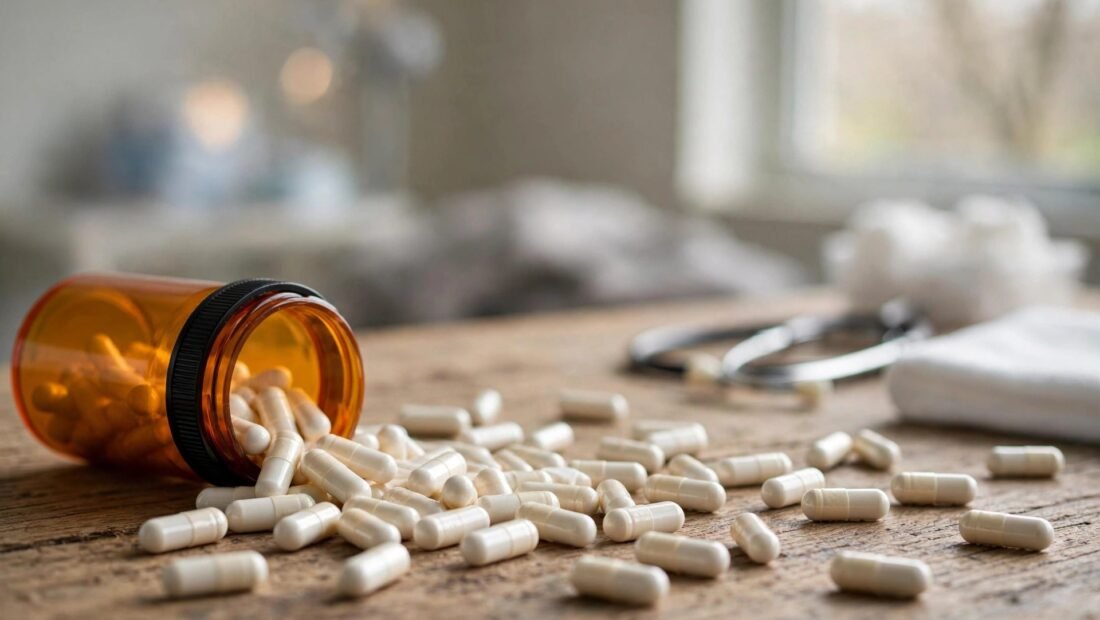
A person in pain swallows a small white pill. There is no drug inside it. It is just sugar, pressed into the shape of medicine. Minutes later the pain eases. Not a little pretend easing. Real relief you could point to. The pill did nothing on its own, so what did?
That question sits at the center of the placebo effect, and it is stranger than it first sounds. The body can change how it feels because of a belief, a ritual, and a moment of care. No chemical from outside the body is needed for that change to happen. At the same time, the effect has hard limits. Getting those limits right matters, because mixing them up leads to two bad mistakes: calling real relief fake, or calling a sugar pill a cure.
What Counts as a Placebo Effect, and What Does Not
A placebo is a treatment with no active drug in it. A sugar pill is the classic example. A saline injection, a sham procedure, or an inactive cream can play the same role. The placebo effect is the improvement that comes from the context around the treatment rather than from a drug action. The white coat, the careful voice, the capsule in your palm, the story that help is on the way — all of that is context.
Researchers also talk about a placebo response, which is a wider idea. If a group of people taking placebos gets better over a few weeks, some of that improvement would have happened anyway. Bodies heal on their own. Symptoms rise and fall. People often join a study when they feel worst, so the next move is often upward even with no treatment at all. Those natural swings are part of a placebo response, but they are not the placebo effect itself. The effect is the extra change that belief and context add on top.
The sharpest line is about what the effect can reach. It does not shrink tumors. It does not kill bacteria or clear a virus. It does not set a broken bone or reverse organ damage. What it does move, and move well, are symptoms the brain itself helps create and regulate. Pain is at the top of that list. Nausea, fatigue, anxiety, low mood, and the stiffness and tremor linked to Parkinson’s disease also respond. Irritable bowel symptoms respond too. Look at that list and a pattern jumps out. The closer a symptom is to brain processing, the more room there is for expectation to turn the dial up or down.
Expectation: The Brain Filling Its Own Prescription
The strongest driver is expectation. When you expect relief, the brain does not sit and wait for a drug to arrive. It starts making its own. For pain, that means releasing natural opioids, the same family of chemicals that morphine mimics. Studies have shown that if you give a person a drug that blocks opioid receptors after a placebo, much of the relief fades. The belief had quietly turned on an internal pharmacy, and blocking the pharmacy blocked the result.
Dopamine tells a similar story in Parkinson’s disease. That condition involves too little dopamine in parts of the brain that control movement. When patients in studies expected a treatment to help their movement, scans showed dopamine release rising in those same areas. Their movement improved along with it, even though the treatment itself held no active drug. Expectation did not regrow lost brain cells. Nothing about the disease itself changed in that moment. But the brain, primed to move better, squeezed out more of the very chemical it was short on, and for a while the body moved better for it.
For a Texas reader thinking about why some people get sick more often than others, this is one piece of a larger puzzle. Stress, sleep, and how supported a person feels all feed into how symptoms are felt and reported. Expectation is one more thread in that same cloth, not a replacement for the rest.
Conditioning: Relief the Body Learned by Heart
The second driver is older and simpler. It is conditioning, the same kind of learning Ivan Pavlov described with dogs that learned to salivate at a bell. The human body learns links the same way. If a certain pill shape, a certain clinic smell, or a certain routine has come right before real relief many times in the past, the body starts to react to the routine itself.
Research has shown this goes beyond pain. In studies where a flavored drink was paired for a few days with a drug that suppressed the immune system, the drink alone later produced a mild version of that suppression. The body had learned the pairing so well that the cue alone could nudge immune activity. That finding surprises people, and it should. It shows conditioning is not just in the mind in some vague sense. It lives in reflex pathways the body can run on cue.
Conditioning helps explain why some treatment rituals work better than others. An injection tends to produce a stronger placebo response than a pill, because an injection feels like a bigger, more serious intervention. Two pills often beat one. A well-known brand often beats a plain generic in head-to-head placebo tests, even when both are inert, because the brand carries a stronger history of trust. Larger capsules, bitter tastes, and elaborate procedures can all raise the effect. None of that makes the treatment more real in a chemical sense. It makes the ritual more convincing to a brain that learns from ritual.
The Room, the Voice, and Being Listened To
The third driver is the human relationship at the center of care. Being listened to, taken seriously, and given time changes outcomes in a way that can be measured. In trials where patients got the same inert treatment, those paired with a warm, attentive clinician who listened without rushing tended to improve more than those paired with a brief, neutral clinician. The pill was the same. The minutes and the attention were not.
None of this means kindness replaces medicine. A warm clinician with no effective treatment for a serious infection is still missing the treatment that matters. What it does mean is that the human part of care is not decoration on top of the real work. For symptoms the brain regulates, the human part is part of the work. Readers who want plain background reading can start with MedlinePlus’s medical encyclopedia resources on the mind, pain and treatment effects and then bring specific questions back to their own clinician.
Two Puzzles That Keep Researchers Honest
The first puzzle is growth. Placebo responses in drug trials, especially trials run in the United States for pain, depression, and similar conditions, have grown stronger over recent decades. That creates a real problem. A new drug has to beat the placebo group to prove it works. If the placebo group keeps improving more and more, even a useful drug can fail to stand out. Why is this happening? No single answer has won. Trials have gotten larger, longer, and more elaborate, with more visits and more attention, which strengthens context effects. Drug ads that urge people to ask their doctor may also raise expectations before a trial even starts. A general cultural faith that new medicine must be powerful could play a role as well. The honest position is that several causes likely stack together.
The second puzzle is even odder. Placebos can help even when the person knows the pill is inert. These are called open-label placebos. In studies of irritable bowel symptoms, chronic back pain, and fatigue, people were told plainly that their capsules held no drug, and that placebos can still help through mind and body pathways. Many still improved more than people who got no treatment. That result breaks the simple idea that a placebo needs a trick to work. Ritual, habit, and the act of taking care of yourself on a schedule seem to carry weight even without deception. The research is promising, but it is still early, and the studies tend to be small. It points to a future where some of these mechanisms might be used openly, alongside real treatment, rather than hidden inside a blinded trial.
The Nocebo Twin: When Expectation Hurts
Expectation cuts both ways. The nocebo effect is the harmful twin of the placebo effect. Expect side effects, and you are more likely to feel them, even on an inert pill. In trial after trial, people in placebo groups report headaches, nausea, dizziness, and fatigue at rates that track the warnings they were given about the real drug. The warning list plants a set of signals to watch for, and a watchful brain finds them in the normal noise of a body.
This creates a hard balance for honest care. People have a right to know the risks of a treatment. Hiding risks is not ethical, and it is not safe either. At the same time, the way risks are framed changes how often they are felt. Saying that most people handle a drug well and a small share notice a headache is the same fact as leading with a long list of dread. The facts match. The felt outcome often does not. Good clinicians learn to be complete and calm at once, giving numbers, context, and a plan for what to do if a side effect shows up.
What to Do With All of This in Real Life
Start with the clear rule. Never swap real treatment for belief when a real treatment exists and the condition is serious. Infections need antibiotics when a clinician says they do. Cancer needs cancer treatment. Diabetes, heart disease, and severe depression need direct care. A placebo cannot do that work, and anyone who sells belief as a substitute for it is putting people at risk. That line should stay bright.
Inside that rule, there is still useful room to act. Approach treatment you and your clinician have chosen with steady, realistic hope. Hope is not a drug, but it does change the brain systems that shape pain and nausea, and it costs nothing to bring it along. Keep the routine steady too. Taking a prescribed medicine at the same time, in the same calm way each day, builds the kind of helpful conditioning that supports the drug rather than fighting it.
The sugar pill that works is not magic, and it is not a trick. It is evidence that the brain is an active part of every treatment, making its own chemicals and learning from ritual. Good medicine does not choose between the drug and that brain. It uses both, honestly, each in its proper place.