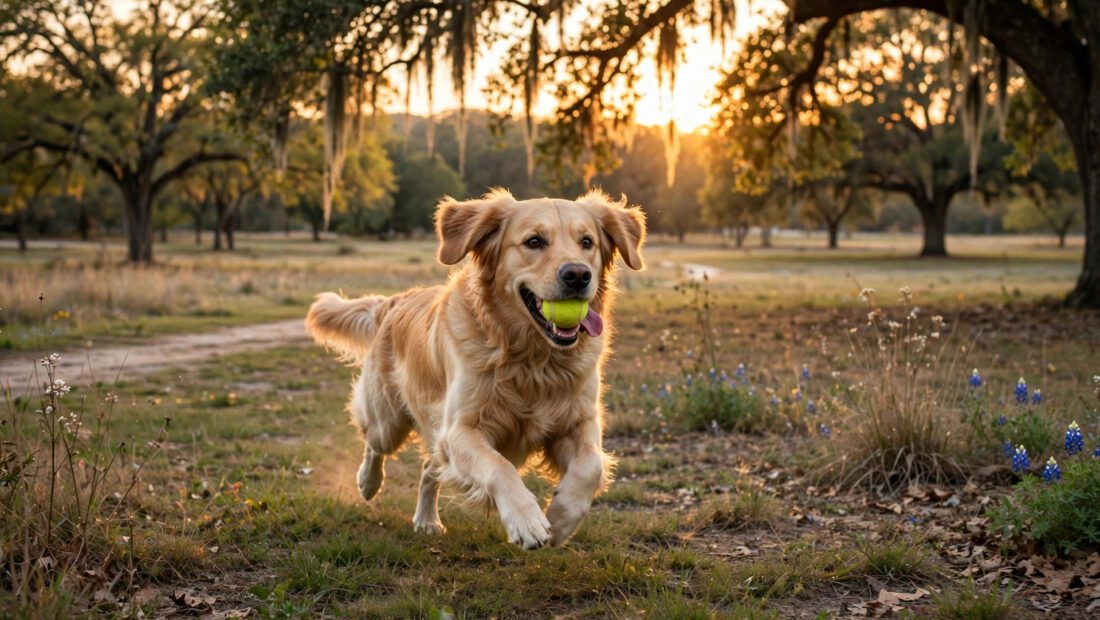
Golden retrievers were built to work in cold water. The breed comes from the Scottish Highlands, where a gundog was expected to swim out through icy lochs, retrieve birds, and do it again all day in weather that sends most animals looking for shelter. Keep that picture in mind, because it explains both halves of the exercise question in Texas. A golden has a working dog’s engine and a working dog’s need to use it. The same dog is also wearing a dense double coat through a Houston August. “One to two hours a day” is the answer most owners hear, and it is roughly right, but it is the start of the answer rather than the whole of it. What those hours are made of, how they change across the dog’s life, and when in the Texas day they happen matter just as much as the total.
The adult baseline, and the split owners miss
A healthy adult golden retriever needs roughly one to two hours of activity a day. The part owners miss is the split inside that total. About 45 to 75 minutes of it should be physical exercise: walking, retrieving, swimming, playing. The remaining 20 to 30 minutes should be mental work: training, searching games, problem-solving around food. A dog that gets two hours of walking and no mental work often comes home physically tired and mentally still wound up, which is why some owners exercise their golden faithfully and still live with a restless dog in the evening. The two kinds of effort tire different systems, and a settled dog needs both. Resources such as the American Kennel Club’s guidance on exercising your dog make the same distinction between physical activity and mental stimulation as separate needs.
Exercise by life stage, because the number moves
Puppies. Young goldens run on the five-minutes-per-month-of-age rule, applied twice a day. A four-month-old puppy gets about twenty minutes of structured exercise at a time. Free play in the yard, where the puppy can stop, flop, and restart on its own terms, can run longer because it is self-regulated. What puppies should not get is forced exercise: long runs, extended leashed marches, or repetitive stair work. Their growth plates are still open and their joints are still forming, and damage done by over-exercise at this age tends to show up years later as joint trouble that cannot be undone. Short, frequent, and playful beats long and earnest at this stage.
Adolescents, six to eighteen months. This is the stage that needs the most, and the stage owners find hardest. A teenage golden is near full size, full of energy, and still mentally a puppy. This is also peak destruction age: the chewed skirting board, the excavated yard, the shredded cushion. Owners often read that behavior as spite or bad character. In a golden of this age, it is almost always an exercise deficit wearing a behavior costume. Adolescents need the top end of the adult range, with extra mental work layered in, because tiring the brain is the fastest legal way to calm a teenage retriever.
Adults. From about eighteen months to seven or eight years, the one-to-two-hour baseline with its physical and mental split applies in full. This is the dog the breed’s reputation is built on: eager, durable, and happiest with a job, whether the job is retrieving, hiking, swimming, or learning something new.
Seniors. Older goldens slow down, and their totals drop, but the daily movement matters more, not less. A senior that stops moving stiffens quickly, loses muscle, and gains weight, and each of those makes the next day’s movement harder. The senior version of exercise is gentle and daily: shorter walks, easy swims, soft ground where possible, and mental games that keep an old dog engaged without asking its joints to pay for it. Watch recovery rather than the clock; a senior that is sore the next morning did too much, whatever the stopwatch said.
Texas heat is the central design problem
For a Texas golden, heat is not a seasonal footnote. It is the constraint the whole exercise plan is built around. A breed developed for cold Scottish water, wearing a double coat, exercising through a Texas summer is working against its own equipment. The practical responses are simple and non-negotiable. Exercise moves to dawn and dusk for the hot months, with midday limited to toilet trips in shade. Pavement gets the five-second hand test: hold the back of your hand on the surface for five seconds, and if it is too hot for your hand, it is too hot for paws. Water and shade get planned like equipment, carried or confirmed before the walk, not hoped for during it.
Heatstroke signs are worth knowing by heart: heavy, frantic panting, thick drooling, bright red gums, wobbliness, vomiting, and a dog that seems disoriented or unusually dull. A dog showing those signs needs cooling and a vet, urgently. The larger point is prevention through scheduling. Most Texas goldens do beautifully in summer on a dawn-and-dusk routine. The ones that get into trouble are usually the ones whose owners kept a winter schedule into August.
Swimming: the exercise this breed was built for
If one activity fits the Texas golden perfectly, it is swimming. It is the work the breed was literally developed to do, it burns serious energy, it is gentle on joints because the water carries the weight, and it cools the dog while it exercises, which solves the summer problem in a way no walk can. A twenty-minute swim can leave a golden more genuinely tired than an hour of leash walking. Two cautions belong with the enthusiasm. Dry the ears afterward, because goldens’ floppy ears trap moisture and ear infections are a familiar sequel to regular swimming. And be careful with warm lakes in high summer: harmful algae blooms occur in Texas waters, and a dog should never swim in water that looks scummy, smells foul, or is posted with a warning. A clean pool, a clear lake on a good day, or a supervised river spot is a gift to this breed. A questionable pond is not worth the risk.
The signs of too little
An under-exercised golden rarely presents as an exercise problem. The signs arrive disguised as behavior and body issues. Destruction leads the list: chewing, digging, and demolishing household items. Night-time hyperactivity follows, the dog that sleeps all day and comes alive at ten in the evening. Barking at small provocations, restlessness, and pestering that no amount of attention settles all belong on the list. So does weight gain. Goldens are famously food-motivated, and in that they are typical of American dogs generally: pet-obesity surveys regularly find around half of American dogs overweight. In a large breed with vulnerable hips and elbows, extra weight is not a cosmetic issue. It is load on joints that were never the breed’s strongest feature. Before paying for behavior help, it is worth auditing the exercise honestly for two weeks, including whether the mental half of the split is actually happening. Basic leash skills matter here too, since a dog that pulls makes walks shorter and rarer; how to teach your dog to walk on a leash without pulling covers the fix.
The shape of a good week
Variety is what keeps this sustainable into year three, for the dog and the owner. A good golden week mixes several kinds of day. Retrieve work with rules taxes brain and body together: a dog that must wait, watch, and go on command, or take a directional cast toward a thrown dummy, is thinking hard while it runs. A long, sniffy hike day lets the dog move at its own pace and read the world through its nose, which is deeply satisfying work for a dog even at walking speed. Swim days carry the summer. Training days build skills in short sessions. Genuine rest days belong in the week too, because muscles and joints recover on them and an adult dog pushed hard every single day is being worn down, not built up. The week that rotates these elements is easier to keep than seven identical walks, and a plan the owner enjoys is the only plan that survives February.
Mental exercise: the half owners skip
Ten to fifteen minutes of training a day does more for a golden’s evening behavior than most owners expect. Short sessions teaching a new cue, polishing an old one, or shaping a small trick engage the dog completely. Puzzle feeders and snuffle mats turn meals from a ninety-second event into fifteen minutes of searching. Nose-work games in the yard, hiding treats or a favorite toy in progressively harder spots, use the sense the dog trusts most. The observation trainers repeat, and owners keep rediscovering, is that a golden that has thought hard for fifteen minutes is often calmer than one that walked an hour on autopilot. Mental work is also the perfect Texas summer tool: it can be done indoors, in air conditioning, at noon, when the physical half of the program is off the table entirely.
The long game: weight, joints, and years
The reason to hold this routine for a decade is written in the breed’s close family. The well-known lifetime feeding study in Labradors, the golden’s close retriever cousins, followed dogs for their whole lives and found that the lean dogs lived roughly two years longer than their heavier siblings. That finding comes from a Labrador study, not a golden one, and it should be quoted that way, but the physiology travels: joints, heart, and weight all respond to the same daily math in both breeds. Every year of sensible exercise and honest feeding is a deposit against mobility in old age. The synthesis, then: one to two hours a day, yes, but made of physical work, mental work, and social time together, scaled to the dog’s age, and scheduled around the Texas sun rather than in defiance of it.