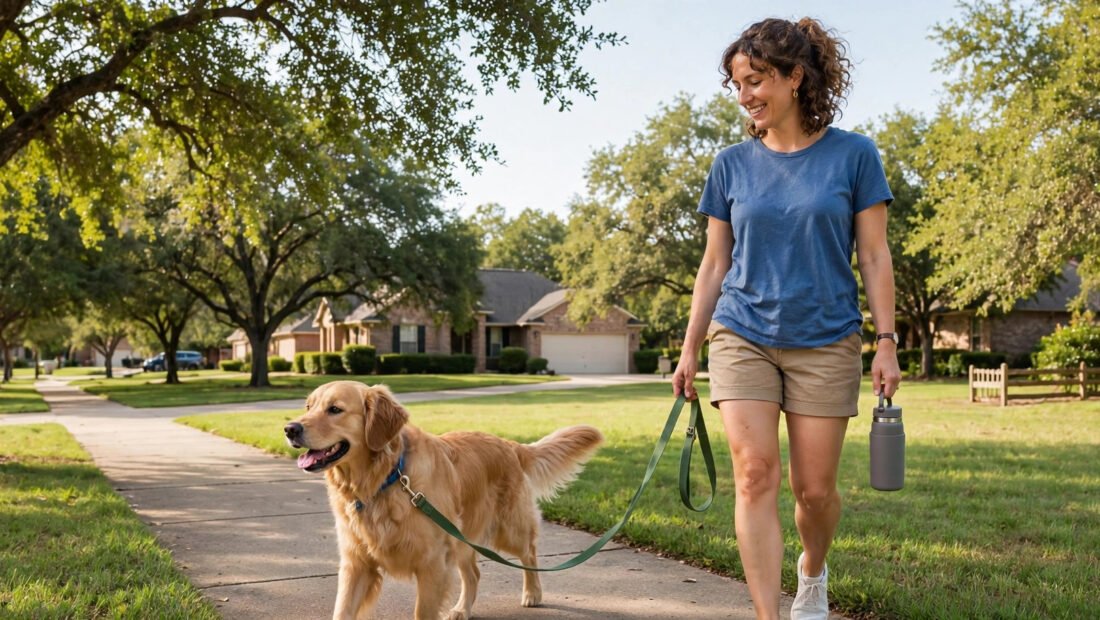
The walk is meant to belong to both of you, but right now it belongs to the dog. Your shoulders ache, the leash feels like a tow rope, and every squirrel turns into a launch. Pulling is not stubbornness and it is not a fight for control. Your dog moves faster than you, the world smells rich and new, and pulling has worked every time so far. Each lunge that got the dog to a smell a second sooner taught the same lesson: pull and the walk moves.
Loose-leash walking gets fixed by changing that lesson, in order, over time. Rush the order and the dog falls apart in busy places. Follow it week by week and the skill holds up where it counts.
Before Week One: Set Up Gear That Helps Learning
Start with a front-clip harness. When the leash clips at the chest, a surge turns the dog’s front a little to the side. Pulling stops paying off, without pain and without a fight. A back-clip harness does the opposite. It lets a strong dog lean in and haul, the way sled dogs are rigged to pull.
Use a plain 6-foot leash. Skip retractable leashes for training. They hold steady tension and stretch when the dog pulls, so the dog learns that pulling earns more room. That is the exact habit you are trying to undo. They are also hard to control near traffic and other dogs.
Treats matter more than most owners expect. Bring small, soft, strong-smelling pieces, such as cheese or bits of hot dog, or soft training treats. Dry kibble rarely wins against a squirrel or another dog across the street. You need a reward the dog can eat fast and still care about when the world is loud.
Leave choke chains and prong collars out of the plan. They can stop a dog in the moment through discomfort, but they teach nothing about where you want the dog to walk. They can also link the sight of other dogs with pain, which makes leash barking worse. If you share pet care tasks at home, the same calm approach helps with jobs like how to trim a cat’s nails without getting scratched: slow steps, good timing, and no force.
Week One: The Boring Street and the Be-a-Tree Rule
Pick the dullest place you can find. Your yard, a quiet side street, or an empty stretch with few dogs and few smells. Do not start at the park, near a school at pickup time, or on your normal full walk. Week one is for learning the rule, not for getting exercise.
Keep sessions to 5 to 10 minutes a day. Start at the door. Ask for a short sit and a look at you before you step out. A dog who bursts out at full speed starts the walk too wound up to think. Thirty calm seconds at the door pays off for the whole session.
The Core Move, Repeated Hundreds of Times
Walk forward at your normal pace. The moment the leash goes tight, stop. Plant your feet and be a tree. Do not jerk the leash, do not scold, and do not step forward to ease the pull. Just stop and wait.
Sooner or later the dog looks back, takes a step toward you, or shifts weight so the leash goes slack. Mark that instant with a clear “yes” and give a treat at your side, near your leg. Then walk on. Tight leash means the walk stops and life gets dull. Slack leash means treats and forward movement, which is what the dog wanted all along.
Expect to cover very little ground. Advancing 50 feet in 10 minutes in the first sessions is normal. It feels silly. It is also the point. Each stop is a clear lesson, and dogs learn this trade fast once the rule never changes. By the end of the first week, with daily practice, most dogs show a clear change on that boring street. They check in more, surge less, and recover faster after a stop.
Weeks Two to Four: Add Distance, Turns, and Mild Distractions
Once the quiet street looks steady on most days, lengthen the route a little. Add one new thing at a time. A slightly busier block. A turn past a yard with a dog behind a fence, seen from far off. A short stretch near parked cars. If the dog falls apart, you added too much at once. Go back to the last level that worked for a few days.
Games That Hold the Dog Near You
Add the 1-2-3 game. As you walk, count out loud, “one, two, three,” and on three, deliver a treat at your side. Dogs learn the pattern fast and start staying close to be ready for three. After the pattern sticks, mix up the count so the dog has to keep watching you rather than guessing.
Use penalty yards for surges. When the dog lunges ahead, turn calmly and walk backward, or walk back 5 to 10 steps, then start forward again. Pulling now loses ground instead of gaining it. That logic lands hard for dogs who want nothing more than to move ahead.
Turn often, and not always for a reason. Change direction when the dog forges ahead and stops paying attention. Reward every check-in, a glance back, an ear flick toward you, a step that matches yours. Also build in sniff breaks on purpose. Stop at a patch of grass, say a cue such as “go sniff,” toss a treat in the grass, and let the dog search. Sniffing lowers stress and meets a real need. A dog who gets planned sniff breaks has less reason to steal them by pulling.
In Texas heat, keep these sessions short. Ten to fifteen minutes of training in summer is plenty, done early in the morning or in the evening. Add indoor play, a flirt pole, or a puzzle feeder at home for the rest of the exercise. A hot, panting dog cannot learn well, and hot pavement can burn paws. If you cannot hold your hand flat on the sidewalk for five seconds, it is too hot for a training walk.
Months Two to Three: Building Real-World Reliability
By the second month, shift the goal from short drills to normal life. Walk real routes, at real times, past real triggers, but keep the same rules. Tree stops still happen. Rewards still happen, though you can space them out. Pay for good stretches, hard passes, and calm recoveries, rather than every few steps.
This is the stage where distance work matters most for hard triggers. If other dogs set your dog off, practice where your dog can see a dog far away and still look back at you and take a treat. Work at that distance for days. Close the gap slowly over weeks, not in one brave walk. If your dog cannot eat, cannot look away, and pulls with full force, you are too close. That is not a manners problem in that moment. It is a dog over threshold, and more space is the fix.
Wildlife works the same way. Squirrels, rabbits, and loose cats in Texas neighborhoods are top-level tests. Do not judge week-one skills by a squirrel test. Build up to it through quieter streets, then busier ones, then park edges at calm hours. For general reward-based methods that match this approach, see the American Kennel Club’s dog training guidance, which stresses reward timing and gradual steps.
Start fading food with care. Many owners quit treats too fast and watch the walk unravel. Instead, pay at random. Treat after the third good stretch, then after the fifth, and mix in praise, sniff breaks, and forward motion itself as rewards. Forward motion is a strong reward for a dog who loves walks. Use it on purpose.
When Progress Stalls or Slides Back
The most common stall sounds like this: perfect in the yard, wild on the street. That almost always means the step up came too soon. Each new place resets part of the learning. Treat a new route like day one for the first few visits, with more stops and faster rewards, and the skill will transfer.
Another stall is a dog who walks well only when treats are in plain sight. That means the lure stage lasted too long. Keep treats hidden in a pocket or pouch. Reward after the good work, not as a bribe held out in front. The dog should learn that paying attention makes good things appear, not that a visible treat is the only reason to stay close.
Pulling only toward other dogs needs its own note. If the dog barks, lunges, and cannot settle even at a distance, that is leash reactivity, driven by strong feeling rather than poor manners. Keep working below threshold and get help from a certified trainer with reward-based credentials if it does not improve. A few skilled sessions early can save months of frustration.
Slides backward are also normal in young dogs. Adolescent dogs, roughly 6 to 18 months old, often test rules they seemed to know. Go back to the boring street for a week, tighten up your timing, and do not take it as failure. The skill is still there. It needs a short refresher at an easier level.
Puppies can start as young as 8 weeks, with very short, fun sessions built around gentle leash pressure and lots of praise. Adult and older dogs learn just as well, and often settle faster because they are less frantic. Age is not the barrier. Skipped steps are.
Give the timeline its full run. Two to four weeks of steady short sessions brings real change in calm places. Two to three months builds the walk you can trust near traffic, people, and other dogs. Start tomorrow morning on the dullest street near your house, ten minutes, same rule every time. The boring start is what makes the good walks later possible.