A grinding noise is a car finishing a sentence it started months ago. Long before metal screams against metal, most failing parts whisper first: a click on turns, a hum at highway speed, a squeal on the first stop of the morning. Grinding means that quiet stage is over. The useful question is not just what the noise is, but when it happens, because timing is the diagnosis. Braking, turning, accelerating, or all the time each point to a different part, a different level of urgency, and a very different bill.
What does grinding when you brake usually mean?
It usually means the brake pads have worn through. Pads are built to be used up. A layer of friction material presses against the rotor to slow the car, and that layer gets thinner with every stop. Once it is gone, the steel backing plate behind it drags directly across the rotor. That metal-on-metal contact is the harsh scraping heard at every stop, and it cuts grooves into the rotor while it makes the noise.
The money changes fast at this stage. Pads caught while some material remains are a routine job, commonly around $200 to $350 per axle at Texas shops. Keep driving on bare metal and the rotors, which might have lasted through another set of pads, are machined deeper with every mile. The same visit then becomes pads plus rotors, often $600 or more per axle. Braking distance also grows as the contact surface turns rough and uneven, so the cost of waiting is paid in safety as well as parts.
What does grinding when you turn point to?
Two parts lead the list, and they fail in different ways. Constant velocity joints, usually called CV joints, carry power to the front wheels while the wheels steer. Each joint sits inside a rubber boot filled with grease. Heat, age, and road debris crack the boot, grease escapes, grit gets in, and the joint wears from the inside. The early sound is a clicking or popping on sharp, slow turns, such as parking maneuvers. Left alone, clicking deepens into grinding, and a joint that fails completely can leave the car with no drive power at all. A CV axle replacement typically runs about $300 to $600.
Wheel bearings fail on a different schedule. A healthy bearing lets the wheel spin quietly for years. A worn one starts with a hum or growl that rises with road speed rather than engine speed, and the sound often changes when the car swerves gently or turns, because the turn shifts weight onto or off the failing side. By the grinding stage the wear is advanced. A bad bearing can overheat, seize, or let the wheel wobble, and replacement generally costs about $300 to $600 per wheel. Readers curious about newer diagnostic shortcuts can compare that with whether AI can diagnose car problems from engine sounds, though a shop inspection still settles the question.
What does grinding when you accelerate suggest?
Noise tied to acceleration or gear changes moves the search to the transmission and drivetrain, and this is the expensive territory. In a manual car, grinding during shifts often means the clutch is worn or not fully releasing, so gears clash as they engage. In an automatic, grinding under load can point to internal wear, a failing torque converter, or low and degraded fluid that has stopped protecting the parts. At the rear of a rear-wheel-drive truck or SUV, a grinding or whining differential can make the same kind of sound.
Repairs in this group commonly land between $1,500 and $5,000, which is exactly why the smaller noises matter. A modest clutch hydraulic repair caught early can prevent a full clutch replacement later. A differential service that costs a few hundred dollars can head off a rebuild that costs thousands. Noting the details helps a shop start in the right place: which gear, whether the engine is hot or cold, whether the noise appears under load or while coasting, and whether it changes with speed.
What if the grinding never stops?
Constant grinding, present while braking, turning, cruising, and accelerating, narrows the list to serious causes. An advanced wheel bearing failure can growl without pause and get louder with speed. A stuck brake caliper can hold a pad against the rotor full time, grinding and pulling and overheating one wheel. A failing clutch can drag and grind across a wide range of driving. A power steering pump low on fluid can whine and grind through every turn of the wheel, sometimes with steering that suddenly feels heavy.
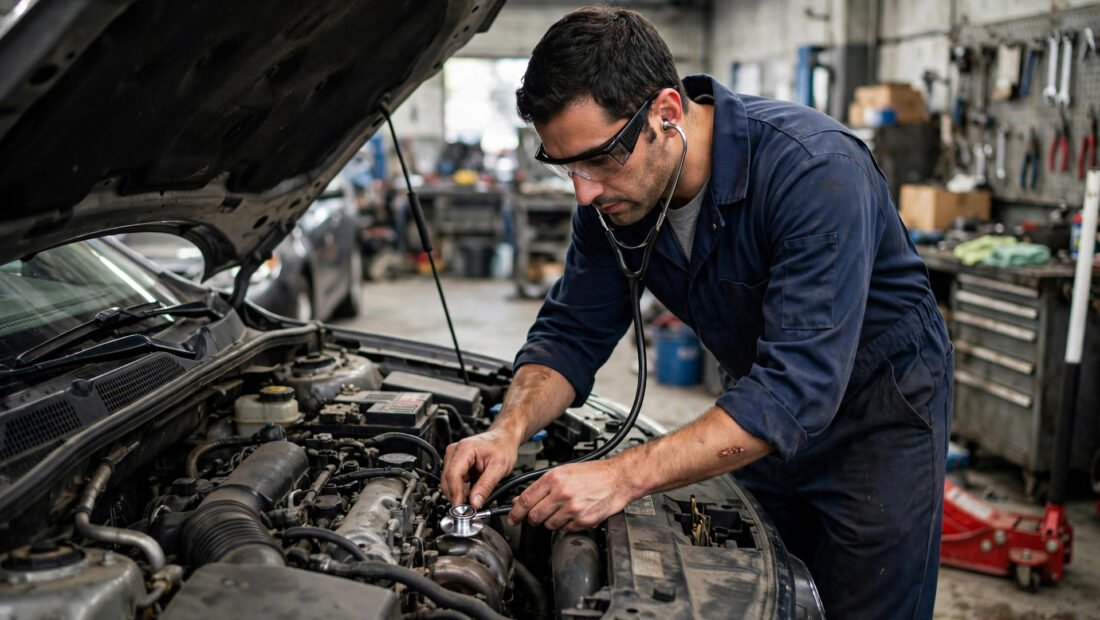
One cheap check belongs at the front of that list. Power steering fluid costs about $15, and a low reservoir can imitate failures that cost a hundred times more. Checking the fluid level, the belt, and any obvious leaks takes minutes and sometimes ends the scare on the spot. If the fluid is fine and the noise stays constant, the car needs a lift and a mechanic’s hands, not more guessing from the driver’s seat.
Is it safe to drive with a grinding noise?
With grinding brakes, the answer is no, beyond a slow, gentle trip straight to a shop. Stopping power is already reduced, the rotors are being destroyed, and pad material that is fully gone can damage the caliper next. Highway speeds, heavy loads, and long downhill braking all raise the risk. A car that grinds on braking should be parked or driven carefully to repair, not used for a week of errands while the sound gets worse.
Other grinding calls for judgment by symptom. A clicking CV joint on turns usually allows a short, calm drive to a shop, while a joint that grinds loudly or vibrates is closer to failure. A humming bearing that has turned to grinding, a wheel that feels loose, or any noise paired with a warning light, smoke, or a change in steering feel means the drive should end. When in doubt, a tow costs less than a wheel, a transmission, or a crash.
Why do Texas cars reach the grinding stage sooner?
Heat is the first accelerator. Summer temperatures cook rubber boots, dry out grease, thin fluids, and bake brake parts through long, hot stops. Dust is the second. Caliche and construction grit work into joints, bearings, and brake hardware, turning lubricant into an abrasive paste that wears parts from inside. The third factor is distance. Annual driving of 15,000 to 20,000 miles is common in Texas, so wear items reach the end of their life in fewer years than the same parts would last in a low-mileage state.
Long highway runs add their own pattern. Parts that are marginal can sound fine around town and only grind after twenty minutes at speed, once heat builds and clearances change. A noise that appears on the commute but not on a short test drive around the block is still real, and describing that pattern saves diagnostic time.
How much does fixing a grinding noise cost?
The spread is wide because grinding is a symptom, not a single part. At the low end sit pads at $200 to $350 per axle and the $15 bottle of power steering fluid that quiets a pump before it burns out. In the middle sit CV axles and wheel bearings, each commonly $300 to $600, and a clutch at $1,200 to $2,000 on a manual car. At the top sit transmission and differential work, where $1,500 to $5,000 is a realistic range depending on whether the fix is a service, a rebuild, or a replacement unit.
Two habits keep that bill honest. The first is asking what the worn part looks like and keeping the old parts after the job, which discourages vague diagnoses. The second is getting a second quote when a single repair passes roughly $1,500 and the car still drives safely enough to reach another shop. Grinding parts rarely improve with time, but a day spent comparing a fair quote against a padded one is different from a month spent hoping the noise goes away.
How can a driver record the noise so a mechanic can use it?
A short phone video is worth more than an impression of a sound repeated from memory. Record from inside the car with the radio and air conditioning off, and note the conditions out loud: speed, gear if known, whether the brakes were pressed, whether the wheel was turned, and whether the car was speeding up or slowing down. Thirty seconds that capture the noise starting and stopping under a clear condition can point a technician at the right corner of the car on the first test drive.
A written note helps just as much. When the noise began, what changed around that time, and whether it is getting louder week by week all shape the inspection. Price expectations can be checked against RepairPal’s fair-price estimates for brake, bearing and drivetrain repairs before approving work, so a quote for pads, a CV axle at $300 to $600, a bearing at $300 to $600, a clutch at $1,200 to $2,000, or transmission work at $1,500 to $5,000 can be judged against a fair range. The pattern to hold onto is simple: grinding is rarely sudden, even when it is suddenly noticed. The car usually asked quietly first. Answering at the click or the hum is how a $300 job stays a $300 job.