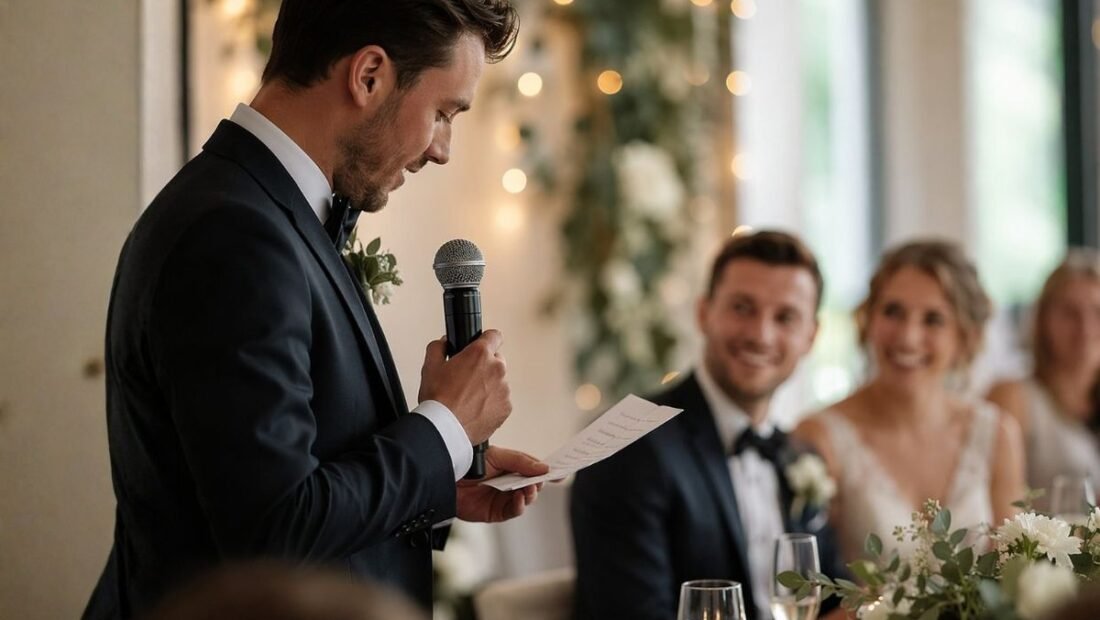
Picture the usual scene, because nearly everyone who has given a wedding speech has lived some version of it. The wedding is Saturday. It is Thursday night, you are the best man or the maid of honor, and the document in front of you contains your name, a blinking cursor, and nothing else — while somewhere in your phone sit ten years of friendship that refuse to become sentences. So you open an AI chatbot and type: “Write a heartfelt and funny best man speech.” What happens next is the whole answer to whether AI can write a wedding speech that sounds personal. It depends entirely on what you feed it.
Round one: the speech from nothing
Given no material, the AI does what it always does: it produces the average of every wedding speech it has ever absorbed. The result is smooth, warm, and eerily familiar. There is a joke about the groom’s luck. There is a line about how “when you know, you know.” There is a toast to “a lifetime of love and laughter.” It is, technically, a perfectly good speech — for a wedding between two people who do not exist.
Read it closely and the hollowness shows. It contains no event that ever happened. It compliments the couple in words that would fit any couple on Earth. It is heartfelt the way a greeting card is heartfelt: sincerely, generically, and about no one. Deliver it and the room will smile politely, and the couple will thank you, and nobody — including you — will remember a word by the anniversary. This is the version people mean when they say AI speeches feel soulless, and they are right. It is not a writing failure. The machine had nothing personal to work with, because the personal part was never given to it.
Round two: the same tool, given a life to work with
Now change the input. Instead of a command, give it the raw material only you possess: how the couple actually met — the delayed flight, the one working phone charger, the four-hour conversation that neither of them planned. The small, true details: that he keeps a photograph of her terrible first haircut in his wallet; that she taught him to cook exactly one dish and he has made it every birthday since; the specific Tuesday when you watched your friend, mid-story, and realized he talked about her differently. Ask the AI to build the speech around those, in an order that builds, at a length you specify, with your clumsy sentences left recognizably yours.
The output this time is a different species. The structure is the machine’s — an opening that lands, stories arranged so each tops the last, a short turn toward sincerity before the toast. But the content is unmistakably about two real people, because a person supplied it. Guests laugh at the charger story because it happened. The bride cries at the haircut detail because it is true and because only someone who knows them could have chosen it. The speech sounds personal for the only reason any speech ever does: it is made of a specific life.
The mechanics that make it work
A few practical rules separate the two rounds. Length: a wedding speech should run about three to five minutes spoken, which is roughly 400 to 650 words — shorter than your instincts say, and the AI will happily over-write unless you set the limit. Stories beat adjectives: for every claim (“she’s kind,” “he’s loyal”), demand of yourself one moment that proves it, and give that moment to the tool instead of the adjective. One laugh per movement is enough: AI stacked with jokes turns a toast into a roast, and roasts are for the rehearsal dinner. Edit toward your own mouth: replace any sentence you would never say with the way you would actually say it, even if it is clumsier — the room can hear the difference. And if you are new to standing up with a microphone at all, Toastmasters’ public speaking tips cover the delivery basics that no draft, human or machine, can do for you.
A before-and-after, so you can hear it
Compare two openings. The round-one version: “For those of you who don’t know me, I’m Jake, the best man. When Mark first told me about Sarah, I could just tell she was the one.” Nothing is wrong with it, which is exactly what is wrong with it — it could open four hundred speeches this weekend, and statistically, it will.
Now the same speaker, same wedding, after handing the machine his memories: “I’m Jake. Three years ago Mark called me from an airport floor, where he was sitting next to a phone charger he was sharing with a stranger, and said — and I wrote this down — ‘I think I just met the person I’m going to marry, and she has my charger.'” The room is awake before the second sentence ends. The story is short, specific, and checkable by the two people at the top table, which is why it lands. The AI contributed the placement and the clean frame. Every single thing that makes it good — the airport floor, the charger, the remembered sentence — came out of Jake’s life, because there was nowhere else it could have come from.
Should you tell anyone you used AI?
Nobody proposes a toast disclosure requirement, and a wedding speech is judged by whether it honors the couple, not by an originality audit. Still, the question has a useful answer: if the speech is your memories, your feelings, and your voice, with a tool helping you arrange them, there is nothing to confess — no more than there would be for using a thesaurus or asking a friend to proofread. What would sit badly, if it ever came out, is the round-one speech presented as your heartfelt words: not because a tool was involved, but because the sentiments were never yours to begin with. The honest test is the same as everywhere else with this technology — if the couple asked “did you really mean all that?”, you want to be able to say yes and mean it.
The skeleton that never fails, if skeletons are your problem
For the speaker whose terror is structural — not “what do I say about them” but “what shape does a speech even have” — there is a simple architecture worth handing to the AI as your brief, because it has carried a thousand nervous speakers safely home. Open by placing yourself: who you are and how you know them, one line, so the back rows can relax. Tell the first story — the earlier, funnier, smaller one — about the person you knew before the couple existed. Turn the speech on the meeting: the moment the other person entered the story, and what visibly changed. Tell the second story, shorter and warmer, about who they are together that neither was alone. Then stop building and land it: one sincere sentence about what you wish for them, glasses up, done. Five movements, no ornament. Brief the AI with that skeleton and your memories in the right slots, and its drafting becomes assembly rather than invention — which is when the tool stops sounding like a machine and starts sounding like a very organized friend.
What to do on the day
Practice out loud, at least twice, standing up. Sentences that read well routinely die in the mouth, and the AI cannot know it wrote you a tongue-twister. Time yourself and cut rather than speed up. Bring the speech on paper, not only on your phone — phones ring, lock, and run out of battery at the exact moment two hundred people look at you. And deliver the toast to the couple, not to the room: find their faces, slow down for the sincere turn, and let the pause after the last story do its work.
There is an analogy worth carrying to other writing in your life: this is the same division of labor as using AI to write a complaint letter that gets results — the machine enforces structure and polish, while the specific facts and feelings that make anyone care have to come from the human. In both cases the tool is honest about the arrangement. It supplies everything except the life.
The verdict
Can AI write a wedding speech that sounds personal? It can assemble one — structure, transitions, timing, polish — to a professional standard in ninety seconds. Whether it sounds personal depends on a single input decision: whether you gave it a generic request or your actual memories. The best man staring at the blank page on Thursday does not need a ghost-writer. He needs to close the chatbot, spend twenty minutes writing down everything he remembers about his friend, in the messiest order it comes — and then open the chatbot again and hand it that. The speech he gives on Saturday will be the AI’s craftsmanship and his friendship, in that order, and the room will know exactly whose it is.