
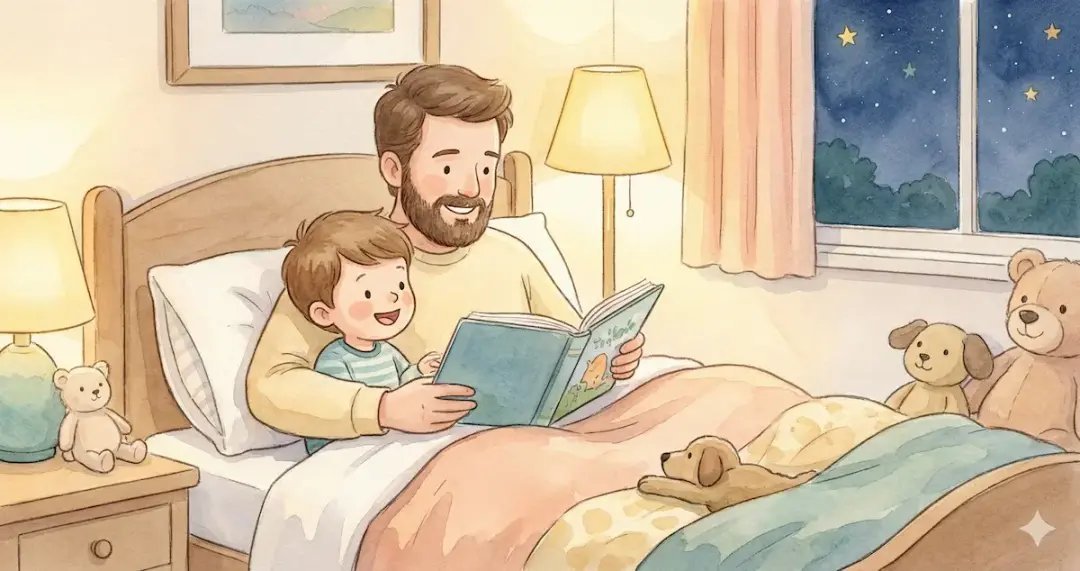
It is bedtime, and your daughter has issued her nightly specification: a story about a bear. Named after her. Who lives in a lighthouse. And there must be a storm, but a friendly one. You could invent this on the spot — some nights you do, gloriously — or you could let an AI do the heavy construction while you supply the parts no software has: her bear’s name, her fears, her jokes. Yes, AI can help you write a storybook for your kids, and the results are best when you treat it as a printing press rather than an author. Here is the workflow that produces a book worth keeping.
What you need before you start
Bring the raw material only a parent has. Your child’s name and the names of their people — siblings, the dog, grandma’s cat. Two or three true details to seed the story: the lost tooth last week, the fear of the basement stairs, the stuffed fox that goes everywhere. The lesson or comfort the story is secretly for, if there is one (new school, a move, being brave at the dentist) — children’s stories have always smuggled these in. And a decision about format: a story told aloud tonight, or a printed book you will build over a few evenings? The aloud version needs nothing but a phone. The keepsake version needs an AI image tool for pictures and a print-on-demand or local print shop at the end.
Step 1: Build the story skeleton yourself, in five lines
Do not ask the AI for “a bedtime story.” Ask it to build from your skeleton: hero, home, want, problem, ending. Five short lines from you — “Mina the bear keeps the lighthouse; she wants to see a whale; a friendly storm blows out the light; she fixes it with help from the gulls; the whale comes at dawn” — give the machine the spine, and the spine is the story. Everything charming in a children’s book hangs off a structure this simple, and everything generic about AI stories comes from skipping it and letting the tool free-associate into a meadow of niceness.
Step 2: Generate in scenes, not in one gulp
Ask for the story scene by scene — the opening page, then the problem arriving, then the worst moment, then the solution — and react to each before continuing. This is where the collaboration actually happens. You will cut the scene where the storm turns genuinely frightening, extend the funny bit with the gulls, and insert the sentence your child will repeat all week. A story generated in one block is a wall of text you must either accept or reject; a story built in scenes is clay. Five to eight scenes makes a picture book; each scene is one to three short paragraphs, because young listeners process a book in page-turns, not in chapters.
Step 3: Write your child into it honestly
The personal details are the entire point, and they must come from you. AI reaches for generic childhood (a boy, his dog, a treehouse) because generic is what it has. Your job is the specifics that make a kid sit up: the bear wears the same yellow boots as Mina; the lighthouse keeper’s sandwiches are the triangular kind; the storm is friendly in exactly the way your household describes thunder — loud, but it is just the sky moving furniture. Keep the fears accurate, too. A story that fixes a child’s real worry with a wave of magic teaches less than one where the hero is scared, asks for help, and manages. You know which worry is real. The software does not, and left alone it will pick one at random.
Step 4: Make the pictures consistent
If you are building the printed version, illustrations are where AI storybooks usually fall apart: a bear who changes color, height, and species of snout between pages. The fix is tedious and worth it. Generate the hero first, alone, in the style you want (soft watercolor suits bedtime; bold flat shapes suit toddlers). Then use that image as the reference for every scene — most tools accept a reference image or a detailed character description to repeat verbatim in each prompt. Keep the style words identical in every prompt, change only the action and setting, and expect to generate three or four versions of each scene and pick. Budget an evening for pictures; it is the slowest step and the one children judge the book by.
Step 5: Read it aloud before you print anything
Children’s text lives or dies by the ear. Read your draft aloud, start to finish, at bedtime speed. You will find the sentence that takes two breaths, the rhyme that almost works, the word your four-year-old will demand defined at the worst moment. AI prose has a particular smoothness that reads fine silently and turns bland aloud; your edits should add rhythm — a repeated refrain, a sound effect the listener gets to shout, a page-turn cliffhanger. The read-aloud pass is also where the story becomes partly yours in the deepest sense: your voice, your pacing, your improvisations around the text are what your child will remember, which is as it should be. Literacy organizations like Reach Out and Read’s guidance on reading with young children make the broader point well — the book is a vehicle; the reading together is the event.
Step 6: Print it like it matters
A story your child loves deserves to exist on paper. Lay the scenes out one per page with the picture above or beside the text, add a title page with their name as the hero and yours as the storyteller, and print the sturdiest version you reasonably can — a board-book style print for toddlers, a simple bound paperback for older kids. Put the date on it. In ten years the file will be lost and the paper copy will be in a memory box, and the date will be the detail that makes an eighteen-year-old go quiet for a second.
Tune it to the age across the pillow
The same workflow bends very differently for a three-year-old than for an eight-year-old, and the adjustments are yours to make, because the software’s sense of age is crude. For toddlers, think in pictures with captions: one or two short sentences per page, heavy repetition, a refrain they can shout, and a story arc that is barely an arc at all — something is lost, something is found, everyone is home by the last page. For four-to-six-year-olds, you get a real plot: a problem, a failed first attempt (this is the page they will love most), help from a friend, and a solution the hero helps create. For seven and up, switch the machine into chapter mode: short chapters with a hook at each ending, a mystery or quest that carries across nights, and vocabulary a notch above their reading level, because listening level runs ahead of reading level and bedtime is where new words get absorbed painlessly. Tell the AI the age and the mode explicitly, every time — “for a five-year-old, one short paragraph per page, with a repeated refrain” produces a different and better book than the same prompt without the numbers.
Let your child co-author, loudly
The step that turns a nice book into an obsession is giving your child editorial power. Children are ruthless, brilliant editors of their own stories. The bear should have a boat. The storm should bring a whale and also, somehow, pancakes. Read a scene, ask “what happens next?”, take dictation for a page, and type their version into the flow even when — especially when — it breaks your elegant structure. The software can smooth the result into consistency afterward, keeping the child’s plot swerves while fixing the grammar. A storybook with your child’s actual ideas in it gets requested nightly for months; a flawless storybook about a generic bear gets a polite week. There is a keepsake argument too: years from now, the pancake whale will be the detail that makes the book unmistakably theirs, and the fact that a machine typeset it will matter not at all.
One boundary worth keeping
Use the same judgment you would apply to any AI use around your children. You would vet a story a stranger handed your kid; vet this one too — read every word before they hear it, because generation can produce odd content occasionally and because the values in the story should be your family’s, not the average of the internet’s. It is the same vigilance, pointed the other direction, as how parents can tell if a child used AI for an essay: the parent stays in the loop, on both sides of childhood.
Can AI help you write a storybook for your kids? It can do the drafting, the rhyming, the illustrating, and the typesetting speed-work. What it cannot supply — the bear’s name, the yellow boots, the true detail about the storm — is precisely the part that makes the book a family treasure instead of a competent product. Bring the love and the specifics. Let the machine carry the paragraphs.




1 Comment