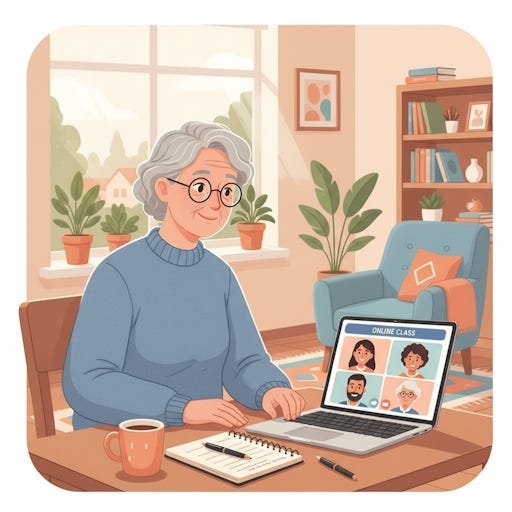
Adults are actually great learners — we just forget how to be beginners. I taught myself sourdough, basic Spanish, and enough Python to automate my chores, all after 30, all with jobs and kids. The secret wasn’t talent or time. It was learning how to learn.
The best way to learn a new skill as an adult isn’t enrolling in the perfect course or finding more hours. It’s deliberate practice in small doses, aimed at a specific project, with feedback loops. Adults learn fastest when the skill solves a real problem — so start with the problem.
Here’s the system, backed by learning science and tested on my own stubborn brain.
The 20-Hour Method: Deconstruct and Drill
Josh Kaufman’s famous TED talk claims you can go from zero to ‘reasonably good’ in 20 hours of deliberate practice — and he’s largely right for skills with clear sub-skills. The method: deconstruct the skill into sub-skills, learn just enough to self-correct, remove distractions, and practice the most critical sub-skills first. Twenty hours is about 45 minutes a day for a month — entirely doable.
Deconstruction is the key step most people skip. ‘Learn guitar’ is overwhelming; ‘learn the four chords for 100 pop songs, then strumming patterns, then transitions’ is a curriculum. ‘Learn Spanish’ is vague; ‘hold a 5-minute restaurant conversation’ is a target with obvious sub-skills. Break it until each piece feels small enough to practice in one session.
Front-load the highest-leverage 20 percent. In every skill, a small subset of knowledge handles most real situations: 100 Spanish words cover half of daily conversation; a few cooking techniques (knife skills, heat control, seasoning) open up hundreds of recipes. Learn the vital few first, and you’ll feel competent fast — which fuels the motivation to continue.
Practice Deliberately, Not Just Repeatedly
There’s a canyon between practicing and merely doing. Deliberate practice means: a specific goal for each session (‘today: clean chord transitions at 80 bpm’), immediate feedback (record yourself, use an app, compare to a reference), and working at the edge of your ability — uncomfortable but not impossible. An hour of deliberate practice beats five hours of noodling.
Get feedback early and often. Adults stall because they practice mistakes into permanence. A single lesson from a teacher, a critique group, an online community review, or even recording yourself reveals blind spots you’d never catch alone. For creative skills, our hobby guide lists communities for most pursuits.
Embrace the plateau of suck. Every skill has a phase where effort stops producing visible progress — usually right before a breakthrough. This is where adults quit, mistaking the plateau for a ceiling. Expect it, schedule through it, and measure process (sessions completed) instead of progress (skill level) during the flat stretches. The science of expertise consistently shows persistence through plateaus separates learners from quitters.
Fit Learning Into an Adult Life
You don’t need big blocks of time — you need consistent small ones. Thirty focused minutes daily beats a four-hour weekend binge for skill acquisition; sleep consolidates learning between sessions, so daily beats cramming neurologically. Anchor practice to an existing habit: guitar after dinner, Spanish during the commute (audiobooks and apps count — see our reading habit audio strategies), coding with morning coffee.
Learn in public or with others. A class, a club, an accountability partner, or even posting progress online adds social commitment that survives motivation dips. Teaching what you learn — explaining the chord to a friend, writing up the recipe — cements knowledge faster than re-studying; it’s called the protégé effect, and it’s powerful.
Pick projects, not curricula. Build the thing: the song for the party, the app that solves your problem, the meal for the dinner party. Projects create deadlines, force integration of sub-skills, and produce proof of progress. Courses are maps; projects are the territory. Walk the territory.
Best Way to Learn a New Skill as an Adult: The Project Method
Let me make the case for project-based learning with a concrete comparison. Two adults want to learn Spanish. One does 30 minutes of app lessons daily for six months — dutiful, comprehensive, and unable to hold a real conversation. The other decides to cook through a Mexican cookbook in Spanish: recipes in Spanish, cooking videos in Spanish, a weekly video call with a tutor to discuss the dishes. After six months, the second cook-conversationalist runs circles around the app user. Same hours, wildly different outcomes — because the project created necessity, context, emotion, and repetition that the curriculum never could.
The project method also solves the motivation problem permanently. Curricula rely on discipline; projects run on desire. You don’t need willpower to work on the song for your friend’s wedding or the app that’ll save you an hour a week — you need willpower to stop. So before you pick a course, pick a project: the performance, the product, the trip, the gift. Then let the project dictate what you learn and in what order. The curriculum serves the project, not the other way around. That’s the best way to learn anything as an adult — want the thing first, then acquire the skill as the price of admission.
Adult Learning Playbook
- Deconstruct the skill into practicable sub-skills
- Target 20 hours of deliberate practice (~45 min/day for a month)
- Learn the highest-leverage 20% first
- Set one specific goal per practice session
- Get feedback early: teacher, community, or recordings
- Practice at the edge of ability — uncomfortable, not impossible
- Expect plateaus; measure sessions, not skill, during flats
- 30 focused minutes daily beats weekend binges
- Anchor practice to an existing habit
- Learn with others or in public for accountability
- Teach what you learn (protégé effect)
- Build projects, not just complete curricula
Stay a Beginner at Something
There’s a hidden benefit nobody mentions: being a beginner keeps you humble, curious, and interesting. Adults who keep learning stay mentally sharper and — anecdotally but powerfully — happier. The beginner’s mind is a feature, not a bug.
Pick the skill that’s been whispering at you. Deconstruct it tonight, practice 30 minutes tomorrow, and give it 20 hours. A month from now, you’ll be reasonably good at something you couldn’t do today. That’s not a small thing — that’s the whole magic of being human.