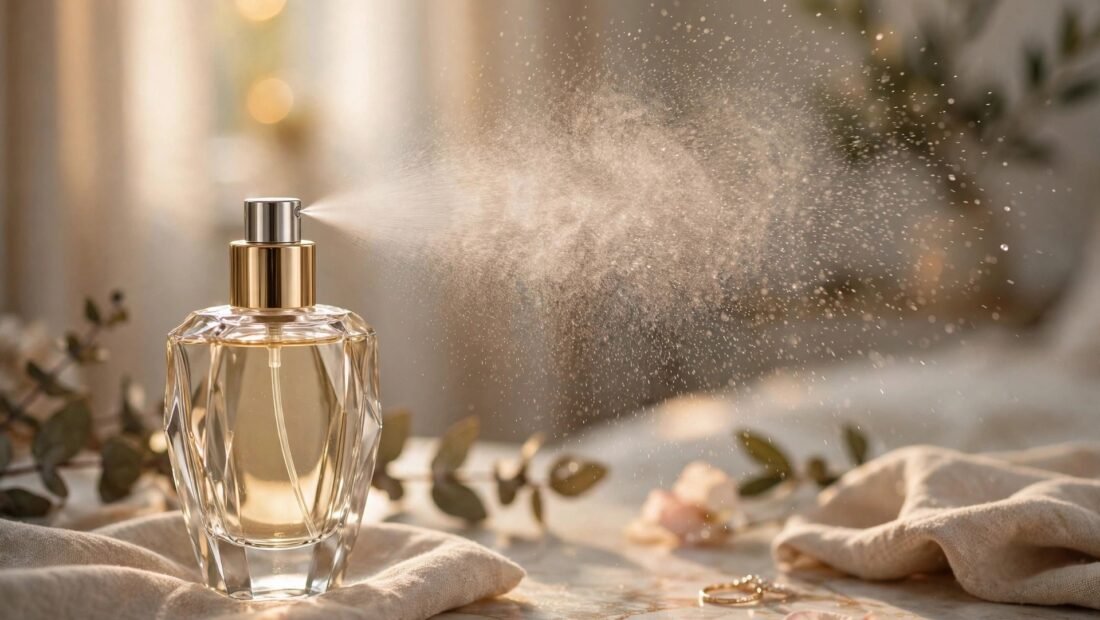
You spray your favorite perfume at 8 a.m. By noon, it’s a ghost — you can’t smell it, and you’re fairly sure no one else can either. Meanwhile your coworker’s scent somehow fills the elevator at 5 p.m. Perfume longevity isn’t about expensive bottles or “good chemistry” — it’s a system of concentration, placement, skin prep, and Texas-heat strategy. Here’s how to make any fragrance actually last all day.
Why Perfume Fades (The Science)
Fragrance longevity depends on evaporation rate: top notes (citrus, light florals) evaporate in minutes; heart notes last hours; base notes (woods, musk, amber, vanilla) persist longest. A fragrance’s staying power is largely determined by its concentration:
- Parfum/extrait (20–30% oils): 8–12+ hours. The longest-lasting format.
- Eau de parfum (15–20%): 6–8 hours. The sweet spot for most people.
- Eau de toilette (5–15%): 3–5 hours. Needs reapplication for all-day wear.
- Eau de cologne / body spray (2–5%): 1–3 hours. Refreshers, not all-day scents.
If your fragrance dies by noon, check the concentration first — an EDT was never going to last all day without help. The second factor is olfactory fatigue: your nose stops registering your own scent within ~20 minutes. You can’t smell it ≠ others can’t. Ask a trusted person before concluding it’s gone — but the techniques below extend real longevity, not just perception.
Skin Prep: The Foundation of Longevity
- Moisturize first: fragrance lasts dramatically longer on hydrated skin — dry skin absorbs and dissipates oils fast. Apply unscented lotion or body oil to pulse points before spraying. This single step adds hours.
- Petroleum jelly trick: a tiny dab of Vaseline on pulse points before spraying creates an occlusive base that holds fragrance oils. The oldest perfumista trick in the book, and it works.
- Don’t rub wrists together: the classic move crushes top notes and generates heat that accelerates evaporation. Spray and let dry untouched.
- Shower timing: apply to warm, slightly damp skin after showering — open pores and hydrated skin absorb and hold fragrance better than dry skin.
Placement: Where You Spray Matters More Than How Much
- Pulse points: wrists, inner elbows, behind ears, base of throat — warmth radiates scent. But wrists wash off (handwashing) — inner elbows and behind ears last longer in practice.
- Hair: hair holds fragrance longer than skin — a light mist on hair (or a dedicated hair perfume, which avoids alcohol drying) extends wear for hours. Texas wind becomes a feature, not a bug.
- Clothes: fabric holds scent far longer than skin — spray the chest area of your shirt or a scarf. Test for staining first (never on silk or light delicates). A scented scarf in winter is an all-day diffuser.
- Behind the knees: the underrated spot — warmth plus air circulation as you move creates a scent trail.
- Don’t over-spray: 3–5 sprays total. More doesn’t last longer — it just announces louder initially, then fades on the same curve. Longevity comes from prep and placement, not volume.
Choosing Long-Lasting Fragrances
- Prefer EDP or parfum concentrations for all-day wear — the concentration upgrade is the highest-impact purchase decision.
- Base-note-heavy compositions (oud, amber, sandalwood, vanilla, musk) outlast citrus-dominant ones by design. If you love fresh citrus scents, accept reapplication as part of the deal — or layer a citrus EDT over a musky base.
- Layering: matching scented body lotion + fragrance, or a complementary base (vanilla body oil under a floral perfume), builds longevity through stacked formats.
- Test on skin, over hours: paper strips lie — skin chemistry transforms fragrance. Wear-test for a full day before committing; the dry-down at hour 6 is the real perfume.
Budget reality: longevity doesn’t require luxury pricing — many affordable EDPs outperform prestige EDTs on wear time. Concentration and composition beat brand. The polished look on a budget absolutely includes a signature scent; spend on concentration, not cachet.
Fragrance Families and Longevity: A Quick Guide
Not all scent families are built for endurance. Knowing which is which saves money and disappointment:
- Longest-lasting: orientals/ambers, woods, gourmands (vanilla, tonka) — heavy molecules that cling to skin and fabric for 8+ hours. The natural all-day choices.
- Medium: florals, chypres, musks — 4–7 hours depending on composition. Most designer bestsellers live here.
- Shortest: citruses, green/aquatic notes, light aromatics — 1–3 hours. Built for freshness, not endurance. Fragrantica’s fragrance encyclopedia lists each perfume’s note pyramid and community-reported longevity — check before buying.
One caution: stronger, longer-lasting fragrances mean more skin exposure to fragrance compounds — a real concern for sensitive skin. If perfumes cause rashes, headaches, or itching, the issue may be fragrance sensitivity rather than technique; the American Academy of Dermatology advises patch-testing new fragrances and choosing fragrance-free personal care for reactive skin. Longevity techniques (fabric application, hair misting) actually help here too — scent on clothes rather than skin reduces direct contact.
Texas-Heat Strategy
- Heat amplifies then kills: Texas heat makes fragrance project strongly for the first hour, then evaporate faster. Compensate with base-note-heavy scents and fabric application (clothes don’t sweat off).
- Store it right: heat and light degrade perfume — Texas bathrooms (hot, humid, bright) are the worst storage. Keep bottles cool, dark, and dry; a degraded fragrance loses both complexity and longevity.
- Carry a travel spray: decant into a 5ml atomizer for midday refresh — one spray at noon on clothes resets the curve. This is the realistic Texas solution, not a failure of technique.
- Go lighter in summer: heavy orientals project overwhelmingly in 100°F heat. Summer calls for lighter application of the same long-lasting bases — or fresh scents accepted as reapply-throughout-the-day choices.
And the ritual framing: fragrance as part of a deliberate routine lasts longer in every sense — a proper self-care day is the perfect time to test, layer, and discover how your skin wears different concentrations without time pressure.
Conclusion
All-day perfume is a system: choose EDP-or-higher concentrations with strong base notes, moisturize skin (or Vaseline) on pulse points before spraying, place strategically (inner elbows, behind ears, hair, clothes — not just wrists), never rub, store bottles away from Texas heat, and carry a travel atomizer for the noon refresh. Do this and the 8 a.m. spray is still present — subtly, on fabric and in hair — at 6 p.m. Longevity was never about the price tag; it’s prep, placement, and concentration.
Frequently Asked Questions
How do I make my perfume last all day?
Moisturize skin before spraying (or use Vaseline on pulse points), choose EDP or parfum concentrations, spray pulse points plus hair and clothes, don’t rub wrists, and carry a travel atomizer for a midday refresh.
Why can’t I smell my perfume after an hour?
Usually olfactory fatigue — your nose adapts within ~20 minutes and stops registering it. Others can still smell you. Ask someone you trust; if it’s genuinely gone, the concentration is too low or the skin prep was skipped.
Where should I spray perfume for longest wear?
Inner elbows, behind ears, base of throat, hair, and clothes — these outlast wrists (which wash off). Behind the knees creates a scent trail. 3–5 sprays total across these points.
Does expensive perfume last longer?
Not necessarily — concentration and composition determine longevity, not price. An affordable EDP with strong base notes outlasts a prestige EDT. Check the concentration (EDP/parfum) rather than the brand.
How should I store perfume in Texas heat?
Cool, dark, and dry — never in hot bathrooms or cars. Heat and light degrade fragrance oils, reducing both complexity and longevity. A bedroom drawer or closet beats the bathroom counter.