The commute is gone, the gym is a twelve-second walk from your desk, and somehow you exercise less than ever. Remote workers across Texas report the same paradox: removing every barrier to working out somehow removed the motivation too. No gym-buddy accountability, no “I’m already out” momentum, and a couch that whispers during every Zoom call. Staying motivated to exercise while working from home is not a willpower problem — it is a design problem. Here is how to redesign your day so movement happens almost automatically.
Why Home Workouts Kill Motivation
In an office, exercise piggybacks on transitions: you work out before the commute, at lunch near the office gym, or after work with colleagues. Remote work erased those transitions. Your brain also struggles with context — the same living room where you answer emails, eat lunch, and watch Netflix is supposed to become a gym at 6 p.m.? Environmental psychology says that is an uphill battle: spaces carry behavioral associations, and your home is associated with rest.
Add decision fatigue. When the gym was a 20-minute drive, you committed the night before. At home, every day presents a fresh negotiation: now or later, living room or garage, 20 minutes or 45. Each decision is a chance to bail. The fix is to eliminate decisions, not to summon more discipline.
Design Your Environment, Not Your Willpower
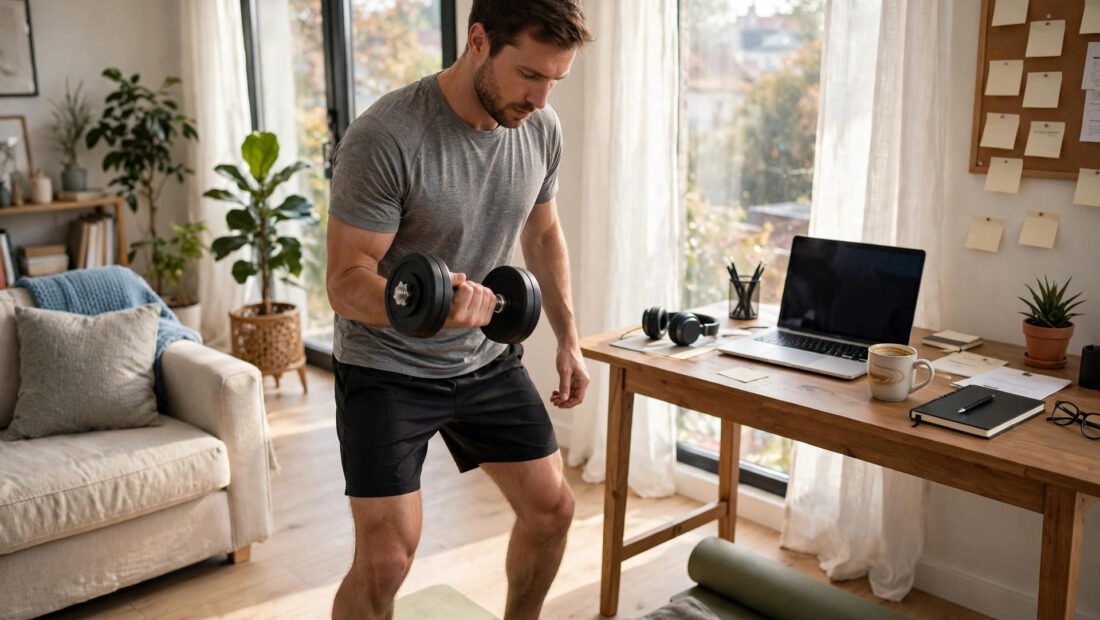
Create a workout zone. It does not need to be a home gym — a cleared 6×6-foot corner with a mat, dumbbells, and a resistance band is enough. The key is that it stays set up. Rolling out a mat you have to unroll and put away adds friction; a permanent corner signals “this is where exercise happens.” If space is tight, even a specific rug that only comes out for workouts creates the mental boundary.
Stack exercise onto existing habits. Habit stacking — attaching a new behavior to an established one — is one of the most replicated findings in behavior science. “After I close my laptop for lunch, I do 15 minutes of bodyweight circuits.” “When my 3 p.m. standup ends, I walk around the block.” The existing habit is the trigger; no motivation required. For more on building these loops, see our guide to how long it takes to build a consistent workout habit.
Dress the part by 9 a.m. Remote workers who change into workout clothes in the morning report significantly higher exercise rates than those who stay in pajamas until noon. It sounds trivial; it is not. Clothing is a commitment device.
Beat the Texas-Specific Obstacles
Texas remote workers face two unique motivation killers: brutal summer afternoons that make outdoor exercise feel punishing, and the siren call of air conditioning. Solve both with scheduling. In summer, your workout windows are before 8 a.m. or after 8 p.m. — treat a 6:30 a.m. session like a meeting with your boss. Indoor options (bodyweight circuits, dumbbell routines, yoga, a used treadmill) remove weather from the equation entirely for June through September.
The loneliness factor is real too. Working from home can feel isolating, and isolation drains the energy exercise requires. Our piece on making working from home feel less lonely pairs well with this — consider virtual workout buddies, live-streamed classes with real-time leaderboards, or a lunchtime walking group with nearby remote workers. Social accountability is the single strongest predictor of exercise adherence in the research literature.
Make It Stupidly Small to Start
The “two-minute rule” from habit research: scale the workout down until starting feels effortless. Ten squats. A five-minute walk. One yoga flow. Starting is the hard part — once you begin, you will usually keep going, and even when you do not, you banked a win. Wins compound into identity: “I’m someone who exercises daily” is infinitely more motivating than “I should work out.”
Calendar-block your sessions like meetings, with notifications. “Workout 12:15–12:45” on a shared calendar creates the same social pressure as a dentist appointment. Even better, schedule it immediately before or after a non-negotiable event — right before lunch, right after the kids’ school pickup — so skipping requires actively rescheduling.
Track, Gamify, and Reward
What gets measured gets repeated. A simple wall calendar with X’s, a free habit app, or a spreadsheet all work — the mechanism is visible streaks you do not want to break. Our roundup of the best apps for tracking daily habits covers several with workout-specific features and streak mechanics.
Add stakes. Bet a friend $50 you will hit four workouts a week. Join a step challenge with coworkers. Sign up for a local 5K eight weeks out — a deadline on the calendar converts vague intentions into a training plan. Rewards work too, but tie them to process (four sessions completed) rather than outcomes (pounds lost), because you control the process.
Vary It Before Boredom Hits
Motivation dies fastest from monotony. Rotate modalities weekly: strength circuits Monday, yoga Wednesday, a walk-run Friday, a weekend hike at a Texas state park. Keep a “menu” of 20-minute, 30-minute, and 45-minute sessions so low-energy days still have an option — a short session beats a skipped one every time, and the CDC’s activity guidelines confirm that even 10-minute bouts count toward weekly totals.
Entertainment pairing helps enormously: save a specific podcast, show, or playlist exclusively for workouts. The “temptation bundling” effect — pairing something you crave with something you resist — has solid experimental support.
Handle the Inevitable Slumps
You will miss days. The research on habit formation is clear about what matters next: never miss twice. One missed workout is life; two is the start of a new pattern. When motivation craters for a full week, do not attempt a heroic comeback session — do the smallest possible workout to restart the streak. And audit the real cause: slumps usually trace to poor sleep, work stress, or an overambitious plan, not character flaws. Fix the cause, not the symptom.
The Science of Exercise and Remote-Work Performance
This is not just about fitness — it is about work output. Research on physical activity and cognition consistently shows that regular exercisers demonstrate better focus, faster problem-solving, and superior stress resilience than sedentary peers. One well-known study found that employees who exercised during the workday reported higher productivity and better time management on exercise days. For remote workers, the mechanism is doubly relevant: exercise breaks interrupt the sedentary marathon that video-call days become, resetting both body and attention. The Mayo Clinic’s exercise guidelines note that even short bouts of activity improve mood and energy — which is exactly what the 3 p.m. remote-work slump needs. Think of your workout not as time stolen from work, but as the highest-ROI meeting on your calendar: the one that makes every other meeting go better.
Conclusion
Motivation is unreliable; systems are not. Remote workers who exercise consistently do not have more willpower — they have a dedicated corner, a calendar block, a habit stack, and a streak they refuse to break. Set up the environment once, shrink the starting bar until it feels silly, add one layer of accountability, and let Texas mornings do the rest. Six weeks from now, the workout will be the part of your work-from-home day you protect most fiercely.
Frequently Asked Questions
How do I exercise at home without any equipment?
Bodyweight training covers everything: squats, lunges, push-ups, planks, glute bridges, and burpees. A well-structured 25-minute bodyweight circuit rivals most gym sessions for general fitness. Add a $15 resistance band later for pulling movements.
What is the best time to work out when working from home?
The best time is the one you will do consistently. That said, midday sessions break up screen time and combat the afternoon slump, while morning sessions have the highest adherence rates because willpower and schedules are freshest.
How do I stop skipping workouts when no one is watching?
Create external accountability: a workout buddy (even virtual), a bet with a friend, a class with attendance, or a public streak. Also reduce friction — lay out clothes and equipment the night before so starting takes under 60 seconds.
Is a 15-minute workout even worth doing?
Absolutely. Short sessions maintain the habit, which is the actual goal. Research shows even 10-minute bouts of moderate activity contribute to the 150-minute weekly target, and a 15-minute intense circuit delivers real cardiovascular and strength benefits.