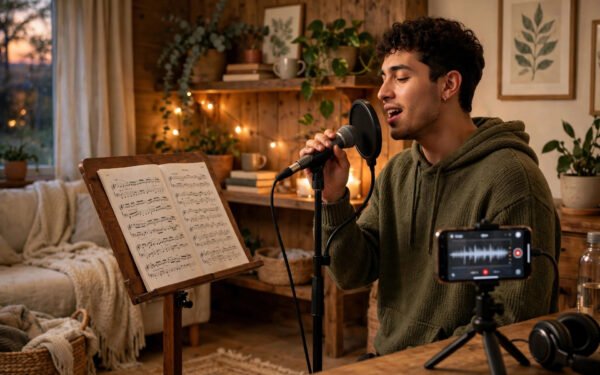
You have a melody in your head — maybe a chorus that won’t leave you alone — but every songwriting guide starts with “learn music theory first,” and you don’t read a note. Here’s the liberating truth: some of the most beloved songs in history were written by people with zero formal theory. The Beatles, Oasis’s Noel Gallagher, and countless Texas singer-songwriters wrote timeless songs on instinct, feel, and trial-and-error. Music theory describes what sounds good; it doesn’t create it. Your ear already knows more theory than you think. Here’s how to write your first song with the ear you have.
Start With What You Already Know
You’ve listened to thousands of songs. That listening is training — your brain has internalized verse-chorus structures, chord feelings, and melodic shapes without you realizing it. Songwriting without theory is about accessing that stored knowledge:
- Hum your melody into your phone: the moment inspiration strikes, record it. Melodies evaporate — the voice memo is the songwriter’s most important tool. Don’t judge it yet; capture first.
- Find your chords by ear: if you play guitar or piano even basically, try chords under your melody until something fits. Start with the “big four” of pop — G, C, D, Em on guitar (or C, G, Am, F on piano). An enormous percentage of hit songs use just these.
- Steal structures: pick a song you love and copy its structure (verse length, where the chorus hits, bridge placement) with your own melody and words. Structure isn’t copyrightable, and every songwriter learns this way.
The No-Theory Songwriter’s Toolkit
Chord hunting (the 10-minute method)
Play your melody’s starting note. Try each of the big-four chords underneath it — one will sound “right” (consonant, settled). That’s your home chord. Now try the others in different orders, humming your melody over each. When a chord makes the melody shine, keep it. When it clashes, discard it. You’re doing harmonic analysis by feel — it works because your ear recognizes resolution. Write down the winning sequence (even as “the sad one, then the happy one, then…”).
Melody shaping without notation
- Contour matters more than notes: great melodies have shape — they rise to a peak and fall, or they hover then leap. Hum your melody and trace its shape in the air. If it’s flat (all one pitch area), add one leap or one climb.
- Repetition + variation: repeat your best 2-bar phrase, then change the ending slightly. This is the DNA of nearly every memorable chorus.
- Rhythm first: chant your lyrics in rhythm before worrying about pitch. A strong rhythmic phrase carries a simple melody; a weak rhythm sinks a clever one.
- The chorus lift: make the chorus melody higher, longer-noted, or rhythmically bigger than the verse. Contrast is what makes choruses feel like arrivals.
Lyrics without poetry degrees
- Write the truth, plainly: “I miss you at the kitchen table” beats abstract poetry. Specific details (the kitchen table, not “loneliness”) make songs feel real.
- Conversational first draft: write what you’d actually say, then shape it. Natural phrasing sings better than forced rhyme.
- Rhyme as seasoning: perfect rhymes every line sound nursery-rhymey. Mix perfect rhymes, near-rhymes, and unrhymed lines — pros do this constantly.
- One idea per song: your first song should be about one feeling, one moment, one person. Focus is what makes 3 minutes feel complete.
Assemble Your First Song (The 1-Hour Method)
- Pick your structure (15 min): Verse – Chorus – Verse – Chorus – Bridge – Chorus. The most forgiving structure in existence.
- Write the chorus first (20 min): it’s the emotional core. Get the hook (the most memorable line/melody) right and the rest follows.
- Write verses that set up the chorus (15 min): verses tell the story; the chorus delivers the feeling. Each verse should add one new detail.
- Record a rough demo (10 min): phone recording, one take, mistakes included. A finished rough song teaches more than a perfect fragment.
Then live with it for a week — sing it in the car, play it for the dog, let it sit. The lines that still feel right are keepers; the ones that embarrass you on replay get rewritten without mercy. Revision is where songs are actually written — first drafts are just raw material, and even professionals rewrite choruses a dozen times before they’re done.
Tools That Replace Theory Knowledge
- Chord progression apps/websites: tools that let you audition progressions by ear (search “chord progression generator”) replace harmonic theory for beginners.
- Capo (guitar): the no-theory transposition device — changes key without changing chord shapes.
- Looping: record a chord loop and improvise melodies over it. This is composition by play, and it’s how many pros write.
- Collaboration: the theory-knowing friend who says “try Am there instead” is worth more than a textbook. Texas’s festival scene is full of potential collaborators — go meet them.
When Theory Becomes Useful (Later)
After 5–10 songs, you’ll hit questions theory answers elegantly: “why does this chord work?”, “how do I modulate?”, “what’s a better bridge chord?” Learn theory then — as solutions to your real problems, not as prerequisites. Theory learned this way sticks because it’s attached to your music. Many working songwriters operate on “enough theory to communicate with the band” and nothing more. That’s a fine destination. For more detail on a related topic, see our article on how to find new music similar to your favorite bands.
Conclusion
Writing your first song without music theory requires only three things: a recorded melody, chords found by ear (start with the big four), and lyrics written plainly about one true thing. Structure borrowed from songs you love, a chorus-first assembly process, and a week of living with the draft will produce something real — maybe rough, but yours. Theory will be there when you’re ready for it, and it’ll make more sense after you’ve already written songs than before. The songs in your head don’t care about your credentials. Get them out now. For inspiration and craft talk from working writers, American Songwriter is a deep well. ASCAP offers songwriter workshops and royalty education for writers ready to take the next step.
Frequently Asked Questions
Can you write good songs without knowing music theory?
Absolutely — countless hit songs were written by ear. Theory describes why music works; it doesn’t generate it. Your listening experience has already trained your instincts more than you realize.
What’s the easiest chord progression for a first song?
The “four-chord” progression (G–D–Em–C on guitar, or C–G–Am–F on piano) underpins thousands of hits. Start there — if your melody fits over it, you have a song.
Should I write lyrics or melody first?
Either works, but beginners often find melody-first easier — hum a tune, then fit words to it. Lyrics-first suits writers with strong verbal instincts. Try both; notice which feels natural.
How do I know if my song is any good?
Play it for 3–5 trusted people and watch their faces, not their words — genuine emotional response is visible. Also: if you still like it after two weeks, that’s meaningful data. And finishing songs (vs. judging fragments) is the real skill.
Do I need to learn an instrument to write songs?
It helps enormously — even basic guitar or piano unlocks chord hunting. But melody + lyrics alone is a complete song (plenty of topline writers work this way), and apps can provide chord backdrops while you learn.