
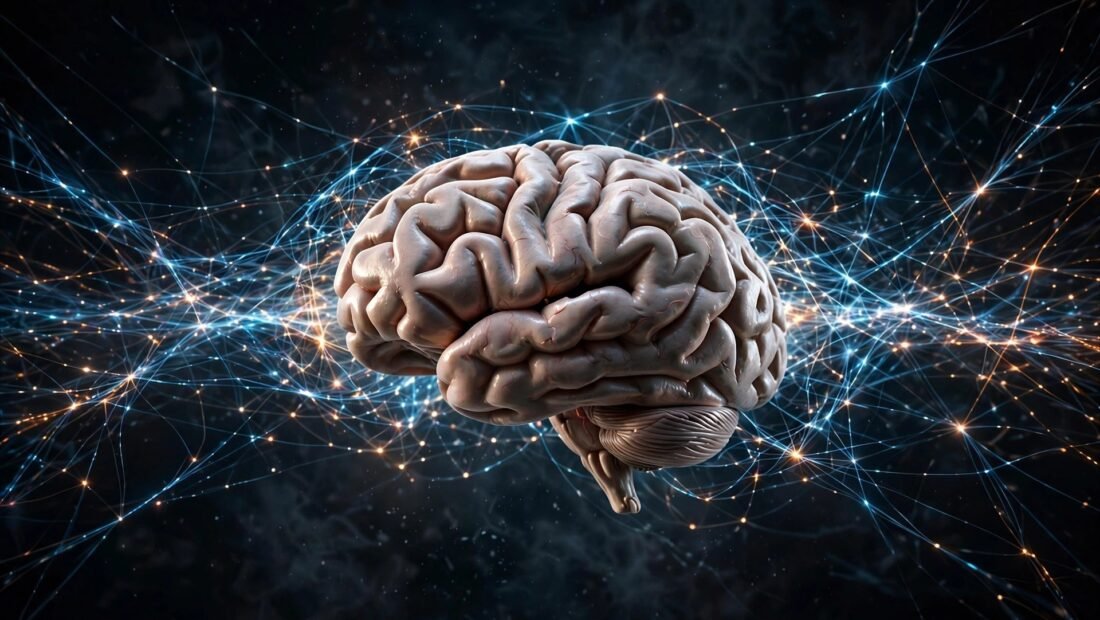
You do not remember last week’s grocery list the way you remember your first day of school, and the difference is machinery, not effort. One list was spoken once, never repeated, and tied to nothing. The school day was new, emotional, talked about, pictured, and recalled for years. Your brain did not store both and lose one by accident. It ran both through the same sorting system and kept only the one that system marked as worth keeping. Once you see how that sorting, binding, and physical storage work, a lot of everyday forgetting stops looking like failure and starts looking like design.
Stage One: Sensory Memory, the Shortest Hold
Every sense feeds the brain a constant stream, far more than you could ever keep. Sensory memory is the first, very short hold on that stream. A seen image leaves a trace that fades in under a few seconds, and a sound leaves an echo that lasts only slightly longer. Almost all of it disappears, and that loss is useful. If every passing face and background noise stayed active, thought would drown in clutter. Attention is the gate here. What you notice moves forward. What you ignore is gone, which is why you can drive a familiar route and recall almost none of the signs you passed.
Stage Two: Working Memory, the Small Desk
What attention selects moves into working memory, the mind’s small desk. It holds roughly 4 to 7 items at once, for under a minute without effort, and it fades fast unless you rehearse it. The phone number you repeat under your breath until you dial it lives here. So does the name of a person you just met, which is why an interruption in those first seconds so often wipes it clean. The desk metaphor matters because the space is truly limited. Add a new item and an old one falls off. Try to hold a grocery list, a door code, and a set of directions at once and each one weakens the others. Working memory is built for handling the present moment, not for keeping a lifetime. Keeping something longer requires a different process entirely.
Consolidation: The Decision to Keep
Consolidation is the transfer from that small, fragile desk into durable long-term storage, and the brain is selective about what earns the transfer. Novel events get priority, because new information may matter. Emotional events get priority, because threats and rewards mattered to survival. Repeated events get priority, because anything that keeps occurring is likely to occur again. Information tied to what you already know gets priority, because it has hooks to hang on. A random lunch on a routine Tuesday scores low on every one of those counts. A wedding, a scare, a first day, or a fact you used ten times scores high. Nothing about this is random, and nothing about it requires you to be good or bad at memory in general. Different inputs simply get different treatment from the same filter.
The Hippocampus: Librarian, Binder, and Teacher
Deep in the temporal lobe, the hippocampus acts as the system’s coordinator. An experience does not arrive in one piece in one place. Sight is handled in visual areas, sound in auditory areas, emotion heavily in the amygdala, and touch, place, and sequence in still other areas. The hippocampus binds those scattered parts into one episode you can later recall as a whole: where you were, what you saw, how it felt. Then, over time, it teaches the cortex to hold that episode without its constant help. This slower handover, called systems consolidation, can take weeks to years.
The clearest proof of that role comes from a patient known as H.M., whose hippocampi were removed in surgery in 1953. Afterward he could hold a conversation, since working memory still worked, and he could recall life from before the surgery, since older memories had already moved to the cortex. What he could not do was form new lasting memories of events. Each day reset. Yet he could still learn new motor skills with practice, getting better at tasks he did not remember doing, which showed early on that skill memory runs on separate machinery from fact and event memory.
Synapses: Where a Memory Physically Lives
A long-term memory is not a file in a cabinet. At the level of cells, it is a pattern of stronger connections between neurons. The main mechanism is called long-term potentiation. When two connected neurons fire together again and again, the junction between them, the synapse, changes. More receptors are added on the receiving side, the synapse can grow physically larger, and the next signal crosses more easily than the last. The short summary often used for this is that neurons that fire together wire together.
With enough reactivation, strengthening becomes structural. New small branches called dendritic spines grow, genes switch on, and fresh proteins lock the change in place. That step is one reason sleep and time matter: a trace not yet stabilized is easy to disrupt. Each recall reactivates the pathway and gives the brain a chance to strengthen it again. That is the physical reason repetition works, and why its timing matters so much.
Explicit Memory: Facts and Events You Can Tell
Explicit memory, also called declarative memory, covers what you can bring to mind and describe. Episodic memory holds personal events: a first day of school, a trip, a celebration. Semantic memory holds general knowledge stripped of the moment you learned it: Paris is the capital of France. Both depend on the hippocampus while they form. Over years, semantic facts become sturdy cortex knowledge that survives even when the learning episode is forgotten. You know thousands of facts whose source you could never name, and that gap is normal.
Implicit Memory: Skills and Feelings That Bypass Words
Implicit memory runs quietly and often better than the explicit system. Procedural memory, handled largely by the basal ganglia and cerebellum, stores skills: riding a bike, typing without looking, swinging a bat. You perform these well and explain them poorly, because they were never stored as sentences in the first place. Emotional associations are another branch. The amygdala helps store links such as fear after a dog bite, and those links can fire before you consciously recall why. This split explains a puzzle families see in memory illness and in cases like H.M.: a person may fail to form new facts and still improve at a physical skill, or feel uneasy in a place without recalling the event that made it uneasy. One brain, several storage systems, each with its own rules.
Sleep serves all of these systems at once. During deep sleep the hippocampus replays the day’s episodes toward the cortex, in fast bursts, like a librarian shelving the day’s returns overnight. Cut sleep short and you cut that shelving shift short. Students who trade sleep for extra late-night review are often trading away the very process that would have kept the review.
Why Forgetting Protects You
Forgetting is not the system breaking. It is the system editing. Synapses that go unused weaken over time, a process called long-term depression, the mirror image of potentiation. Similar memories interfere with each other at recall, so a new password blurs the old one. New neuron growth in the hippocampus may also clear space for new learning at the cost of older traces. The value of this editing shows in rare people with near-total autobiographical recall, who often describe the gift as a burden: every slight, every awkward moment, every date stays vivid and unfiltered, with no softening over time. A brain that kept everything at full strength could not tell the signal from the noise. Yours makes that call constantly, and mostly makes it well.
Retrieval failure is not the same as storage loss. The trace can be intact while the path to it is blocked, which is the tip-of-the-tongue feeling, and a cue such as a smell or a related name can rebuild the path hours later. Recall is also a rebuild, not playback. Each retelling slightly reshapes the trace, which is why honest witnesses disagree and two siblings remember the same holiday in different ways.
For a practical set of methods built on these mechanisms, see study techniques backed by science, and for clear background reading, BrainFacts.org’s explainers on memory and how the brain stores it lay out the brain regions and cell processes in plain language.
Working With the Machinery: Spacing, Testing, and Sleep
The most reliable schedule for keeping new material is spaced review at expanding gaps: review after 1 day, then 3 days, then 1 week, then 1 month. Each return visit lands just as the trace begins to fade, so reactivating it takes real effort, and that effort is what restabilizes it more strongly. Cramming packs the same total minutes into one night, when each reread feels easy precisely because the trace has not faded yet, and easy rereads build weak storage.
Testing yourself beats rereading for the same reason. Trying to pull an answer out of memory, even when you partly fail, fires the full pathway and strengthens it more than seeing the answer on a page. Linking new facts to stories, images, or knowledge you already hold gives the hippocampus more binding hooks, and odd or funny links tend to survive because they stand out at the novelty gate. Sleep after learning, regular aerobic exercise, which supports hippocampal health, and steady social and mental activity round out the short list of habits with the strongest support behind them.
Aging, and When Loss Is Not Normal
Normal aging usually slows retrieval and shrinks working memory a little, while well-consolidated knowledge holds up well. A name arriving an hour late is typically a retrieval delay, not a lost memory. Alzheimer’s disease is a different process. It attacks the hippocampus and the entorhinal cortex early, damaging the consolidation machinery itself, so recent events fail to store while remote childhood memories, long since moved to the cortex, can remain clear for a long time. Rapidly worsening loss of recent memory, getting lost in familiar places, or memory trouble that interferes with daily life are patterns worth raising with a doctor promptly. No supplement has shown preventive power to match the plain fundamentals: sleep, exercise, heart health, social engagement, and continued learning.
Your brain was built to keep what is new, emotional, repeated, or connected, and to clear the rest so the important traces stay findable. Remembering well means feeding that system the signals it already listens for.




1 comment