You’ve always wanted to play drums. But you live in a Texas apartment with paper-thin walls, or a suburban neighborhood with an HOA and neighbors who definitely don’t share your passion for blast beats at 9pm. Acoustic drums hit 100–120 decibels — louder than a chainsaw, roughly a rock concert in your living room. Learning anyway seems impossible without starting a neighborhood war. It’s not. Between electronic kits, smart practice tools, and strategic scheduling, you can go from zero to genuinely good drummer without a single noise complaint. Here’s the complete quiet-learning system.
The Electronic Drum Kit: Your Primary Weapon
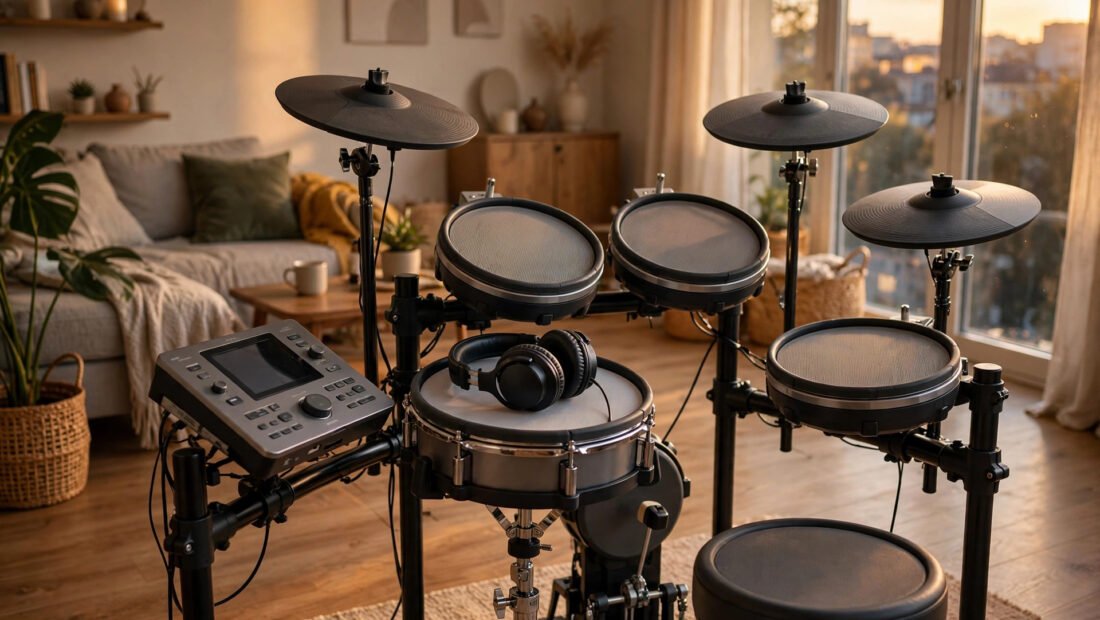
This is the answer for 90% of noise-constrained beginners. Modern electronic kits (Roland, Alesis, Yamaha) produce sound only through headphones or at whatever volume you choose — the physical striking noise is roughly the volume of typing on a keyboard.
- Budget pick (~$300–$500): Alesis Nitro Mesh — mesh heads (quieter and more realistic than rubber pads), perfectly adequate for 1–2 years of learning. The most-recommended beginner e-kit in existence.
- Mid-range (~$700–$1,000): Roland TD-1DMK or Yamaha DTX402K — better sounds, better feel, more durable. Worth it if you’re committed.
- What matters: mesh heads over rubber pads (quieter + better rebound), a kick pedal (not just a pedal pad) for realistic foot technique, and a kit that folds or has a small footprint for apartments.
- The remaining noise: kick pedal thumps transmit through floors — the one complaint neighbors actually make about e-kits. Fix it with a tennis-ball riser platform (DIY: plywood + tennis balls, ~$30) or a purpose-built isolation pad under the kit. This solves 95% of e-kit neighbor issues.
If You Must Play Acoustic (or Already Own One)
- Mesh head conversions: replace acoustic heads with mesh heads (~$100–$150 for a full kit) and add low-volume cymbals (Zildjian L80, Sabian Quiet Tone — about 80% quieter than normal). Your kit looks and feels nearly identical at conversation volume.
- Mute pads: rubber pads that sit on drums and cymbals, cutting volume 70–90%. Cheap (~$30–$60 for a set) and removable — practice quietly, remove for the rare loud session.
- The room matters: interior rooms away from shared walls, rugs and soft furnishings to absorb sound, and never in a garage with the door open (the classic suburban mistake).
Silent Practice Tools (No Kit Required)
Some of the most valuable drumming practice makes zero noise:
- Practice pad + metronome: the $30 practice pad is the single best investment in drumming. Rudiments, stick control, and timing — the actual foundations — are all pad work. Pair with a free metronome app and practice anywhere: couch, balcony, parked car.
- Pillows: practicing on a pillow (no rebound) builds wrist strength and control that a bouncy pad can’t. Old-school teachers swear by it.
- Air drumming with intent: sounds silly, works surprisingly well for learning coordination patterns and song structures — many pros do it.
- Drumming apps: apps with touch pads let you work on rhythm and coordination silently with headphones.
The unsexy truth: the first 3–6 months of drumming are mostly pad work anyway. Stick control, rudiments, and timing don’t require a kit — they require a pad, a metronome, and consistency. By the time you need a full kit, your technique will be solid.
The Neighbor Diplomacy Playbook
- Talk to them first: before the first session, knock on doors: “Hey, I’m learning drums — I’ve got an electronic kit with headphones, so it should be very quiet, but please tell me if you ever hear anything.” This single conversation prevents 90% of complaints. People tolerate what they’ve been warned about; they’re furious about surprises.
- Set and keep hours: propose specific practice windows (e.g., 6–8pm weekdays) and stick to them religiously. Predictability is everything.
- Know your lease/HOA: many Texas apartments have quiet hours (typically 10pm–8am) and some HOAs restrict “musical instruments.” Electronic kits usually comply since they’re not audible outside the unit — but verify.
- The occasional peace offering: if you’re pushing boundaries (a loud acoustic session), advance notice plus a six-pack has resolved more neighbor conflicts than any legal argument.
A Realistic Learning Path
- Months 1–2: practice pad, metronome, basic rudiments (single strokes, double strokes, paradiddles). 20–30 minutes daily. Zero noise.
- Months 2–4: add the e-kit (or muted acoustic). Learn basic rock/pop beats, play along to songs with headphones. This is where it gets fun.
- Months 4–8: fills, dynamics, playing with others (even online). Record yourself — phone recordings reveal timing issues you can’t hear while playing.
- Month 8+: you’re a drummer. Consider lessons (even monthly) to fix technique before bad habits fossilize — many Texas music schools offer 30-minute slots that fit apartment schedules.
Free resources: Drumeo’s YouTube beginner series, the “80/20 Drummer” practice concepts, and r/drums for gear advice. When you’re ready to play with others, hosting a music night at home is a great low-pressure way to jam with friends — and expanding your listening across genres makes you a more versatile player.
Conclusion
Learning drums without annoying your neighbors is a solved problem: an electronic kit with headphones and a kick-drum isolation platform handles 90% of it, practice pads and metronomes handle the fundamentals silently, and a 5-minute introductory conversation with your neighbors handles the rest. The noise was never the real barrier — consistency was. Twenty focused minutes a day on a pad will take you further in six months than sporadic loud sessions ever could. So get the pad, download a metronome app, knock on your neighbor’s door with a friendly heads-up, and start today — even fifteen minutes of rudiments counts. Your future drummer self is waiting, your neighbors will never know, and the first beat you nail in perfect time will make every quiet practice minute worth it. School of Rock publishes beginner drumming guides covering technique that won’t drive the household crazy. For gear reviews and practice ideas, Modern Drummer has served the drumming community for decades.
Frequently Asked Questions
How loud are electronic drums really?
The stick-on-pad impact is about as loud as typing — roughly 50–60 decibels. The kick pedal thumping through floors is the main neighbor concern, solved with an isolation riser. With headphones, the actual drum sounds are silent to everyone but you.
Can you learn drums on just a practice pad?
For the first few months, absolutely — rudiments, stick control, and timing are all pad work. You’ll eventually want a kit for coordination (hands + feet together), but pad fundamentals transfer directly and many teachers insist on pad-first learning.
What’s the quietest way to practice drums in an apartment?
Practice pad + metronome (silent), or an electronic mesh-head kit with headphones plus a tennis-ball riser under the kick pedal. This combination is effectively inaudible to neighbors.
Are cheap electronic drum kits worth it?
The Alesis Nitro Mesh (~$300–$500) is genuinely good for 1–2 years of learning — mesh heads, usable sounds, compact. Below that price point, rubber-pad kits feel unrealistic and discourage practice. Buy the Nitro or better.
How long does it take to learn drums as an adult?
Basic beats and playing along to simple songs: 2–4 months of consistent practice. Solid intermediate playing: 1–2 years. Drums are actually one of the faster instruments for beginners to sound musical on — rhythm is intuitive in a way melody isn’t.