You love strategy games — Civilization, StarCraft, Age of Empires, Total War, Into the Breach — but the skill ceiling feels infinite, and the standard advice is “watch 40 hours of pro guides on YouTube.” Who has that kind of time? Here’s the good news: most strategy game skill doesn’t come from guides. It comes from understanding a small set of transferable principles, practicing them deliberately, and analyzing your own games — all of which you can do in normal play sessions. This is the no-guides-needed improvement system. For more detail on a related topic, see our article on how to plan the perfect game night for couples.
The 80/20 of Strategy Games: Core Principles
Nearly every strategy game rewards the same fundamentals:
- Economy first: in RTS games, the player with the better economy usually wins — more workers, faster expansion, fewer idle resources. In 4X games, the same logic applies to science/culture/gold per turn. Before learning fancy tactics, learn to never stop building workers and never float 2000 unspent resources.
- Information wins wars: scouting (RTS), map awareness, knowing what your opponent is doing. Most lost games are lost to surprise, not skill — the player who sees the attack coming usually holds it. Build the habit: every 30 seconds, glance at the minimap.
- Concentration of force: ten units together beat ten units arriving one at a time. New players trickle units into fights; good players mass then strike. Same principle in turn-based games: focus fire, don’t spread damage.
- Opportunity cost thinking: every decision is “what am I NOT doing?” Building that unit means not building that upgrade. Ask the question explicitly until it becomes instinct.
- Win conditions, not vibes: know how the game is actually won and play toward it. Beautiful empires that ignore victory conditions lose to ugly empires that don’t.
Deliberate Practice (Without It Feeling Like Homework)
- One focus per session: pick ONE thing to improve — “this session I never stop producing workers” or “this session I scout every 2 minutes.” Single-focus practice builds skills far faster than trying to fix everything at once.
- Play against slightly better opponents: crushing easy AI teaches nothing; getting crushed by experts teaches nothing either (you can’t parse why you lost). The sweet spot is opponents who beat you 60–70% of the time.
- Use build orders as training wheels: for RTS games, learn ONE standard opening per matchup — not from hours of guides, but from a single written build order (Spawning Tool, Liquipedia). Practice it against easy AI until it’s muscle memory, then take it to real games.
- Shorter games, more reps: a 20-minute 1v1 teaches more per hour than a 3-hour epic. Volume of decisions is what builds skill.
Analyze Your Own Games (The Real Secret)
This replaces guides entirely:
- Watch your losses, not your wins: after a loss, spend 5 minutes in the replay asking one question: “When did I actually lose this game?” It’s almost always 5–10 minutes before the defeat screen — the missed scout, the unspent resources, the bad engagement. Find that moment.
- Track one stat: most strategy games show post-game stats. Pick the one tied to your current focus (workers built, resources collected, APM in fights) and watch it trend upward over weeks.
- Keep a one-line journal: after sessions, write one sentence: “Lost to early rush — need earlier scout timing.” Review weekly. Patterns emerge that no guide could have told you about your specific weaknesses.
- Ask better players one question: instead of watching their 3-hour guide, ask a better player (Discord communities are full of helpful people): “What’s the single biggest mistake players at my level make?” One targeted answer beats ten hours of content.
Game-Specific Shortcuts
- Civilization-style 4X: learn the tech/civic tree priorities for your chosen victory type (one page of notes, not a guide series). The biggest beginner mistake is unfocused research — pick a victory condition at turn 1 and let it drive every decision.
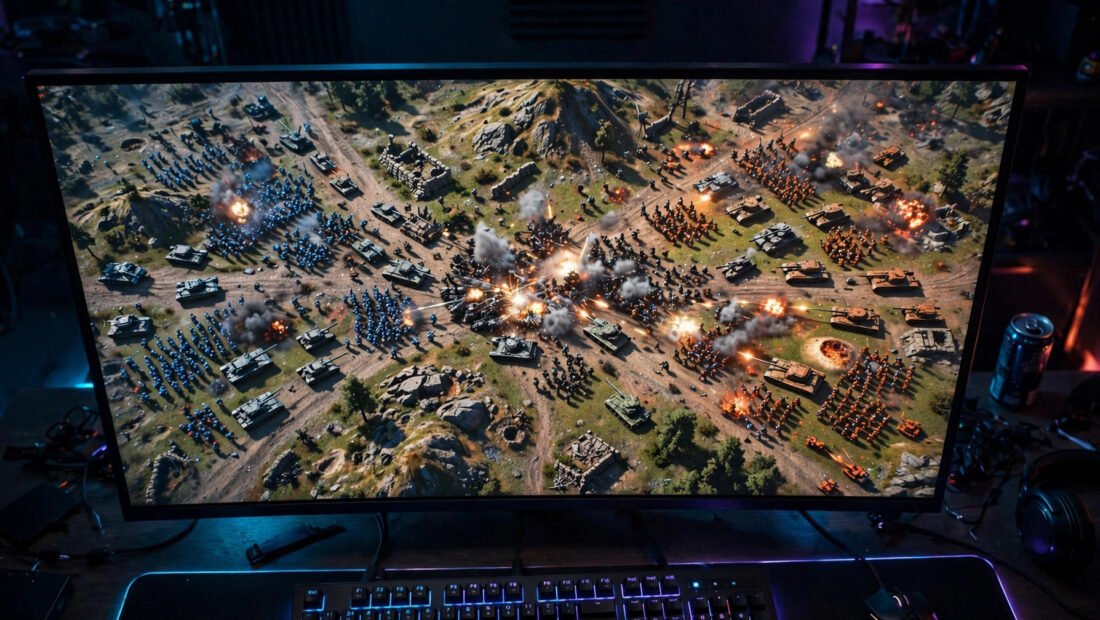
- StarCraft/AoE-style RTS: mechanics beat strategy until mid-level — if your macro (worker production, spending resources, hotkeys) is clean, you’ll beat 80% of players with mediocre tactics. Practice macro against AI; tactics come from games.
- Total War: the campaign layer is won in the first 20 turns (economy, diplomacy, expansion tempo). Battle tactics matter less than arriving with the bigger, better-composed army — which is an economy achievement.
- Into the Breach / tactics games: slow down. The genre rewards perfect information use — most mistakes come from rushing turns. The undo button is a learning tool, not cheating.
Strategy thinking transfers beautifully to tabletop too — modern board games for strategy fans sharpen the same decision-making muscles away from the screen.
Mindset: The Hidden Skill
- Lose productively: every loss contains the lesson; tilt contains nothing. If you’re queuing angry, you’re practicing bad habits.
- Embrace the plateau: skill improves in jumps separated by flat stretches. Plateaus mean your brain is consolidating — keep practicing and the jump comes.
- Play to learn, not to rank: ladder anxiety makes everyone play worse. Reframe ranked as “practice with stakes” and watch performance improve.
- Take breaks: fatigue destroys decision quality. Two focused hours beat six tilted ones, and a short walk between sessions resets decision fatigue better than another queued match.
Conclusion
Improving at strategy games without watching hours of guides comes down to: master the transferable fundamentals (economy, information, concentration of force), practice one thing at a time deliberately, analyze your own losses in 5-minute replay reviews, and ask better players single targeted questions instead of consuming content passively. Guides aren’t useless — but they’re supplements, not the meal. The meal is playing thoughtfully, reviewing honestly, iterating deliberately, and trusting the compounding effect of hundreds of small, well-examined decisions. A month of this routine will take most players further than a year of passive guide-watching, because skill lives in your decisions, not in your watch history. For written build orders and strategy references when you want them, Liquipedia remains the gold standard — consult it like a dictionary, not a textbook. The International Game Developers Association publishes resources on game design thinking that sharpen strategic instincts.
Frequently Asked Questions
How long does it take to get good at strategy games?
With deliberate practice (focused sessions + replay review), most players see major improvement in 4–8 weeks. Reaching genuinely high levels takes months to years — but “good enough to have fun and win regularly” is weeks away, not years.
What’s the most important skill in RTS games?
Macro — continuously producing workers, spending resources, and expanding. Until high levels of play, the player with better macro beats the player with better tactics almost every time. It’s unglamorous and decisive.
Should I play ranked or casual to improve?
Ranked, once basics are comfortable — matched opponents provide the ideal 60/40 challenge ratio, and the stakes focus your attention. But mute toxic chat; ladder anxiety and flame wars actively harm learning.
Do I need high APM to be good at StarCraft?
Not as much as believed. Effective actions matter more than raw speed — 100 useful actions per minute beats 300 wasted ones. Many strong players sit at modest APM with excellent decision-making.
Are strategy guides ever worth watching?
Yes, selectively — a single focused guide on your specific weakness (after you’ve identified it from your own replays) is worth more than 50 hours of general content. Use guides as targeted medicine, not background entertainment.