If you learned to drive anywhere flat, your first encounter with a real Texas hill — the winding grades around Austin, the steep residential streets in San Antonio’s hill country edges, the parking garages of downtown Dallas — comes with a queasy mechanical question: when I shift into Park on this slope, what exactly is holding two tons of car? The answer is a small metal pin called the parking pawl, and while it’s tougher than it looks, making it bear the full weight of your vehicle on a grade, day after day, is one of the most quietly expensive habits a driver can have. Transmission repairs start around $1,500 for minor work and climb past $4,000 for a rebuild — and pawl damage is entirely preventable. For more detail on a related topic, see our article on what to include in an emergency kit for your car.
The correct hill-parking technique takes about five extra seconds and costs nothing. Here’s exactly how to do it, why it works, and the Texas-specific situations where it matters most.
What Actually Holds Your Car on a Hill
When you shift an automatic into Park, a small hardened-steel pin — the parking pawl — engages a notched wheel on the transmission’s output shaft, locking the drivetrain. On flat ground, the pawl bears almost no load; it’s just a backup. On a grade, the entire weight of the vehicle trying to roll downhill presses against that single pin.
The pawl is engineered to handle this — it won’t snap the first time you park on a slope. But repeated shock-loading (that clunk you feel when shifting out of Park on a steep hill) wears the pawl and the notches over time. In extreme cases — a heavy vehicle on a very steep grade, or a pawl weakened by years of abuse — it can fail or jam, and then your car is rolling. Your parking brake, by contrast, is a dedicated system designed for exactly this job: it clamps the rear brakes (or all four, on electronic systems) with far more holding force than the pawl. Use the right tool for the job.
The Correct Sequence: Brake, Then Park
Memorize this order — it applies to automatics, and the principle applies to manuals too:
- Stop fully with your foot on the brake pedal, in your parking spot.
- Keep your foot on the brake and engage the parking brake firmly (pull the lever, press the pedal, or activate the electronic button).
- Shift into Park (automatic) — or into first gear or reverse (manual; more on that below).
- Release the foot brake slowly. The car may settle a fraction of an inch as the parking brake takes the load. That’s the sound of your transmission saying thank you.
When leaving: foot on brake, shift into Drive (or neutral for manuals), then release the parking brake. Reversing the order — releasing the brake while still in Park on a grade — drops the load onto the pawl with a jolt. That jolt is the wear you’re trying to avoid.
Why does the order matter? Because whichever system engages first bears the load. Parking brake first means the brakes hold the car and the pawl just sits there unloaded. Park first means the pawl takes the hit. Five seconds, zero cost, transmission saved. The National Highway Traffic Safety Administration emphasizes parking brake use as a core vehicle-safety habit, not an optional extra.
Turn Your Wheels: The Curb Rule
Texas driver’s ed taught you this, but it’s worth a refresher since it’s legally required and genuinely useful:
- Downhill (facing downhill): turn the steering wheel so the front wheels point toward the curb. If the brakes fail, the car rolls forward and the front tire wedges against the curb.
- Uphill with a curb: turn the wheels away from the curb. If the car rolls backward, the back of the front tire catches the curb.
- Uphill without a curb: turn the wheels toward the edge of the road (to the right), so a rolling car leaves the roadway rather than rolling into traffic.
This is your failsafe layer. Parking brake is layer one, Park/pawl is layer two, wheel direction is layer three. On the steep driveways common in Austin’s hillier neighborhoods, use all three every time.
Manual Transmissions on Hills
Manual drivers: leave the car in gear (first or reverse — reverse has the lowest ratio and most holding power on many gearboxes) plus the parking brake engaged. Never rely on gear alone or brake alone on a grade. Facing uphill, first gear; facing downhill, reverse — the logic being that engine compression resists rolling in the direction the gear would drive you. And the same curb-wheel rules apply.
Texas-Specific Situations to Watch
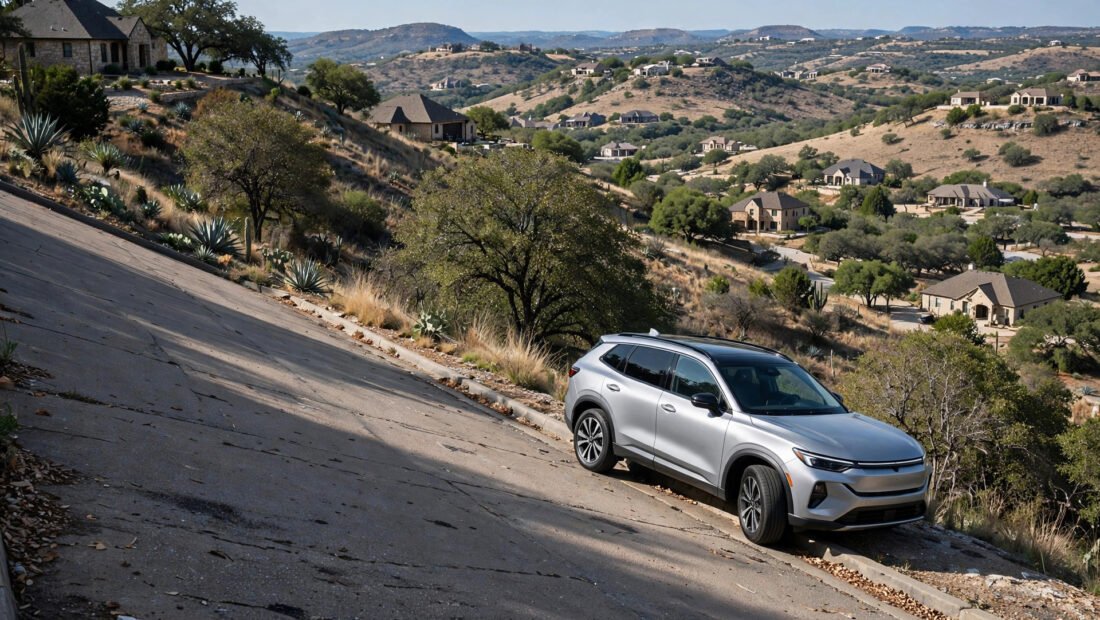
- Steep driveways: many Texas Hill Country homes have driveways that would qualify as ski slopes elsewhere. On the steepest ones, consider rubber wheel chocks ($15–$25) as a fourth layer — cheap insurance, especially for heavier SUVs and trucks.
- Flash-flood grades: during heavy Texas rains, never park in low-water crossings or dry creek beds regardless of transmission concerns — that’s a life-safety issue, not a mechanical one.
- Electronic parking brakes: most new cars have them; they engage automatically on many models when you shift to Park. Check your owner’s manual — if yours auto-engages, the correct sequence happens for you, but verifying is still smart.
- Heavy loads: towing a boat to the lake or hauling a loaded trailer? The pawl’s load multiplies with weight. Parking brake discipline matters even more, and chocks become near-mandatory on grades.
If your car has started making new clunks, grinding, or resistance when shifting out of Park on hills, have the parking pawl and linkage inspected — unusual sounds from your drivetrain are always worth investigating early, when fixes are cheap.
What About “Just Using Park” — Really?
Let’s be honest: millions of drivers park on mild grades using only Park and never have a failure. The pawl is robust, and on gentle slopes the load is small. The risk concentrates in three scenarios: steep grades (San Francisco-style streets, steep driveways), heavy vehicles (full-size trucks and SUVs multiply the force), and habitual use (the same loaded pawl, twice a day, for years). You don’t need to be precious about a 3% grade at the grocery store. You do need the full routine on real hills — and making it automatic means you never have to judge which is which.
Conclusion
Protecting your transmission on hills comes down to a five-second habit: foot brake, parking brake, then Park — plus turned wheels as your failsafe. The parking pawl is a backup, not a primary holding device, and treating it that way costs nothing while eliminating one of the most common sources of slow transmission wear. In a state with real hills, real heat (which already stresses transmissions), and real repair bills, it’s the cheapest maintenance you’ll ever perform. Make it muscle memory and your transmission will never know the difference — which is exactly the point. For more on keeping your vehicle healthy in demanding conditions, AAA’s car care guidance covers maintenance schedules worth following.
Frequently Asked Questions
Can parking on a hill actually damage my transmission?
Yes, over time. Resting the vehicle’s full weight on the parking pawl — especially on steep grades or with heavy vehicles — causes repeated shock-loading every time you shift out of Park. This wears the pawl and its mating gear. Using the parking brake first transfers the load to the brakes, which are designed for it.
Should I use the parking brake every time, even on flat ground?
It’s good practice. Regular use keeps the parking brake cables and mechanisms from seizing due to disuse — a common cause of parking brake failure. On flat ground the transmission isn’t at risk, but the habit keeps the system working for when you need it.
Which way do I turn my wheels when parking uphill without a curb?
Turn the front wheels toward the edge of the road (to the right in the US). If the brakes fail, the car will roll off the roadway rather than backward into traffic. Uphill with a curb: wheels away from the curb. Downhill: wheels toward the curb.
Is it bad that my car clunks when I shift out of Park on a hill?
That clunk is the sound of the loaded parking pawl releasing — it’s the wear you’re trying to avoid. An occasional mild clunk on a steep grade isn’t an emergency, but if it’s loud, frequent, or new, have the pawl and linkage checked. And start using the parking-brake-first sequence.
Do electronic parking brakes engage automatically?
Many newer vehicles auto-engage the electronic parking brake when you shift to Park or turn off the engine, but not all do. Check your owner’s manual to confirm your car’s behavior — and on steep hills, manually engaging it before shifting to Park is still the safest routine.