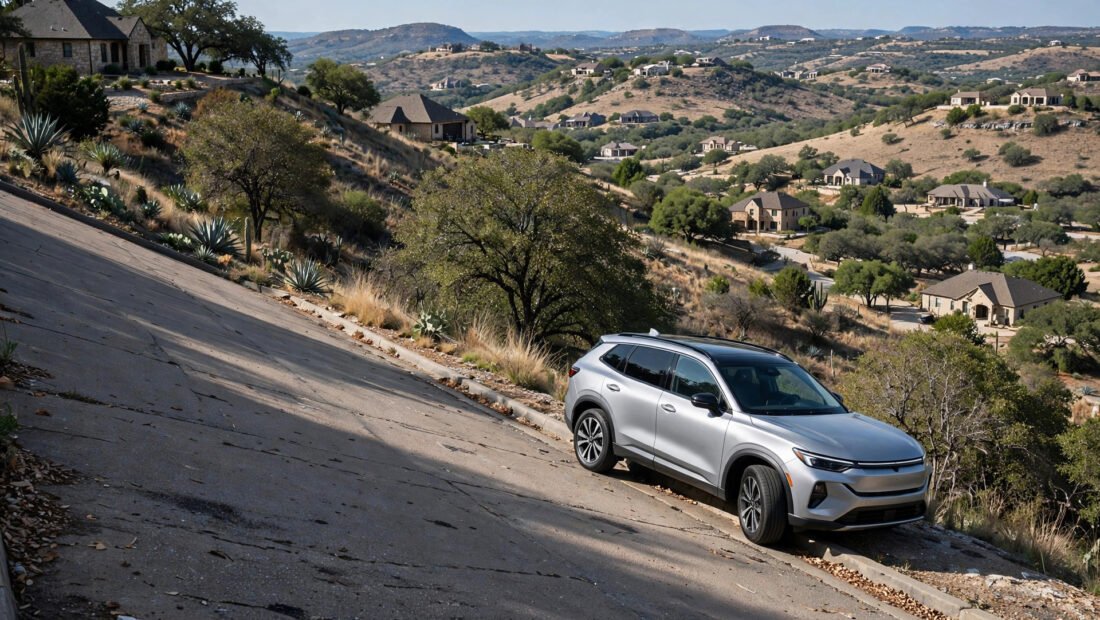
That heavy clunk when you shift out of Park on a slope is not just an ugly noise. It is the parking pawl unloading the weight of the whole car. The pawl is a small metal pin inside the transmission that slots into a notched wheel to stop the output shaft from turning. It was built to hold a parked car on level ground, not to act as the main brake for two tons of steel on a grade. Use it that way often enough and you wear the pin, stress the linkage, and make every departure from a hill start with a bang. Parking on a hill safely takes about ten extra seconds, done in the right order.
Step 1: Stop With the Foot Brake and Keep Your Foot Down
Come to a full stop in your space using the regular brake pedal, and do not lift your foot yet. The service brakes are by far the strongest holding system on the car, and they need to stay in charge until the parking brake takes over. If you shift to Park first and let the car roll a few inches until something catches, that catch is the pawl taking the load. On a flat driveway that roll is tiny. On the grades around Austin or in a steep Dallas parking garage, it is the whole weight of the car settling onto one small part.
While your foot is still down, take a second to straighten the car in the space and leave room to open your door. Rushing this moment is how most hill-parking mistakes happen. Everything that follows depends on the car staying completely still, held by the brakes, while you set the other systems in order.
Step 2: Set the Parking Brake While the Foot Brake Is Still Held
With your foot still firm on the brake pedal, set the parking brake fully. In a car with a lever, pull it up until it feels solid. With a pedal on the far left, press it all the way down. With an electronic parking brake, pull or press the switch and wait for the dashboard light that confirms it has engaged. Do not treat a half-set brake as good enough on a slope. The parking brake works on the rear wheels through a cable or small electric motors, separate from the transmission, and it is the system that should carry the car’s weight on the hill.
Now ease off the foot brake slowly and watch what happens. The car should barely move. A tiny settle onto the parking brake is normal. A clear roll that ends with a clunk means the parking brake is weak, was not fully set, or needs service. Test it here, while you are still in the seat, rather than discovering it after you walk away. If the brake will not hold the car on its own, do not trust Park to save it. Move to flatter ground and get the brake checked.
Making this a habit on flat ground helps too. A parking brake that gets used every day stays free and works when a hill demands it. One that sits unused for months can stick or lose its bite. Regular use also takes strain off the pawl everywhere you park, which costs you nothing and protects a transmission repair bill that starts around $1,500 for minor work and climbs past $4,000 for a rebuild.
Step 3: Turn the Wheels Toward Safety
Wheel direction is your backup plan if both brakes fail. The curb is the tool, so use it on purpose. The rule changes with direction and with whether a curb exists, and TxDOT’s Texas driver guidance teaches the same curb logic new drivers learn for the licensing test.
- Parking downhill with a curb: turn the front wheels toward the curb. If the car rolls, the front tire rolls gently into the curb and stops.
- Parking uphill with a curb: turn the front wheels away from the curb. Let the car roll back a few inches until the back of the front tire rests against the curb. If the brakes fail, the curb blocks the roll.
- Uphill or downhill with no curb: turn the front wheels toward the edge of the road, away from traffic. If the car rolls, it rolls off the roadway instead of into it.
On an uphill street with a curb, that small roll back to touch the curb is worth doing while your foot is still near the brake. It proves the tire is actually in position to catch the car. On steep residential streets, some drivers also carry rubber wheel chocks, at about $15 to $25 a pair, wedged against the downhill side of a tire. For a heavy truck or SUV on a serious grade, chocks are cheap, sensible insurance rather than overkill.
Step 4: Shift to Park Last, Then Shut Down
Only after the parking brake holds the car and the wheels are set should you shift to Park. At that point Park becomes the third layer of protection instead of the only one. Keep your foot on the brake while you shift, then turn off the engine and take the key or fob with you. Lock the car as usual. If you are parking a vehicle that will sit on the slope for days, a quick glance back to confirm it has not crept is worth the pause.
Drivers of manual-transmission cars follow the same brake order, then add gear choice. Set the parking brake first, let it take the weight, and leave the car in a low gear: first gear when facing uphill, reverse when facing downhill. The engine’s compression then resists rolling in the direction the slope wants to push the car. Never leave a manual in neutral on a hill and rely on the parking brake alone.
Step 5: Leave in Reverse Order So the Pawl Never Takes the Load
Getting out of the space correctly matters as much as parking, because this is when the clunk happens. Start the engine and put your foot firmly on the brake pedal first. Hold the car with the foot brake, then shift out of Park into Reverse or Drive while the brakes, not the pawl, hold the weight. You should feel the shifter move freely. Then release the parking brake, check your mirrors and blind spot, straighten the wheels if they are turned to the curb, and pull away gently.
If the shifter feels stuck and needs force, stop and reset. Press the brake harder, and on a steep grade let the parking brake hold while you try again. Forcing a loaded shifter is exactly the strain you are trying to avoid. One stuck shift on a mountain trip will not ruin a transmission. A daily habit of yanking the car out of Park on the same sloped driveway can wear the pawl and linkage over time and turn a cheap parking habit into shop time.
The same calm order helps with everyday efficiency habits too. Smooth stops and gentle starts protect brakes and save fuel, an idea covered in how to improve fuel efficiency without upgrades — careful inputs at low speed tend to be cheaper inputs everywhere.
A Note on Electronic Parking Brakes and Steep Garages
Many newer cars set the parking brake with a button instead of a lever or pedal, and some apply it on their own when you shift to Park or open the door. That convenience is welcome, but do not let it make you careless about order. Automatic engagement still happens after Park on some models, which means the pawl may already have taken a small load before the brake sets. On a real slope, press or pull the switch yourself while your foot is still on the brake pedal, wait for the confirmation light, and only then shift. If your car has a brake-hold or hill-hold feature, remember that it is a short-term driving aid that releases when you drive off or shut down. It is not a parking brake and it does not replace one.
Parking garages deserve special care because their ramps combine slope, smooth concrete, and tight turns. Stop fully on the ramp only when you must, keep extra distance from the car ahead, and use the full sequence when you reach your space, since garage floors are often sloped for drainage even when they look flat. If the car settles noticeably every time you park in the same garage spot, that spot is telling you the grade is real.
How Much Slope Is Enough to Bother?
You do not need a ceremony for every parking spot. On ground that is truly flat, Park plus the parking brake as a regular habit is plenty, and wheel turning matters only where a curb and a grade meet. The full sequence matters whenever the car would roll if you let off the brake in neutral, whenever you can feel the car settle hard into Park, and whenever you park on gravel, wet pavement, or a garage ramp where grip is lower. Downtown garage ramps, hill country driveways, and the sloped streets near a stadium all count.
Pay extra attention with heavy loads and trailers. Extra weight multiplies the force on every holding system, and a loaded truck on a grade deserves the parking brake, turned wheels, and chocks if you have them. Also be careful after brake work or on an older car whose parking brake has not been tested in a while. The first steep street is a bad place to learn the cable has stretched.
Learn the order once — foot brake, parking brake, wheels, then Park, and the reverse when you leave — and it becomes automatic within a week. Your shifter will move easily, the clunk will disappear, and the small pin inside your transmission can go back to the easy job it was designed for.