
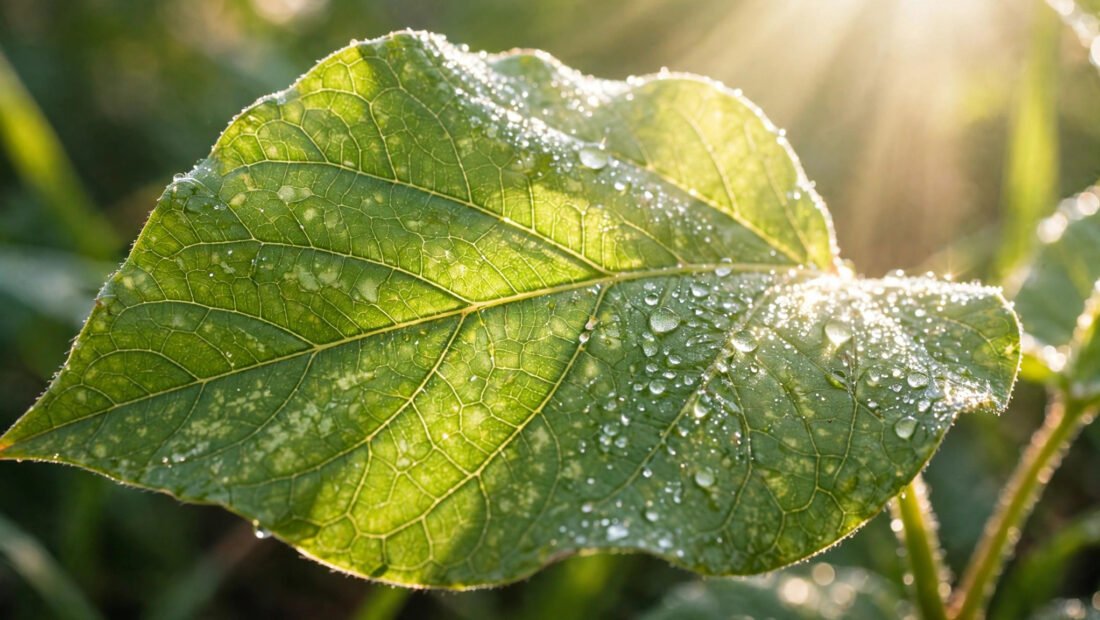
Every bite of food you’ve ever eaten, every breath you’ve ever taken, traces back to one elegant piece of molecular machinery: photosynthesis. Plants take sunlight, water, and air — three things that are individually useless as food — and manufacture sugar and oxygen from them, powering essentially all life on Earth. It’s the most important chemical reaction on the planet, and it happens silently in every leaf, including the houseplants on your windowsill. Here’s how it works, step by step, in plain English.
The Big Picture: Inputs and Outputs
The overall equation fits on one line: 6CO₂ + 6H₂O + light energy → C₆H₁₂O₆ + 6O₂. Carbon dioxide from the air plus water from the soil, powered by sunlight, becomes glucose (sugar) plus oxygen. The plant keeps the sugar as food and building material; the oxygen — the waste product — is what you and I breathe. Every oxygen molecule in the atmosphere was at some point photosynthetic waste. You’re breathing plant exhaust right now, and it’s wonderful.
This happens in two linked stages inside chloroplasts — the tiny green organelles packed into leaf cells. If you keep houseplants, you’ve seen chloroplasts’ handiwork: our guide to keeping houseplants alive is really a guide to keeping photosynthesis running smoothly, since light, water, and air are the three inputs your plants are constantly managing.
Step 1: Capturing Light (The Light-Dependent Reactions)
It starts with chlorophyll — the pigment that makes plants green — sitting inside structures called thylakoids within the chloroplast. Chlorophyll molecules act like antennas: when a photon of sunlight strikes one, it kicks an electron into a high-energy state. That energized electron gets passed along an electron transport chain — a molecular relay race — and the energy released at each handoff is captured to build two energy-carrier molecules: ATP and NADPH. Think of these as charged batteries the plant will spend in step 2.
Meanwhile, the chlorophyll molecule is missing its electron and needs a replacement. It steals one from water — splitting H₂O molecules in a process called photolysis. This split releases oxygen as a byproduct (there’s your breathable air) plus hydrogen ions that help power the whole system. So the oxygen you breathe is literally the leftover from plants recharging their chlorophyll with water-derived electrons. ASU’s Ask a Biologist program has excellent visual explainers of this stage for curious readers of any age.
Step 2: Building Sugar (The Calvin Cycle)
Now the plant spends its charged batteries. In the chloroplast’s fluid interior (the stroma), the Calvin cycle — named for chemist Melvin Calvin, who mapped it in the 1940s–50s — takes carbon dioxide from the air and assembles it into sugar. The key enzyme, RuBisCO, grabs CO₂ molecules and attaches them to a 5-carbon starter compound. Through a series of steps powered by the ATP and NADPH from step 1, these get rearranged into G3P — a 3-carbon sugar building block. Two G3P molecules combine to make one glucose.
Here’s the staggering part: RuBisCO is quite possibly the most abundant protein on Earth — there’s more of it than any other — because every plant needs enormous quantities to fix carbon fast enough. And it’s famously slow and sloppy as enzymes go, sometimes grabbing oxygen instead of CO₂ (a wasteful glitch called photorespiration). Plants compensate with sheer volume. Evolution’s most important enzyme is also one of its clunkiest — a humbling reminder that “good enough, at planetary scale” beats perfection.
Khan Academy’s photosynthesis unit walks through the Calvin cycle with diagrams that make the chemistry click, and the Smithsonian’s science resources cover photosynthesis in the broader context of Earth’s systems.
Step 3: What the Plant Does With the Sugar
Glucose isn’t the end — it’s the beginning. The plant immediately puts sugar to work: burned for energy through cellular respiration (plants respire too, day and night — photosynthesis and respiration are complementary, not opposites); built into cellulose for cell walls (that’s wood, cotton, and paper — all former sunlight); stored as starch in roots and seeds (potatoes, grains — the foods feeding humanity); and converted into everything else — proteins, fats, pigments, defensive chemicals. A tree is, quite literally, solidified sunlight and air, assembled molecule by molecule. Next time you see a Texas live oak, you’re looking at decades of captured photons holding up branches.
This is also why garden planning starts with light: different plants need different light intensities because their photosynthetic machinery is tuned differently. Our guide to planning your garden by location covers matching plants to your actual sun exposure — applied photosynthesis, essentially.
Why It Matters Beyond Biology Class
Photosynthesis isn’t just academic — it’s the foundation of civilization’s biggest challenges. Food security: crop yields are photosynthesis efficiency, and scientists are engineering better RuBisCO and photorespiration bypasses to feed 8+ billion people. Climate: photosynthesis is Earth’s largest carbon-capture technology, pulling ~120 billion tons of carbon from the air annually — forests and oceans are doing geoengineering for free. Energy: artificial photosynthesis research aims to replicate the process for clean fuel production. Understanding the mechanism means understanding the leverage points for humanity’s future — which is a lot of weight for a process happening quietly in a leaf.
See It Yourself: A Kitchen Experiment
Want to watch photosynthesis in action? Try the classic leaf-disk assay: punch small disks from a spinach leaf, sink them in a baking-soda solution with a syringe (removing air from the leaf), and place the cup in bright light. As photosynthesis produces oxygen, bubbles form in the leaf tissue and the disks rise — usually within 15–30 minutes. Move the cup to darkness and they sink again. It’s the standard biology-class demonstration of the light-dependent reactions, it costs almost nothing, and it makes the invisible visible. Kids love it; adults find it quietly astonishing.
Conclusion
Plants convert sunlight into energy in two linked stages: the light-dependent reactions capture photons with chlorophyll, split water (releasing the oxygen we breathe), and charge up ATP and NADPH batteries; then the Calvin cycle spends those batteries to assemble CO₂ from the air into sugar, which becomes everything from wood to wheat. It’s the most consequential chemistry on Earth — the reason there’s food, oxygen, and ultimately you. And it runs on three free inputs, in every green leaf, all day, asking nothing in return except decent light and a little water.
Frequently Asked Questions
Do plants do photosynthesis at night?
No — the light-dependent reactions need photons. But plants respire (burn sugar for energy) around the clock, and the Calvin cycle can briefly continue after dark using stored ATP/NADPH until those run out.
Why are plants green?
Chlorophyll absorbs red and blue light most efficiently and reflects green — the leftover wavelengths our eyes see. Some plants use accessory pigments (carotenoids, anthocyanins) that add yellows, oranges, and reds.
Can photosynthesis happen under artificial light?
Yes — grow lights work because plants care about photon quantity and wavelength, not the source. Red and blue LEDs are most efficient since they match chlorophyll’s absorption peaks.
How efficient is photosynthesis?
Surprisingly inefficient: most plants convert only 1–2% of incoming sunlight into biomass (sugarcane and a few others reach ~7–8%). Theoretical maximum is around 11% — there’s enormous headroom that crop scientists are trying to unlock.
Do all plants photosynthesize the same way?
Most use C3 photosynthesis (the Calvin cycle described here), but hot-climate plants evolved variants — C4 (corn, sugarcane) and CAM (cacti, agaves) — that handle heat and water scarcity better. Texas gardens are full of all three strategies.
