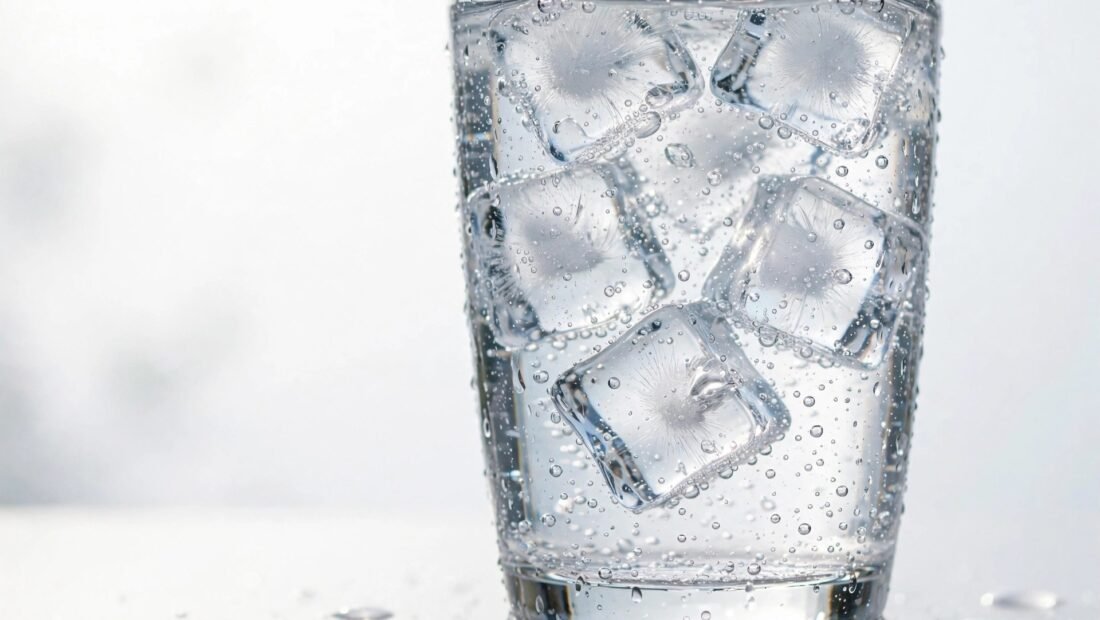
Drop a cube of ice into a glass of water and it bobs at the surface, most of it hidden below. It feels ordinary because you have seen it ten thousand times. It is not ordinary at all. Almost every other liquid, when it freezes, pulls its molecules closer together, grows denser, and its solid form sinks straight through its own melt. Solid steel sinks in molten steel. Frozen oil sinks in liquid oil. Water breaks the pattern. Its solid is lighter than its liquid, so it floats — and that one wrong-way behavior shapes lakes, oceans, plumbing, and the chances for life itself.
The Bonds That Refuse to Pack Tight
A water molecule is small and lopsided. It has one oxygen atom and two hydrogen atoms, and the electrical charge across it is uneven. The oxygen end carries a slight negative charge. The hydrogen ends carry a slight positive charge. Because of that unevenness, neighboring molecules attract each other in a specific way called a hydrogen bond. These bonds are weak compared with the bonds inside the molecule itself, and in warm liquid water they form and break at a furious pace. Molecules slide past each other, tumble, pair up for an instant, and move on.
As water cools, the sliding slows. Molecules have less energy to break free, so hydrogen bonds last longer and start to dictate where each molecule sits. Each molecule settles into bonds with four neighbors, arranged in a loose, open pattern rather than a tight pile. In liquid water, molecules can crowd in closer than that pattern allows, filling gaps as they move. In ice, they cannot. The bonds hold them at fixed angles and fixed distances, with empty space built into the arrangement itself. Order, in this case, takes up more room than disorder. That single fact explains almost everything that follows.
An Open Lattice, and the Numbers Behind Floating
When water freezes at normal pressure, its molecules lock into a hexagonal lattice — a crystal built from six-sided rings, open in the middle like a tiny honeycomb stretched in three dimensions. You can see the echo of that six-sided plan in a snowflake, which grows outward following the same geometry. The lattice is strong, but spacious — the empty space is part of how it is built.
The arithmetic is plain. Ice at freezing has a density of about 0.917 grams per cubic centimeter. Liquid water near freezing has a density of about 0.9998 grams per cubic centimeter. Ice is therefore roughly 9 percent less dense than the water it formed from, which is another way of saying that a given amount of water takes up about 9 percent more space once it is frozen. An object floats when it is less dense than the liquid around it, settling until it has displaced a weight of liquid equal to its own weight. For ice in fresh water, that balance point leaves about 90 percent of the ice below the surface and about 10 percent above it. The phrase tip of the iceberg is not a metaphor borrowed loosely from nature. It is a measurement.
That hidden bulk is why icebergs deserve their fearsome reputation. A berg that looks modest from a ship’s deck can extend far below and far outward underwater, in water cold enough to keep it intact for a long time. The same ratio holds at kitchen scale. Most of a large cube sits below the surface of a drink, quietly melting where you cannot see it. For a full treatment of water’s structure and behavior, Encyclopaedia Britannica’s explainers on the physics and chemistry of water provide a solid reference that goes well beyond the floating question.
The Second Quirk That Completes the Picture
Water has a companion oddity that matters just as much. Most liquids grow steadily denser as they cool, all the way down to freezing. Water does that only partway. It reaches its greatest density at 4 degrees Celsius, about 39 degrees Fahrenheit. Cool it further, from 4 degrees down toward 0, and it becomes slightly less dense again, expanding gently as loose, ice-like groupings begin to form in the liquid before true freezing starts.
Put the two quirks together and a lake in a cold climate behaves in a very specific, life-friendly sequence. In fall, surface water cools. Until it reaches 4 degrees, cooling makes it denser, so it sinks, pushing warmer water up to be cooled in turn. The lake mixes from top to bottom, carrying oxygen down and nutrients up. Once the whole body of water nears 4 degrees, further cooling changes direction. The coldest water, now the lightest, stays at the surface. It is that top layer that freezes. The ice forms a lid, and beneath the lid the water remains liquid, much of it near that 4-degree maximum, all winter long.
Remove either quirk and the sequence collapses. If ice were denser than water, each winter’s ice would sink as it formed, exposing fresh surface water to freeze in its place. Lakes would fill with ice from the bottom up, and many would freeze solid. If water kept growing denser below 4 degrees, the coldest water would collect at the bottom and freezing would work against life from both directions. Instead, the floating lid insulates. Ice and the snow that lands on it are poor conductors of heat, so they slow further cooling of the water below. Fish, insects, and plants winter over in that dark, cold, but liquid refuge, waiting for spring melt. Much of the freshwater life in temperate regions exists because freezing stops at the surface.
Where the Expansion Shows Up in Daily Life
The same 9 percent expansion that lifts ice in a glass becomes a destructive force when water freezes inside a closed space. A pipe full of water has nowhere for that extra volume to go. Pressure builds sharply behind and inside the ice plug, and it is often the pressure, acting on a weaker stretch of pipe away from the ice itself, that splits the metal or plastic. The damage then hides until the thaw, when water flows freely through the split and into walls, ceilings, and floors. Texas learned this at enormous scale during the February 2021 freeze, when pipes burst across the state in homes and buildings that had rarely needed to plan for sustained hard cold. Anyone reviewing how to winterize your home before the cold season is, at heart, planning around this exact expansion — draining exposed lines, insulating pipes, and letting faucets drip so pressure has a release.
Roads tell the same story in slow motion. Water seeps into small cracks in pavement, freezes on a cold night, and wedges the crack a fraction wider. Melt, seep, freeze, wedge — repeated over a season, the cycle turns hairline cracks into potholes. The same wedging, called frost action, splits rock over long spans of time and helps break mountains down into soil. In a freezer, the force announces itself more gently. The surface of a tray of water freezes first, forming a shell. The water inside freezes last and expands against that shell, which is why cubes often grow a small spike or crack with a cloudy, stressed center. Even the cooling of a drink follows the density rules. Meltwater near the surface is close to 4 degrees and at its densest, so it sinks, setting up a slow circulation that spreads the cold through the whole glass instead of leaving it in a layer at the top.
Ices That Do Sink
The floating kind of ice, the hexagonal form in your freezer, is only one of many ices scientists know. Under the extreme pressures found deep inside large icy moons and giant planets, water is squeezed into other crystal forms with tighter structures. Those high-pressure ices are denser than liquid water, and they would sink. They are not curiosities for their own sake. They shape how scientists model the interiors of worlds like Europa and Enceladus, where a floating surface shell of ordinary ice may cover a deep liquid ocean kept warm by tidal flexing. The floating shell insulates that ocean just as lake ice insulates a lake, which is one reason those distant oceans rank among the most promising places to search for life beyond Earth.
Closer to home, water still holds puzzles. It can be supercooled — kept liquid below its normal freezing point if it is very clean and left undisturbed — then freeze in a sudden rush when shaken or touched with a seed crystal. Heavy water, made with a heavier form of hydrogen, forms ice that sinks in ordinary water, a neat proof that floating is a matter of molecular structure and mass, not a rule that frozen things must rise. Researchers still debate fine details of liquid water’s structure and odd effects like the claim that hot water can sometimes freeze faster than cold water under specific conditions. Water is the most studied liquid on Earth, and it has not finished surprising the people who study it.
Two Kitchen Checks That Make It Visible
You do not need a lab to watch the density rules work. For the first check, fill a clear plastic bottle completely with water, right to the brim, cap it tightly, and put it in the freezer. Check it after several hours. The bottle will bulge, strain at its seams, or split as the freezing water claims its extra 9 percent of space. That is pipe-bursting physics at a safe scale, and it lands harder than any diagram. Use a bottle you do not mind throwing away, and set it in a bowl in case it leaks as it thaws.
For the second check, freeze a small container of olive oil alongside a container of water. Olive oil behaves the way most substances do. It contracts as it solidifies, and the frozen portion sinks in its own liquid. Set the two side by side and you have the normal rule and water’s exception in front of you at once, visible to a child in under a minute. A tall glass of water with a large cube offers a third, quieter check any day of the year. Look at the waterline and judge the split for yourself. About a tenth rides above the surface. The other nine-tenths, the part doing the insulating in lakes and hiding the danger in icebergs, stays out of sight — which is, in the end, the most fitting thing about it.