
My first apartment kitchen was roughly the size of a parking space, and I cooked in it almost every night. It taught me something big kitchens never do: organization isn’t about having more space, it’s about making every inch work harder.
The best way to organize a small kitchen starts with a hard truth — you probably own too much stuff for the space. That’s not a judgment; it’s physics. Once you right-size your tools, a handful of smart strategies can make a tiny kitchen feel genuinely functional.
Here’s the exact approach I’d use, whether you’re in a studio apartment or just working with a galley kitchen that never had enough cabinets.
Declutter First: The Small Kitchen Edit
Before buying a single organizer, do the edit. Pull everything out of one cabinet at a time and ask the honest question: have I used this in the last year? The bread maker, the fondue set, the third mixing bowl — donate, sell, or relocate them. In a small kitchen, every item pays rent in cabinet space, and freeloaders get evicted.
Consolidate ruthlessly. You need one good chef’s knife (plus a paring knife), one cutting board, one sheet pan, one skillet, one pot, one saucepan. Everything beyond that should justify its footprint weekly. I got rid of my toaster oven when I realized the regular oven did the job — instant shelf back.
This pairs perfectly with a full-home reset: our guide to decluttering your home in one weekend uses the same zone-by-zone method and covers the kitchen in detail.
Create Zones, Even in 60 Square Feet
Professional kitchens run on zones, and tiny kitchens should too. Group by task: a prep zone (knives, cutting board, mixing bowls near the counter), a cooking zone (pots, pans, utensils, oils near the stove), and a cleanup zone (dish soap, towels, drying rack near the sink). When everything for a task lives together, you stop crisscrossing the kitchen.
Store items at their point of use. Spices near the stove, not across the room. Coffee stuff together in one spot — I keep beans, grinder, and filters in a single basket so ‘making coffee’ is one grab. Dishes and glasses near the dishwasher or drying area. It sounds obvious, but most kitchens grow by accident, not design.
Think in terms of frequency too: daily items at eye and hand level, weekly items up high or down low, yearly items (the turkey roaster) somewhere else entirely — a closet, the top of a wardrobe, anywhere but prime kitchen real estate.
Go Vertical: Walls, Doors, and the Space Above
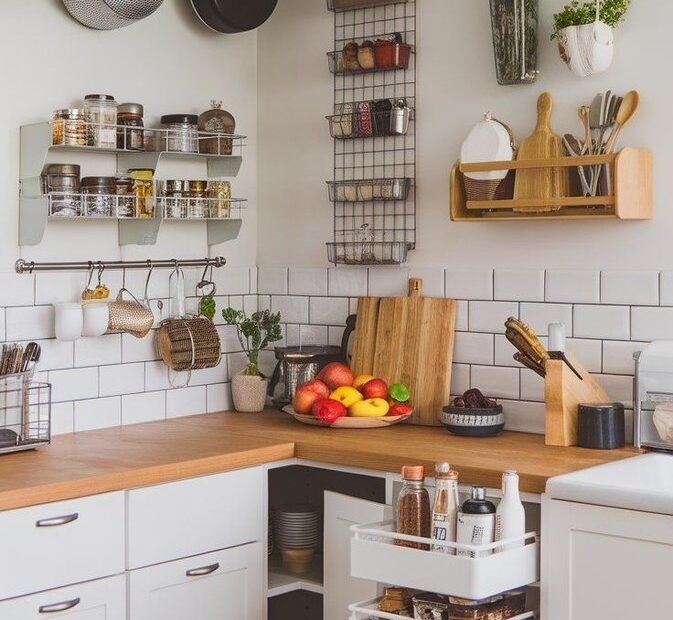
In a small kitchen, the walls are cabinets you haven’t installed yet. A magnetic knife strip frees an entire drawer. A pegboard or rail with hooks holds utensils, pots, and pans — the classic Julia Child-style pegboard isn’t just charming, it’s brutally efficient. Over-the-door racks on pantry doors add a full shelf of storage for spices and wraps.
Don’t ignore the cabinet doors themselves: mount a small rack inside for cutting boards and sheet pans, or stick a paper towel holder under a cabinet. The inside of a sink cabinet door is perfect for a trash bag dispenser. These are $10 fixes that create storage out of thin air.
Above the cabinets, if there’s a gap, use it for the rarely-used stuff in labeled bins — just keep a step stool handy. And if you have any wall space at all near the prep area, a narrow floating shelf for oils, salt, and the pepper grinder keeps counters clear while keeping essentials within reach.
How to Organize a Small Kitchen You Actually Cook In
A small kitchen has to be organized around your real cooking, not a magazine layout. Track what you actually make for two weeks — most families rotate the same 10–12 meals. Then organize around those: the pasta pot lives near the stove because Tuesday is pasta night, the baking sheet is accessible because sheet-pan dinners happen weekly, and the bread maker you use twice a year lives in a closet. This ‘cook-first’ organization means the 20 percent of tools you use 80 percent of the time are always within reach, and everything else is stored, not staged.
Don’t underestimate the power of decanting. Flour, sugar, rice, and pasta in uniform clear containers do three things: they show you exactly what you have (no more buying a third bag of rice), they stack efficiently in a way bags never do, and they make the shelves look calm — which makes the whole kitchen feel bigger. It’s a $30 investment that pays off daily. And if the rest of the house needs the same treatment, our weekend declutter plan uses the identical zone-by-zone method for every room.
12 Small Kitchen Organization Wins
- Do the one-cabinet-at-a-time declutter edit first
- Keep only tools you use weekly; relocate the rest
- Set up prep, cooking, and cleanup zones
- Store items at their point of use
- Mount a magnetic knife strip to free a drawer
- Hang pots and utensils on a wall rail or pegboard
- Use over-the-door racks on pantry doors
- Add risers inside cabinets to double shelf space
- Nest bowls and use lid organizers for pots
- Corral coffee/tea supplies in one grab-and-go basket
- Put daily items at eye level; yearly items elsewhere
- Keep counters 80% clear — only the true daily essentials stay out
The Clear-Counter Rule
If you take one rule from this, make it the clear-counter rule: counters should be at least 80 percent empty. A clear counter makes a small kitchen feel twice as big, makes cooking actually pleasant, and makes cleanup take minutes. Everything left out must earn its spot daily — the coffee maker qualifies; the decorative olive oil does not.
Revisit the system every few months. Kitchens drift — a gadget creeps in, a zone blurs. A fifteen-minute reset each season keeps the small kitchen working hard. And remember the goal was never a magazine kitchen; it’s a kitchen where cooking dinner after work doesn’t feel like a punishment.
Small kitchens reward the organized and punish the cluttered. Get the edit right, zone it well, go vertical — and that parking-space kitchen will cook like one twice its size.



