
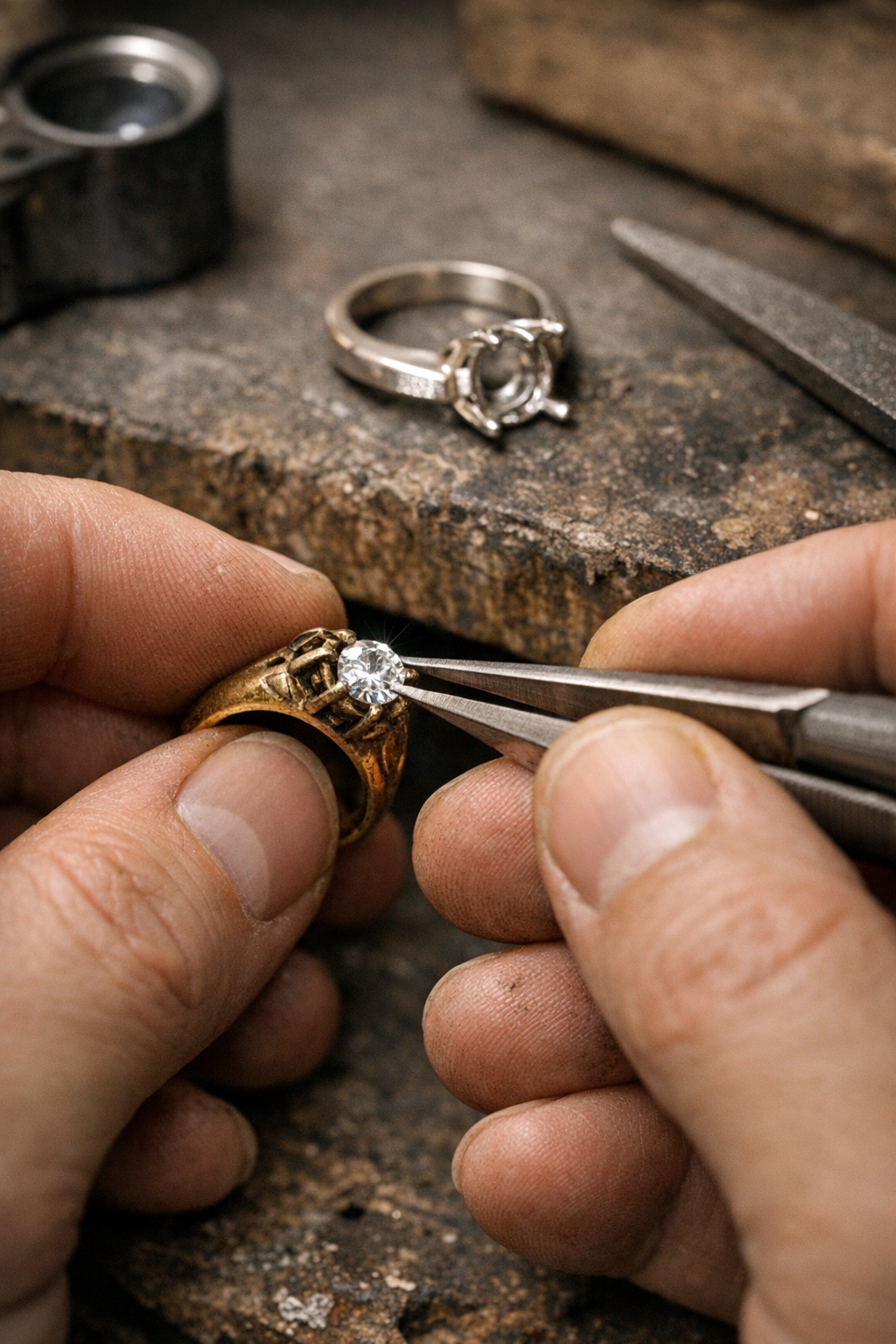
The ring spins loose on your finger in winter and sticks tight in summer, and now it needs resizing for good. Before you hand it over, know that the jeweler’s quote turns on five things you can check yourself in about two minutes. None of them requires tools. All five are listed below, and each one can move a routine $40 job toward $150 or more, or confirm that your ring sits at the cheap end of the range.
The Five-Point Check Before You Get a Quote
- 1. Direction and distance: Are you sizing up or down, and by how many sizes? Down is cheaper. One size is routine. Three or more sizes is a different, pricier job.
- 2. Metal: Is the band silver, gold, or platinum? Silver costs least, gold sits in the middle, platinum costs most. Titanium and tungsten usually cannot be resized at all.
- 3. Stones and setting style: Is it a plain band, a single center stone, or rows of small stones? Plain bands cost least. Pavé and channel settings cost more, and an eternity band with stones all the way around usually cannot be resized.
- 4. Band width and surface detail: Is the band wide and thick, and does engraving or a pattern cross the bottom of the band where the cut is made? Wide bands need more metal and labor, and detail that crosses the cut must be restored afterward.
- 5. Timing and shop: Do you need it rushed, and are you going to a city jeweler, a chain, or a small independent shop? Rush work adds a quarter to a half, and city prices run well above small-town prices for the same job.
With those five answers in hand, the price ranges below stop being a guess. For a standard gold or silver ring adjusted by one size, expect $30 to $80. Most routine resizes land between $30 and $150 in total. Platinum, detailed designs, and multi-stone settings can push the bill past $250. Couples pricing a wedding set alongside everything else may also find it useful to see how to build a Texas wedding budget without debt, since small services like resizing are exactly the costs that get forgotten until the final month.
Direction and Distance: Why Down Costs Less Than Up
Sizing down by one size typically costs $30 to $80. The jeweler cuts a small section out of the band and solders the ends back together. No new precious metal is needed, which keeps both material and labor low.
Sizing up by one size typically costs $50 to $150. Going larger means adding precious metal, so you pay for the gold or platinum itself plus the extra labor of blending it in. That single difference, material added versus material removed, explains most of the gap between up and down quotes across nearly every shop.
Distance matters as much as direction. A simple adjustment of one size on a plain band runs $20 to $60. A moderate resize of two to three sizes runs $50 to $150. At three sizes or more, a jeweler may need to re-shank the ring, replacing part of the band entirely, which moves the price into the $120 to $250 range. A complex resize involving a detailed design and several sizes can reach $150 to $300 or more. If your ring needs a large change, ask whether re-shanking is part of the quote, because that one word explains a quote that looks high next to a one-size price.
Metal: The Second-Biggest Price Driver
Sterling silver, at $20 to $60, is soft and easy to work, and a simple silver band is often a same-day job. It is the cheapest common metal to resize.
Gold, at $30 to $100, is also relatively soft and resizes well. Expect that range for 14K yellow gold. An 18K ring costs more because the metal itself is pricier. White gold carries a specific extra: it usually needs rhodium re-plating after resizing to restore its bright finish, which adds $25 to $60. Rose gold can be resized, but its copper alloy makes clean soldering trickier, so quotes tend to sit at the higher end of the gold range and the work is best given to a jeweler experienced with it.
Platinum, at $50 to $150 or more, is harder, has a higher melting point, and takes more labor. Industry pricing roundups put platinum resizes at roughly double the cost of gold. Titanium and tungsten sit outside the table entirely. Both are too hard to cut and solder by normal methods, so a ring in either metal generally needs replacement rather than resizing. Stainless steel belongs in the same hard-to-resize group. For general care and metal guidance beyond pricing, the Gemological Institute of America’s jewelry guides are a solid reference to check before any bench work is agreed.
Stones and Settings: Where Design Changes the Job
A plain band with no stones is the easiest resize in the business, often $20 to $50 and back within days. There is nothing to protect from heat and nothing to reset.
A solitaire engagement ring typically runs $60 to $120. The single center stone usually does not interfere, because the jeweler works on the opposite side of the band from the setting. That holds unless you are changing more than two sizes, at which point the setting itself may need attention.
Pavé and channel-set rings run $90 to $180. Rows of small stones near the cut site may need to be removed and reset so the heat of soldering does not damage them. Each stone adds labor, and each reset stone adds a small amount of risk that should be discussed before work starts.
Heat-sensitive stones add a separate surcharge. Opals, emeralds, pearls, and turquoise can crack or discolor under a jeweler’s torch. A careful jeweler will remove them first or use laser welding, which concentrates heat in a tiny area. Either approach adds handling, typically $20 to $50 per stone.
Eternity bands are the usual refusal. With stones set all the way around the band, resizing breaks the symmetry of the design. Some jewelers will attempt it for a steep fee of $150 or more, but most will advise against it, and a tension setting raises the same problem. A jeweler can tell you whether your ring falls in this group in about thirty seconds, so ask before assuming any price applies.
Width, Detail, Shop, and Speed: The Remaining Costs
Band width and thickness change the amount of metal and labor in direct proportion. A slim 2mm band and a heavy 8mm band are priced like different jobs because they are different jobs. Engraving, patterns, and milgrain edges that cross the cut point must be restored after resizing, and that restoration adds $30 to $100 or more.
Where you go shifts the total by a wide margin. Urban jewelers charge 20 to 50 percent more than suburban or small-town shops. Chain stores sometimes include free resizing with a new purchase, so ask if you bought the ring there. Independent jewelers often give the best mix of price and craftsmanship for repair work, since repairs are a core part of their trade rather than an add-on service.
Speed is the last lever. Standard turnaround is 3 to 7 business days, with same-day or next-day service sometimes available for plain bands and complex stone work taking 2 to 3 weeks. Expedited resizing adds 25 to 50 percent to the bill. A proposal deadline is a poor reason to pay that premium if the ring can be handed over a week earlier instead.
Five Questions to Ask Before the Ring Leaves Your Hand
- Is this an all-in price? Confirm that polishing, refinishing, and any stone tightening are included rather than added at pickup.
- Will the sizing show? A skilled jeweler’s solder joint should be invisible. Hesitation on this answer is a reason to choose another shop.
- Could any stones loosen? Sizing down can loosen settings. Ask whether re-tightening is included in the quote.
- Do you guarantee the work? Reputable jewelers warranty sizing work, typically for at least a year.
- How long will it take? Get the answer in writing if a date matters to you.
One measurement habit prevents a repeat visit. Have your finger measured professionally at the time of day when your fingers are largest, usually the afternoon. Fingers swell in heat and shrink in cold, so a ring sized on a winter morning can spin by summer, which is the exact problem described at the start. Done properly, resizing does not damage a ring: the joint should be invisible, the band should stay sound, and polishing and refinishing should leave the finish uniform. Done poorly, it can leave a visible seam, a weakened band, or loosened stones, which is why the choice of jeweler matters more than a small price difference.
Resist any urge to do it at home. Do-it-yourself sizing kits exist, but without proper soldering equipment the likely result is a weak, rough joint or a ruined ring. A standard one-size job is a modest professional service, usually back on your finger within a week. Run the five-point check, ask the five questions, and the quote you receive should hold no surprises.




1 Comment