Somewhere between the profile photo and the first coffee, there is a new question in online dating that nobody had to ask five years ago: how much of this person am I actually meeting — and how much of them is software? AI has not replaced dating apps; it has seeped into every stage of the funnel, from the photo you swipe on to the message that charms you to the system deciding who sees whom. Following one match from creation to coffee shows where the machines now stand, and the one stage they still cannot reach.
Stage one: the profile is no longer just written, it is produced
Profile creation used to mean a friend, a camera, and an excruciating half-hour choosing adjectives. Now the standard toolkit includes AI photo enhancement and selection — tools that rank your photos by predicted appeal and clean up lighting — generators that draft bios from a few bullet points about your life, and prompt-answer polishers that sand a real answer into a charming one. The honest spectrum runs from harmless (choosing which of your real photos leads) to quietly fictional (a face tuned past recognition, a personality assembled by a language model). Daters have always curated; what is new is the degree of manufacture available to everyone, for free, in minutes — which moves the old advice “the photos should look like you” from etiquette to verification strategy.
Stage one-and-a-half: some of the people are not people
The sharper end of profile production deserves its own stage. Alongside real users polishing real photos sits a population of profiles that are fabricated outright — stolen pictures, generated faces, script-driven conversation — built to harvest money, data, or attention. AI has lowered the cost of a convincing fake to nearly nothing: a face that exists nowhere, a backstory in fluent local idiom, small talk that never sleeps. The defense is partly the platforms’ (stage four), but partly a new instinct daters are developing: skepticism proportional to perfection. The profile with studio-grade photos, a biography like a film trailer, and replies that are always charming and never specific is no longer just a lucky dater; it is a pattern to verify. A short video call before meeting — once considered forward — is becoming the standard authenticity check, the dating equivalent of asking to see the goods before paying. None of this is a reason to leave the apps. It is a reason the verification step has moved from the first date to before it.
Stage two: matching, from filters to behavior
The matching layer changed earlier and deeper than most users realize. First-generation apps matched on stated preferences: age, distance, the boxes you ticked. Modern systems weight what you do — who you linger on, reply to, and meet — learning patterns from millions of interactions to predict mutual interest rather than declared interest. The effect is a feed that feels eerily attuned and a new kind of opacity: neither person in a match can fully say why the algorithm introduced them, and the system’s real objective — engagement with the app — is not identical to yours, which is a successful relationship that deletes it. Holding both truths at once is the adult way to use these platforms: the matchmaker is talented, and it works for the app.
Stage three: the first message, possibly written by neither of you
Here is where the ground has shifted most recently. Apps have begun offering AI-drafted openers and reply suggestions; third-party “wingman” tools will analyze a profile and compose the witty first line; and some users run entire early conversations through a chatbot, pasting in replies and sending what it suggests. The tell, when there is one, is texture: messages that are smooth, warm, and strangely unconnected to anything specific the other person said. Learning to spot machine-polished text is becoming a basic dating literacy — the same skill, interestingly, as how to tell if a product review was written by AI: look for fluency without fingerprints.
Set aside the deception question and a practical one remains: a conversation conducted by two AIs on behalf of two humans generates chemistry data about nobody. The early chat used to be a low-resolution preview of the person. Outsourced, it becomes two brochures exchanging pleasantries — which is why so many people now report the strange experience of a sparkling text exchange and a flat first date. The medium was carrying information; the polish removed it.
Stage four: the safety layer, where AI is unambiguously welcome
Not every change is a loss. The same pattern-matching now works defensively at scale: detecting fake profiles built from stolen or generated photos, flagging the conversational shapes of romance scams — the rapid intimacy, the engineered crisis, the pivot to money — and powering photo verification that ties an account to a real, present human. Romance fraud is industrial in scale and devastating in effect; AARP’s guide to spotting romance scams catalogues the human red flags, and the platforms’ AI screening is increasingly the automated version of the same vigilance, intercepting bad actors before any individual has to spot them alone. If AI’s role in dating has a clear win, this is it: the bouncer, not the ghost-writer, is its best job.
Stage five: the coffee, unchanged
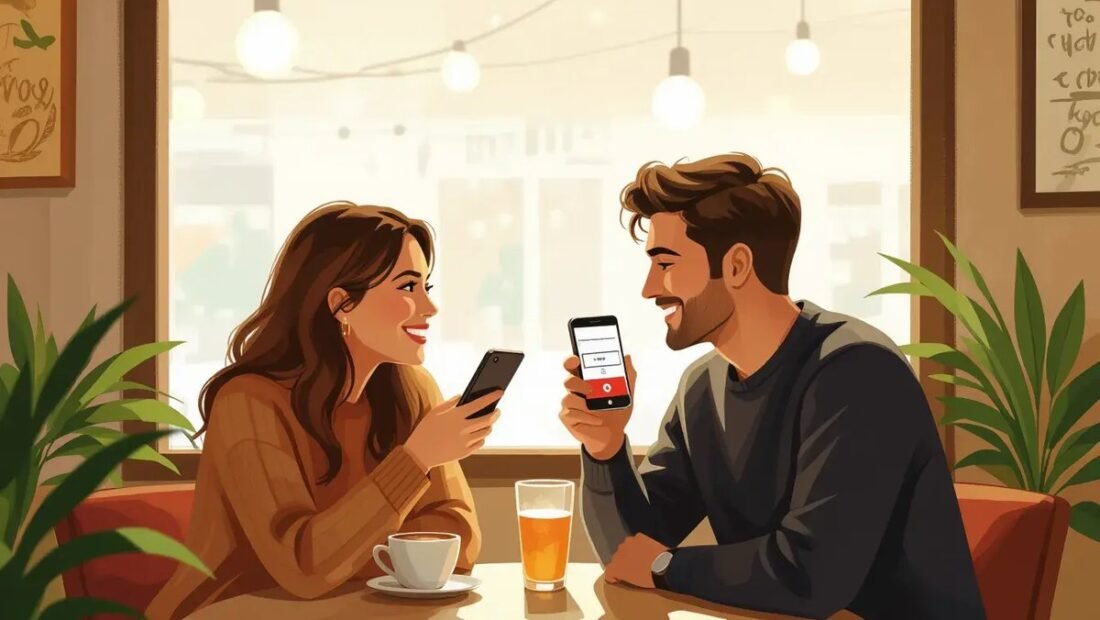
And then the funnel ends where it always has. Two people, a table, and the rapid, unmediated assessment humans have run on each other forever — voice, humor, kindness to the waiter, the feeling of being listened to. Nothing in the pipeline simulates it and nothing about it has been automated, which throws the earlier stages into useful relief. Every AI improvement to the funnel increases the volume and polish of people reaching this table; none of them changes what happens at it. The practical daters are adapting accordingly: lighter investment in text chemistry, faster movement to a short real meeting, and a gentle presumption that the charming profile — like a good CV — is a document to be verified in person rather than a person to fall for in advance.
What daters are quietly doing about all this
Adaptations are emerging that say a lot about what people actually value once the polish is stripped away. Deliberately unpolished profiles — unfiltered photos, a bio with an odd specific detail no generator would invent — are being used as authenticity signals, the equivalent of a handwritten note in a world of printed ones. Some daters open with a voice message instead of text, because a voice is still expensive to fake convincingly and carries the warmth text cannot. Others state their AI use plainly in the profile — “photos are mine, opener wasn’t” — treating disclosure the way other fields treat it: as the difference between a tool and a trick. And the oldest technology in the story is having a revival: meeting briefly and early, in public, for coffee, before the texting builds a person who does not exist. Every one of these habits points the same direction. The more manufactured the funnel becomes, the more the scarce and valued commodity is unmanufactured evidence of a real human — which suggests the apps’ future competes less on who generates the smoothest illusion and more on who verifies reality best.
A note on the money layer underneath it all
One stage hides beneath the five: payment. Premium boosts, priority visibility, read receipts, unlimited swipes — the modern app increasingly sells relief from the very friction it designed, and AI sharpens this too, by identifying exactly which users are frustrated enough to pay and timing the offer to the moment of maximum discouragement. None of this is scandalous; it is a business model. But it completes the honest picture of the intermediary: the system that introduces you also meters your hope, and its definition of a good outcome — a subscribed, engaged, still-swiping user — is not the same as yours. Daters who do best on these platforms tend to hold the relationship lightly for exactly this reason: use the app as an introduction service, set a budget of money and attention in advance, and let success mean leaving. An AI matchmaker that profits while you search is a tool to be used with a plan, not a fate to surrender to.
The shape of the change
AI has made online dating more produced, more mediated, and in its safety layer, genuinely safer — while leaving its essential transaction, two people deciding about each other in person, entirely untouched.
The risks are new versions of old ones: misrepresentation with better tools, and an intermediary whose interests are not yours quietly shaping who you meet. The opportunity is equally traditional: people who present themselves honestly now stand out precisely because the machinery makes polish cheap. In a feed of generated charm, the specific, slightly unoptimized, evidently real person has become the rarest profile on the app — which is a strange and rather hopeful place for a technology story to end up.