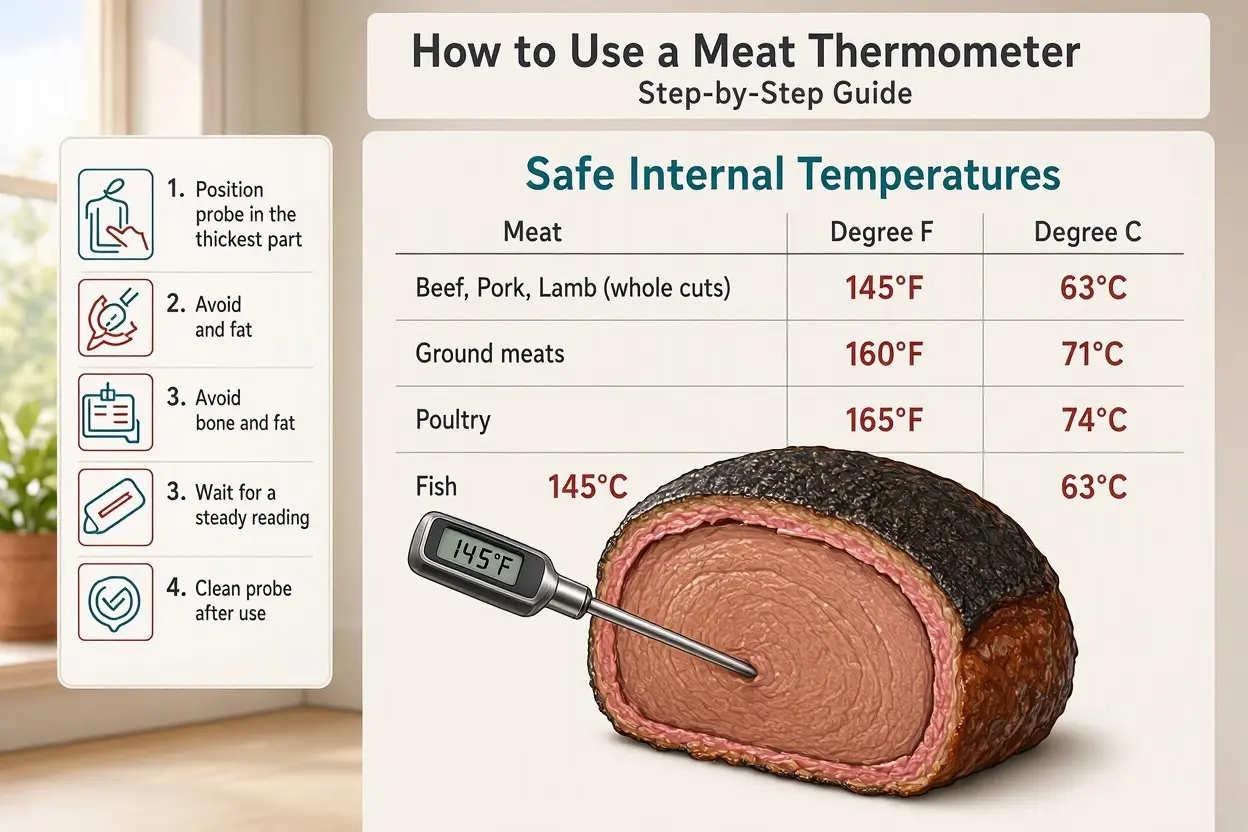
Color, firmness and cooking time are unreliable ways to tell when meat is done. A meat thermometer takes the guesswork out, keeps your food safe and stops you from overcooking a great cut. This guide covers how to use a meat thermometer, where to place it, how to read it and what temperatures to aim for.
Why You Should Use a Meat Thermometer
The USDA says to never rely on color, firmness or time to know if food is fully cooked. Always cook meat to a minimum safe internal temperature measured with a food thermometer. A USDA study found that only 55% of people use one, even though 88% own one.
Any cooked, uncured red meat, including pork, can look pink even after it reaches a safe internal temperature. You can’t judge safety by eye.
Types of Meat Thermometers
- Instant-read (digital or dial): Gives a reading in seconds. Instant-read thermometers are not oven-safe and must not stay in the meat while it cooks. You insert them near the end of cooking, check, then remove.
- Leave-in (oven-safe) or probe thermometers: The probe stays in the meat while it cooks in the oven, and a cable connects it to a display outside. This is what you want if you ask, “can you leave a meat thermometer in the oven?” Only use models labeled oven-safe.
- Wireless or smart thermometers: Probe-based models that send readings to your phone, good for long roasts and grilling.
- Analog (dial) thermometers: Cheaper and slower, but fine for roasts if you read them carefully.
How to Use a Meat Thermometer, Step by Step
- Calibrate it first. Put the probe in a glass of ice water. It should read 32°F (0°C). If it doesn’t, adjust it or follow the maker’s instructions.
- Start checking near the end of cooking. Don’t wait until the meat is overdone.
- Insert into the thickest part. The thermometer should go in the thickest part of the food, away from bone, fat or gristle, which can give false readings.
- Go deep enough. For an instant-read, insert about 2 inches or to the indicator mark on the stem, and let it stay for about 15 seconds.
- Read the temperature. Wait for the number to stop climbing on a digital model, or for the needle to settle on a dial.
- Clean the probe. Wash it with hot soapy water between checks, especially after raw meat, to avoid cross-contamination.
Where to Put a Thermometer in Chicken
For whole poultry such as a chicken or turkey, insert the thermometer into the inner thigh near the breast, without touching bone. If you’re cooking chicken breast, insert it sideways into the thickest part. Check a second spot if the bird is large, and cook until the lowest reading reaches 165°F.
How to Use a Meat Thermometer on Steak, Roast Beef and Pork
- Steaks and chops: Insert from the side into the center of the thickest part so the tip sits in the middle, not poking through.
- Roasts (beef tenderloin, roast beef, pork): Insert into the center of the thickest part, away from bone and fat.
- Ground meat and burgers: Insert the probe sideways into the center of the patty.
- Ham: Insert into the thickest part, avoiding the bone.
- Fish: Insert into the thickest part of the fillet.
Safe Internal Temperature Chart (USDA)
| Meat | Minimum internal temperature |
|---|---|
| Beef, pork, veal and lamb (steaks, chops, roasts) | 145°F (63°C) with a 3-minute rest |
| Ground meat and sausage | 160°F (71°C) |
| Chicken, turkey and all poultry | 165°F (74°C) |
| Raw ham | 145°F (63°C) with a 3-minute rest |
| Precooked ham (to reheat) | 165°F (74°C), or 140°F (60°C) for ham packaged in USDA-inspected plants |
| Fish | 145°F (63°C) |
| Leftovers and casseroles | 165°F (74°C) |
These figures come from the USDA and foodsafety.gov. Rest time matters too. During the rest, the meat’s temperature stays the same or keeps rising, which destroys harmful germs.
Steak Doneness Temperatures
The USDA minimum for steak is 145°F. Many cooks prefer steak cooked less, which is a personal choice, and USDA notes that people may cook to higher temperatures by preference. Common guides are roughly 125°F for rare, 130 to 135°F for medium-rare, 140 to 145°F for medium and 150 to 155°F for medium-well. If you cook steak below 145°F, you accept some food-safety risk, which matters most for ground meat, poultry, pregnant women, older adults and young children.
Also, remember carryover cooking: meat keeps climbing a few degrees after leaving the heat, so pull it slightly early for larger roasts.
How to Read a Meat Thermometer
- Digital: Read the number once it stops changing.
- Dial (analog): Read the needle straight on to avoid parallax, and check the marked zone for each meat if your dial has one.
- Dial probes: Insert to the marked dimple, which is the sensing point.
Brands like OXO, Good Cook and others follow the same basic logic, but check your manual for how deep the sensing area sits.
Common Mistakes to Avoid
- Touching bone, which reads hotter than the meat
- Inserting too shallow, which reads cooler
- Leaving a non-oven-safe thermometer in the oven
- Skipping calibration
- Not cleaning between raw and cooked meat
- Checking only one spot on thick or irregular cuts
- Using a meat thermometer to take your body temperature, which is unsafe and inaccurate
How to Use a Meat Thermometer: FAQs
How do you use a meat thermometer correctly?
Insert it into the thickest part of the meat, away from bone, fat and gristle, wait for a stable reading and compare it to the safe temperature for that meat.
Where do you put the thermometer in a chicken?
In the inner thigh near the breast without touching bone, or in the thickest part of a breast. Cook until it reads 165°F.
Can you leave a meat thermometer in the oven?
Only if it’s oven-safe, such as a leave-in probe model. Instant-read thermometers should not stay in the oven.
Can you leave a thermometer in meat while cooking?
Yes, with a leave-in or probe thermometer designed for it. Not with a standard instant-read.
How do you read a meat thermometer?
On a digital model, read the number once it settles. On a dial, read the needle at eye level.
What temperature is meat done?
USDA minimums are 145°F for whole cuts of beef, pork, lamb and veal (with a 3-minute rest), 160°F for ground meat and 165°F for poultry.
How deep should you insert a meat thermometer?
About 2 inches, or to the marked line on the stem, reaching the center of the thickest part.
Should the thermometer touch bone?
No. Bone conducts heat differently and gives a false reading.
Can I use a meat thermometer to take my temperature?
No. Meat thermometers aren’t designed or calibrated for body temperature, so use a medical thermometer.
What’s the best meat thermometer to buy?
A fast digital instant-read suits most people, and a leave-in probe is better for roasts and long cooks.Color, firmness and cooking time are unreliable ways to tell when meat is done. A meat thermometer takes the guesswork out, keeps your food safe and stops you from overcooking a great cut. This guide covers how to use a meat thermometer, where to place it, how to read it and what temperatures to aim for.
Why You Should Use a Meat Thermometer
The USDA says to never rely on color, firmness or time to know if food is fully cooked. Always cook meat to a minimum safe internal temperature measured with a food thermometer. A USDA study found that only 55% of people use one, even though 88% own one.
Any cooked, uncured red meat, including pork, can look pink even after it reaches a safe internal temperature. You can’t judge safety by eye.
Types of Meat Thermometers
- Instant-read (digital or dial): Gives a reading in seconds. Instant-read thermometers are not oven-safe and must not stay in the meat while it cooks. You insert them near the end of cooking, check, then remove.
- Leave-in (oven-safe) or probe thermometers: The probe stays in the meat while it cooks in the oven, and a cable connects it to a display outside. This is what you want if you ask, “can you leave a meat thermometer in the oven?” Only use models labeled oven-safe.
- Wireless or smart thermometers: Probe-based models that send readings to your phone, good for long roasts and grilling.
- Analog (dial) thermometers: Cheaper and slower, but fine for roasts if you read them carefully.
How to Use a Meat Thermometer, Step by Step
- Calibrate it first. Put the probe in a glass of ice water. It should read 32°F (0°C). If it doesn’t, adjust it or follow the maker’s instructions.
- Start checking near the end of cooking. Don’t wait until the meat is overdone.
- Insert into the thickest part. The thermometer should go in the thickest part of the food, away from bone, fat or gristle, which can give false readings.
- Go deep enough. For an instant-read, insert about 2 inches or to the indicator mark on the stem, and let it stay for about 15 seconds.
- Read the temperature. Wait for the number to stop climbing on a digital model, or for the needle to settle on a dial.
- Clean the probe. Wash it with hot soapy water between checks, especially after raw meat, to avoid cross-contamination.
Where to Put a Thermometer in Chicken
For whole poultry such as a chicken or turkey, insert the thermometer into the inner thigh near the breast, without touching bone. If you’re cooking chicken breast, insert it sideways into the thickest part. Check a second spot if the bird is large, and cook until the lowest reading reaches 165°F.
How to Use a Meat Thermometer on Steak, Roast Beef and Pork
- Steaks and chops: Insert from the side into the center of the thickest part so the tip sits in the middle, not poking through.
- Roasts (beef tenderloin, roast beef, pork): Insert into the center of the thickest part, away from bone and fat.
- Ground meat and burgers: Insert the probe sideways into the center of the patty.
- Ham: Insert into the thickest part, avoiding the bone.
- Fish: Insert into the thickest part of the fillet.
Safe Internal Temperature Chart (USDA)
| Meat | Minimum internal temperature |
|---|---|
| Beef, pork, veal and lamb (steaks, chops, roasts) | 145°F (63°C) with a 3-minute rest |
| Ground meat and sausage | 160°F (71°C) |
| Chicken, turkey and all poultry | 165°F (74°C) |
| Raw ham | 145°F (63°C) with a 3-minute rest |
| Precooked ham (to reheat) | 165°F (74°C), or 140°F (60°C) for ham packaged in USDA-inspected plants |
| Fish | 145°F (63°C) |
| Leftovers and casseroles | 165°F (74°C) |
These figures come from the USDA and foodsafety.gov. Rest time matters too. During the rest, the meat’s temperature stays the same or keeps rising, which destroys harmful germs.
Steak Doneness Temperatures
The USDA minimum for steak is 145°F. Many cooks prefer steak cooked less, which is a personal choice, and USDA notes that people may cook to higher temperatures by preference. Common guides are roughly 125°F for rare, 130 to 135°F for medium-rare, 140 to 145°F for medium and 150 to 155°F for medium-well. If you cook steak below 145°F, you accept some food-safety risk, which matters most for ground meat, poultry, pregnant women, older adults and young children.
Also, remember carryover cooking: meat keeps climbing a few degrees after leaving the heat, so pull it slightly early for larger roasts.
How to Read a Meat Thermometer
- Digital: Read the number once it stops changing.
- Dial (analog): Read the needle straight on to avoid parallax, and check the marked zone for each meat if your dial has one.
- Dial probes: Insert to the marked dimple, which is the sensing point.
Brands like OXO, Good Cook and others follow the same basic logic, but check your manual for how deep the sensing area sits.
Common Mistakes to Avoid
- Touching bone, which reads hotter than the meat
- Inserting too shallow, which reads cooler
- Leaving a non-oven-safe thermometer in the oven
- Skipping calibration
- Not cleaning between raw and cooked meat
- Checking only one spot on thick or irregular cuts
- Using a meat thermometer to take your body temperature, which is unsafe and inaccurate
How to Use a Meat Thermometer: FAQs
How do you use a meat thermometer correctly?
Insert it into the thickest part of the meat, away from bone, fat and gristle, wait for a stable reading and compare it to the safe temperature for that meat.
Where do you put the thermometer in a chicken?
In the inner thigh near the breast without touching bone, or in the thickest part of a breast. Cook until it reads 165°F.
Can you leave a meat thermometer in the oven?
Only if it’s oven-safe, such as a leave-in probe model. Instant-read thermometers should not stay in the oven.
Can you leave a thermometer in meat while cooking?
Yes, with a leave-in or probe thermometer designed for it. Not with a standard instant-read.
How do you read a meat thermometer?
On a digital model, read the number once it settles. On a dial, read the needle at eye level.
What temperature is meat done?
USDA minimums are 145°F for whole cuts of beef, pork, lamb and veal (with a 3-minute rest), 160°F for ground meat and 165°F for poultry.
How deep should you insert a meat thermometer?
About 2 inches, or to the marked line on the stem, reaching the center of the thickest part.
Should the thermometer touch bone?
No. Bone conducts heat differently and gives a false reading.
Can I use a meat thermometer to take my temperature?
No. Meat thermometers aren’t designed or calibrated for body temperature, so use a medical thermometer.
What’s the best meat thermometer to buy?
A fast digital instant-read suits most people, and a leave-in probe is better for roasts and long cooks.