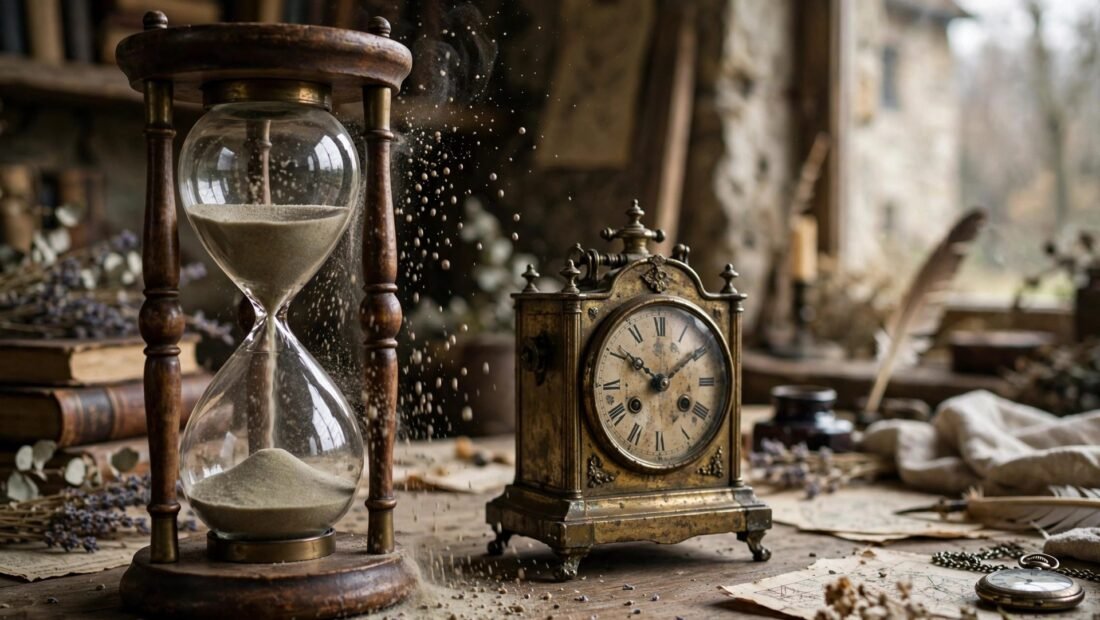
Ask a 10-year-old about summer and it’s an eternity; ask a 50-year-old about the last decade and it’s a blur that somehow already happened. Nearly everyone experiences time accelerating with age — the years don’t just pass, they evaporate. Psychologists have studied this universal sensation for over a century, and while there’s no single proven cause, the leading theories converge on something fascinating: your brain doesn’t measure time with a clock. It measures it with memories.
Here’s what science says about why time speeds up as we age — and what you can actually do to slow it down.
The Memory Theory: Time Is What You Remember
The dominant explanation, tracing back to William James in 1890, is elegantly simple: we judge the length of a time period by how many memorable events it contained. Childhood is dense with firsts — first day of school, first bike, first everything — each laying down vivid, distinct memories. Looking back, the period feels long because the mental archive is full.
Adulthood is the opposite: routine compresses experience. The commute, the inbox, the weekly groceries — the brain, an efficiency machine, stops recording repetitive events distinctly. A year of routine leaves few memory landmarks, so in retrospect it feels like almost nothing happened. As neuroscientist David Eagleman puts it, time’s apparent speed is a function of memory density: novel experiences stretch time in retrospect; routine shrinks it.
This also explains the paradox of the present moment: a boring meeting drags in real time (prospective timing — you’re watching the clock) but vanishes in retrospect (nothing worth remembering). Vacations feel short while happening but long looking back — dense with novelty. The two judgments use different machinery.
The Proportional Theory: A Year Is a Smaller Slice
The oldest folk explanation is mathematical: at 10, a year is 10% of your life; at 50, it’s 2%. Each unit of time is proportionally smaller, so it feels shorter. Intuitive — but psychologists note it can’t be the whole story, because the effect persists even when researchers control for proportional framing, and because subjective time doesn’t scale as neatly as the math predicts. Still, proportionality likely contributes: the brain does seem sensitive to relative magnitudes, and a decade genuinely is a smaller fraction of a 60-year life than a 6-year one.
The Attention Theory: We’re Distracted Now
A newer candidate: attention fragmentation. Modern adult life — especially in always-connected Texas metros — is lived in a state of continuous partial attention: phones, notifications, multitasking. Time perception research shows that when attention is divided, less gets encoded, and periods of divided attention feel shorter in retrospect. Childhood, for all its chaos, involved deeper immersion in single activities — hours lost in play that adults rarely replicate.
Related is the “routine automation” effect: as skills automate (driving, working, cooking), consciousness disengages — you arrive home with no memory of the drive. Automated time leaves no trace. Children automate little; almost everything requires attention, so almost everything gets recorded.
The Biological Clock Theory: Does the Brain Slow Down?
Some researchers propose a physiological component: that the brain’s internal pacemaker — the rate at which it samples the world — slows with age. Children process more “frames per second,” making the world seem slower and richer; adults process fewer, making time feel compressed. There’s intriguing support: studies show older adults are worse at detecting rapid flicker and brief gaps, consistent with a slower sampling rate. Dopamine decline with age may play a role, since dopamine modulates time perception.
This theory is the least settled but potentially the most profound — it suggests the acceleration isn’t just about memory or routine, but about the literal speed of neural processing changing across the lifespan.
Why It Matters: More Than a Curiosity
The speeding of time isn’t just cocktail conversation — it shapes life satisfaction. People who feel time flying report more regret about unused time and more anxiety about mortality. But the research also reveals the levers: the same mechanisms that accelerate time can be deliberately countered. Understanding that time perception is constructed — not measured — means it can be influenced.
There’s also a well-being angle: the “time famine” feeling (never enough time) correlates with stress and reduced happiness, while “time affluence” — the sense of having enough — predicts well-being more strongly than income in some studies. Managing your relationship with time is genuinely a health behavior, adjacent to stress management and sleep hygiene in its life-satisfaction impact.
How to Slow Time Down: Evidence-Based Strategies
Seek novelty deliberately. The strongest lever: new experiences create dense memories that stretch retrospect. Take different routes, try new restaurants, learn skills, travel — even micro-novelty (a new park, a new recipe) helps. The goal isn’t constant adventure; it’s breaking the automation that erases time.
Practice attention. Single-task sometimes. Put the phone away during dinner. Mindfulness meditation has modest but real effects on time perception — present-moment awareness is the opposite of the divided attention that compresses time.
Mark time with rituals and firsts. Annual traditions, monthly adventures, weekly “new thing” commitments create the memory landmarks that make years feel full in retrospect. Photographs and journaling amplify the effect — reviewing them re-densifies the past.
Learn continuously. The APA’s research on engagement and well-being aligns with a simple truth: brains engaged in learning lay down richer memories. A year of learning feels longer than a year of routine — and leaves you with more than memories.
The Pandemic Effect: Why 2020-2021 Felt So Strange
The COVID years provided a natural experiment in time perception — and the results were paradoxical. Lockdown months dragged interminably in the moment (prospective timing: monotony plus clock-watching) yet the years vanished in retrospect (almost no distinct memories formed). Psychologists call this the “pandemic time warp,” and it perfectly illustrates the memory-density theory: routine without novelty compresses the past even when the present felt endless.
It also demonstrated the theory’s practical lever: people who deliberately created novelty during lockdowns — new skills, new routes, new rituals — reported the period feeling longer and richer in retrospect. The lesson generalizes: when life forces routine on you, manufacturing small novelties isn’t frivolous — it’s how you keep time from disappearing.
Conclusion
Time seems to move faster as we age mostly because our brains measure the past in memories, and adult routine starves the archive — compounded by proportional shrinking, divided attention, and possibly a slowing neural clock. But none of this is destiny. Novelty, attention, rituals, and learning re-densify experience, stretching time back out. The years will pass at the same speed regardless; the question is how much of them you’ll actually have lived — and remembered.
For the neuroscience of time perception, NIH research on cognition and aging funds the relevant work.
Frequently Asked Questions
Why does time go faster as you get older?
The leading theory: we judge past time by memory density, and adult routine creates fewer distinct memories than novelty-rich childhood. Proportionality (a year is a smaller fraction of life), divided attention, and possibly slower neural processing also contribute.
Is there scientific proof that time speeds up with age?
The subjective experience is near-universal and well-documented, though its causes are still debated. Memory-density theory has the strongest support; biological-clock theories have intriguing but preliminary evidence.
Can you actually slow down your perception of time?
Yes — seeking novel experiences, practicing focused attention, creating rituals and “firsts,” and continuous learning all increase memory density, which stretches time in retrospect. Routine is what compresses it.
Why did childhood summers feel so long?
They were dense with firsts and novel experiences, each laying down distinct memories — plus at age 8, three months is a huge proportional chunk of life. Both memory density and proportionality were maximized.
Does the brain have an internal clock?
Yes — multiple timing systems exist, from millisecond-level cerebellar timing to circadian rhythms. Dopamine modulates interval timing, and age-related dopamine decline may partly explain why time feels faster as we age.