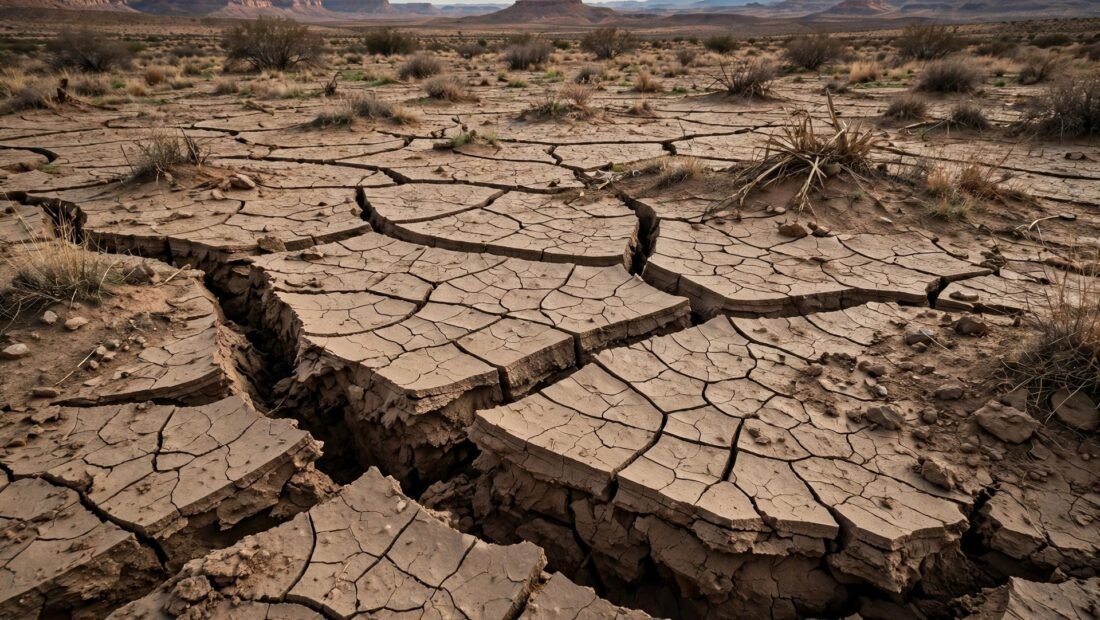
Texas isn’t California — but the ground moves here more than most residents realize. Between natural fault lines and thousands of oilfield wastewater injection wells, Texas has gone from a handful of noticeable quakes a year to hundreds, including magnitude 5+ events that cracked walls in West Texas. Understanding how earthquakes happen — and why predicting them remains one of science’s famous unsolved problems — matters more in Texas than it used to.
How Earthquakes Happen: The Elastic Rebound
Earth’s outer shell is broken into tectonic plates that creep past each other at roughly the speed your fingernails grow. Where plates meet — at faults — the rock edges catch and lock while the plates keep pushing. Stress builds for years, decades, or centuries, deforming the rock like a stretched rubber band. Eventually the stress exceeds the friction holding the fault, the rock snaps forward in seconds, and the stored energy radiates outward as seismic waves. That snap is the earthquake.
The point underground where the rupture starts is the hypocenter; the point on the surface above it is the epicenter. The rupture can tear along the fault for miles in a major quake — the 1906 San Francisco rupture ran nearly 300 miles. Magnitude measures the energy released (each whole number is ~32x more energy); intensity measures the shaking felt at a location.
Texas’s Earthquake Story: Natural and Human-Made
West Texas sits in a naturally active zone — the 1931 Valentine earthquake (magnitude 6.5) remains the state’s largest recorded. But the modern surge is largely human-caused: injecting oilfield wastewater deep underground increases pore pressure along ancient faults, effectively lubricating them until they slip. The science is settled — the U.S. Geological Survey has documented the injection-earthquake link extensively, and studies of the Permian Basin and Dallas-Fort Worth sequences finger wastewater disposal specifically.
The Texas Railroad Commission (which regulates oil and gas) has responded with injection limits in the hardest-hit areas, and quake rates have moderated in some zones — evidence that the lever works both ways. Notable recent events include the 2022 magnitude 5.4 quake near Midland and swarms around Pecos and Snyder that rattled nerves and cracked foundations.
Can We Predict Earthquakes? The Honest Answer
Short-term prediction — no. Despite decades of research, no one can predict the time, place, and magnitude of a specific earthquake. Promising precursors (animal behavior, radon gas, electromagnetic signals) have all failed rigorous testing — they produce far too many false alarms and misses. The USGS states plainly that earthquake prediction is not currently possible, and claims otherwise (viral “predictions” after every major quake) are pseudoscience: with enough vague forecasts, someone always appears right by chance.
Long-term forecasting — yes, probabilistically. Seismologists can estimate the likelihood of quakes over decades on known faults — the famous “72% chance of a magnitude 6.7+ in the Bay Area by 2043” style forecasts. These use fault slip rates, historical records, and stress models. They’re genuinely useful for building codes and insurance, just not for evacuation timing.
Early warning — yes, after it starts. Systems like ShakeAlert detect the fast, weak P-waves and warn before the destructive S-waves arrive — seconds to tens of seconds of warning. Enough to stop trains, halt surgeries, and duck under desks. Texas doesn’t yet have a public warning system, but the technology is proven in California, Oregon, and Washington.
What Science Is Working On
The frontier is operational forecasting — updating probabilities in near-real-time after quakes (aftershock forecasting already works reasonably well) — and AI pattern detection in seismic data. Machine learning models have found subtle patterns in laboratory rock-fracture experiments and in slow-slip events that precede some quakes. Whether these scale to real prediction remains unproven, but it’s the most promising avenue in decades. Researchers are also mapping Texas’s faults in unprecedented detail using oil-industry seismic data — knowing exactly where the faults are is prerequisite to any forecasting.
For context on how forecasting compares across hazards, AI weather prediction accuracy shows what machine learning can and can’t do with chaotic natural systems — earthquakes are harder, because we can’t see the fault the way we see the sky.
What Texans Should Actually Do
Prediction isn’t coming soon; preparation works now. Know your zone: West Texas and parts of North Texas near injection areas have the highest hazard — check the USGS seismic hazard maps. Secure your space: anchor water heaters and tall furniture, know how to shut off gas. Plan: drop, cover, and hold on during shaking; keep shoes and a flashlight by the bed (broken glass is the classic quake injury); maintain 72 hours of water and supplies — standard emergency guidance that covers hurricanes too. Insurance: standard Texas homeowners policies don’t cover earthquake damage — riders are cheap in most of the state and worth considering in active zones.
Notable Texas Earthquakes: A Brief History
1931 Valentine earthquake (M6.5): the state’s largest recorded — toppled chimneys, cracked walls across West Texas, felt from Oklahoma to Mexico. A reminder that natural Texas quakes predate the oil industry by a lot.
1995 Alpine earthquakes (M5.7, M5.0): a doublet near Alpine that damaged buildings and rattled the Big Bend region — natural tectonic activity along West Texas fault systems.
2008-2015 Dallas-Fort Worth swarm: hundreds of small quakes near Irving and Azle, conclusively linked to wastewater injection — the sequence that proved the human-caused mechanism to Texas regulators and led to injection restrictions.
2022 Midland M5.4: the fourth-strongest in state history, felt across West Texas and eastern New Mexico, causing minor damage — part of the ongoing Permian Basin induced sequence.
The pattern is clear: a background of natural West Texas seismicity, overlaid since ~2008 by injection-induced swarms in the Barnett Shale and Permian Basin. Both demand the same preparedness.
Conclusion
Earthquakes happen when tectonic stress overcomes fault friction in a sudden snap — and in Texas, human wastewater injection has been pulling that trigger with increasing frequency. We can’t predict specific quakes, may never be able to, but we can forecast hazard zones, get seconds of early warning, and prepare effectively. The science has moved from “why is the ground shaking?” to “we know why, and we know what to do.” In earthquake country — which now includes parts of Texas — preparation is the prediction.
Earthquake country overlaps flood country in much of Texas — know what to do if your basement floods after heavy rain, since the same emergency kit covers both.
For household preparedness checklists, Ready.gov’s earthquake preparedness guidance is the official resource.
Frequently Asked Questions
Why is Texas having more earthquakes?
Primarily oilfield wastewater injection: pumping huge volumes of water deep underground increases pressure on ancient faults until they slip. The USGS has extensively documented this link, especially in the Permian Basin and Dallas-Fort Worth areas.
Can scientists predict earthquakes?
Not specific ones — no reliable method predicts the time, place, and magnitude of an earthquake. Scientists can forecast long-term probabilities for fault zones and provide seconds of early warning after a quake starts, but precise prediction remains unsolved.
What was the biggest earthquake in Texas history?
The 1931 Valentine earthquake in West Texas, magnitude 6.5 — the largest recorded in state history. Recent induced quakes have reached magnitude 5.4 (Midland, 2022).
Does Texas have an earthquake early warning system?
Not yet — systems like California’s ShakeAlert provide seconds to tens of seconds of warning by detecting fast P-waves before destructive S-waves arrive. The technology is proven but not deployed statewide in Texas.
Does homeowners insurance cover earthquakes in Texas?
Standard Texas homeowners policies exclude earthquake damage. Inexpensive earthquake riders are available and worth considering, especially in West and North Texas near active zones.