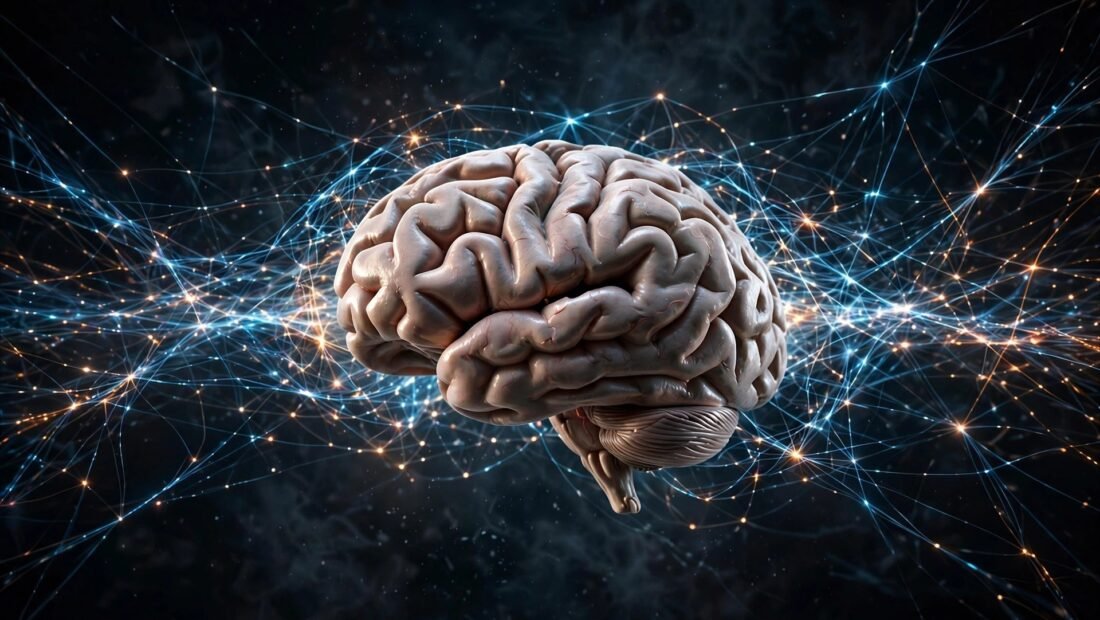
You can probably recall your childhood phone number but not what you had for lunch last Tuesday. That selective permanence isn’t a flaw — it’s the design. Your brain processes millions of sensory inputs daily, keeps a tiny fraction, and files the keepers through one of the most sophisticated storage systems in nature. Understanding how long-term memories form doesn’t just satisfy curiosity; it reveals how to learn faster, remember longer, and protect your memory as you age.
Here’s what neuroscience actually knows about how your brain stores long-term memories — and how to work with the system instead of against it.
From Sensation to Storage: The Three Stages
Memory formation moves through three stages. Sensory memory holds raw input for milliseconds to seconds — the visual echo of a scene, the ring of a sound. Almost all of it vanishes instantly. Short-term (working) memory keeps about 4-7 items active for under a minute through rehearsal — the phone number you repeat until you dial. Long-term memory is the durable archive: potentially unlimited capacity, lasting decades.
The critical transition — from working memory to long-term storage — is called consolidation, and it’s where the real neuroscience happens. Not everything gets consolidated; your brain is ruthlessly selective, prioritizing emotionally charged, novel, repeated, and survival-relevant information. That’s why you remember your wedding day and forget Tuesday’s lunch: the system is working as designed.
The Hippocampus: Memory’s Librarian
Deep in the temporal lobe sits the hippocampus, a seahorse-shaped structure that acts as memory’s intake coordinator. When you experience something, the hippocampus binds together the distributed fragments — the sights processed in visual cortex, sounds in auditory cortex, emotions in the amygdala — into a coherent episode, then gradually teaches the cortex to store it independently.
This “systems consolidation” takes weeks to years. It’s why damage to the hippocampus (as in the famous patient H.M., whose hippocampi were surgically removed in 1953) destroys the ability to form new long-term memories while leaving old ones — already consolidated to cortex — intact. H.M. could learn new motor skills without remembering practicing them, proving that different memory types use different machinery.
Synapses: Where Memories Physically Live
At the cellular level, memories are patterns of synaptic strength. The dominant mechanism is long-term potentiation (LTP): when two neurons fire together repeatedly, the connection between them strengthens — more receptors are inserted, the synapse physically enlarges, and future signals cross more easily. “Neurons that fire together, wire together” is the one-sentence summary of memory formation.
Strengthened synapses can then trigger structural changes: new dendritic spines grow, gene expression shifts, and proteins are synthesized to lock in the change. This is why repetition and spaced practice work — each reactivation re-triggers the molecular cascade that stabilizes the trace. Memories aren’t filed like documents; they’re etched as preferred pathways through neural networks, reactivated (and slightly rewritten) each time you recall them.
Different Memories, Different Systems
Explicit (declarative) memory — facts and events you can consciously recall — depends on the hippocampus and medial temporal lobe. It splits into episodic (your experiences) and semantic (general knowledge: Paris is France’s capital).
Implicit memory — skills and habits you can’t necessarily articulate — runs on different hardware: the basal ganglia and cerebellum handle procedural memory (riding a bike, touch-typing), while the amygdala stores emotional associations (fearing dogs after a bite). This is why you can lose the ability to form new facts yet still learn new skills — the systems are genuinely separate.
Sleep plays a starring role across all systems: during deep sleep, the hippocampus replays the day’s experiences to the cortex, like a librarian shelving books overnight. Cutting sleep short-circuits consolidation — which is why getting enough sleep is the single most underrated memory technique in existence.
Why We Forget (And Why It’s a Feature)
Forgetting isn’t system failure — it’s curation. The brain actively prunes: unused synapses weaken (long-term depression, LTP’s mirror), interference from similar memories blocks retrieval, and neurogenesis in the hippocampus may actually overwrite old traces to make room for new learning. People with hyperthymesia — near-perfect autobiographical memory — often describe it as a burden, not a gift: unable to filter, they drown in recall.
Retrieval failure differs from storage loss: the memory exists but the access path is broken — the tip-of-the-tongue phenomenon. Cues (context, smells, related facts) rebuild the path, which is why you remember the name in the shower. Memories are also reconstructive, not recordings: each recall slightly alters the trace, which is why eyewitness testimony is notoriously unreliable and why two siblings remember childhood differently.
How to Work With Your Memory System
Space your repetitions. Reviewing material at expanding intervals (1 day, 3 days, 1 week, 1 month) exploits the consolidation curve far better than cramming — each spaced retrieval strengthens the trace more than the last.
Test yourself, don’t re-read. Retrieval practice (trying to recall) builds stronger memories than re-reading, because the effort of retrieval itself reinforces the pathway.
Connect to what you know. Elaboration — linking new facts to existing knowledge, stories, or vivid images — gives the hippocampus more hooks for binding. Bizarre, emotional, or funny associations stick best.
Sleep on it. Study, then sleep — consolidation does its heaviest work overnight. An all-nighter before an exam sacrifices the very process that would have saved the material.
Exercise regularly. Aerobic exercise promotes hippocampal neurogenesis and is one of the few interventions with solid evidence for memory protection with aging. The National Institute on Aging’s brain health resources summarize the lifestyle factors with the strongest evidence.
When Memory Fails: Aging and Disease
Normal aging slows retrieval and working memory but leaves well-consolidated knowledge largely intact — the “senior moment” is usually a retrieval glitch, not storage loss. Alzheimer’s disease is different: it attacks the hippocampus and entorhinal cortex first, destroying the consolidation machinery itself — which is why recent memories vanish while childhood ones persist. Current research focuses on early detection (blood biomarkers, now emerging) and interventions that support synaptic health. While no supplement has proven preventive power, the boring fundamentals — sleep, exercise, social engagement, cardiovascular health, continued learning — have the best evidence of any “memory protection” strategy.
Conclusion
Long-term memories form through a remarkable pipeline: the hippocampus binds experiences, sleep replays them to the cortex, and synapses physically strengthen through repeated co-firing — with different systems handling facts, skills, and emotions separately. Forgetting is the system’s curation, not its failure. Work with the machinery — space your practice, test yourself, sleep enough, stay active — and you’ll remember more with less effort. Your brain already knows how to store a lifetime; you just need to give it the conditions it was designed for.
Since consolidation happens overnight, falling asleep faster without sleeping pills is one of the highest-leverage memory upgrades available.
For deeper reading on memory science, NIH neuroscience resources aggregates the research.
Frequently Asked Questions
Where are long-term memories stored in the brain?
Initially coordinated by the hippocampus, long-term memories are gradually consolidated into the cortex — distributed across the regions that originally processed the experience. Procedural memories (skills) live in the basal ganglia and cerebellum; emotional memories involve the amygdala.
How does sleep affect memory?
During deep sleep, the hippocampus replays daily experiences to the cortex, driving systems consolidation. Sleep deprivation directly impairs this process — it’s the single biggest controllable factor in memory formation.
Why do I remember emotional events better?
The amygdala tags emotionally arousing experiences as important, triggering stress hormones that strengthen hippocampal consolidation. Evolution prioritized remembering threats and triumphs over neutral details.
Can you improve your long-term memory?
Yes — spaced repetition, retrieval practice (self-testing), elaborative encoding, adequate sleep, and regular aerobic exercise all have solid evidence. No supplement has proven comparable benefit.
Is forgetting normal or a sign of a problem?
Forgetting is normal and functional — the brain prunes unused traces deliberately. Concern is warranted only for patterns like rapidly worsening recent-memory loss, getting lost in familiar places, or functional impairment — worth discussing with a doctor.