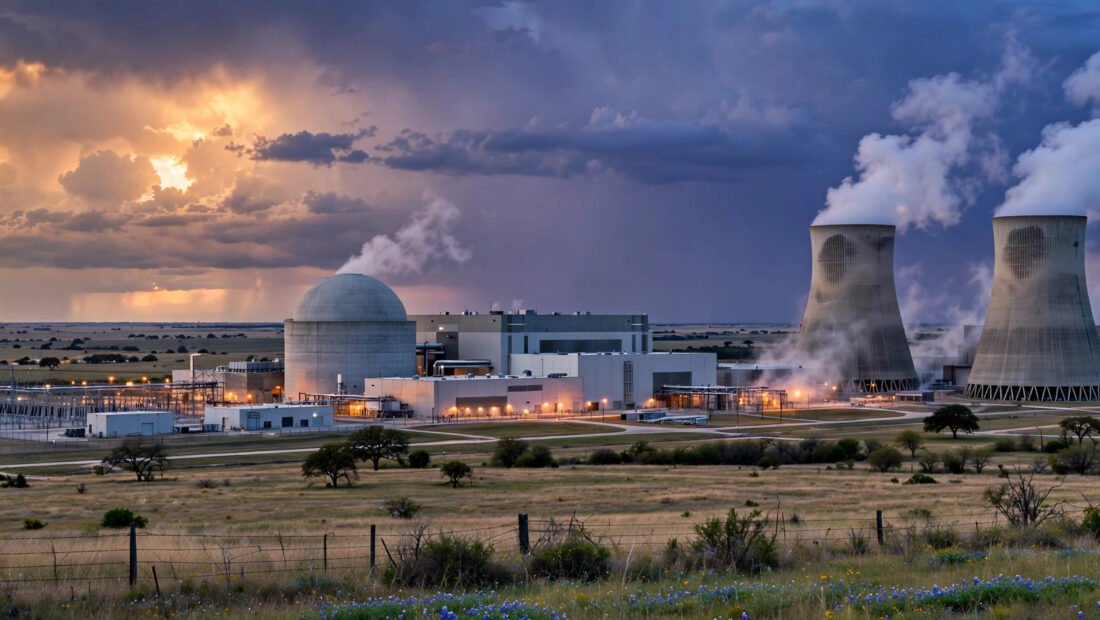
Texas is America’s nuclear powerhouse in waiting: the state already hosts two operating nuclear plants (Comanche Peak and South Texas Project), multiple advanced-reactor projects are in development, and the 2021 winter freeze plus surging data-center demand have pushed nuclear back into serious policy conversation. But the question most Texans actually ask — usually right after a headline about waste, or a memory of Fukushima — is simpler: is nuclear energy actually safe compared to other power sources? The answer, measured in deaths per unit of electricity produced, surprises almost everyone. Let’s look at the real numbers, the real risks, and what they mean for Texas.
The Number That Changes the Conversation
The standard safety metric is deaths per terawatt-hour (TWh) of electricity generated — it captures the full lifecycle: mining, construction, operation, waste, and even the air pollution from each source. The figures, compiled from peer-reviewed studies including data from Our World in Data and The Lancet:
- Coal: ~25 deaths per TWh (air pollution dominates — coal kills mostly through the lungs of people who never see a power plant)
- Oil: ~18 deaths per TWh
- Natural gas: ~3 deaths per TWh
- Hydropower: ~1.3 deaths per TWh (dominated by rare dam failures)
- Wind: ~0.04 deaths per TWh
- Nuclear: ~0.03 deaths per TWh — including Chernobyl and Fukushima
- Solar: ~0.02 deaths per TWh
Read that again: nuclear power, including the two worst accidents in history, has killed roughly 800 times fewer people per unit of energy than coal. The deadliest energy source in human history isn’t the one with the scary headlines — it’s the one whose victims die quietly of respiratory disease, far from any camera. Texas, which still generates a large share of electricity from gas and some coal, lives inside this math every day.
Why Nuclear Feels Dangerous (Psychology vs. Statistics)
The gap between perceived and actual risk has well-studied causes:
- Availability bias: Chernobyl and Fukushima are vivid, cinematic events. The ~8 million annual deaths from fossil-fuel air pollution (per Harvard research) are statistical and invisible. Brains overweight the vivid.
- Dread factor: radiation is invisible and poorly understood, which amplifies fear beyond the dose data. Meanwhile, the particulates from gas plants that Texans breathe daily feel “normal.”
- Catastrophic potential vs. chronic harm: people fear rare catastrophes more than routine harm, even when routine harm kills orders of magnitude more people. It’s the same psychology that makes flying feel scarier than driving.
None of this means nuclear risk is zero — it means our fear is miscalibrated relative to the alternatives actually powering Texas today.
The Real Risks, Honestly Stated
- Accidents: modern reactor designs (Generation III+ and the small modular reactors Texas is courting) have passive safety systems that shut down without human intervention or external power — the exact failure modes that caused Fukushima. The industry’s safety record over 18,000+ cumulative reactor-years is the data, not the exception.
- Waste: the genuinely unsolved political problem. High-level waste stays hazardous for thousands of years, though its volume is tiny — all of America’s commercial nuclear waste from 60+ years would fit on a single football field stacked 10 yards high. Finland’s Onkalo repository shows deep geological storage works technically; the US failure is political (Yucca Mountain), not scientific. Texas’s proposed interim storage sites remain contested.
- Proliferation and security: civilian power programs and weapons programs are separable but adjacent concerns; this is a geopolitical risk, not a Texas-grid risk.
- Cost and construction: nuclear’s biggest real-world problem isn’t safety — it’s economics. Recent US builds (Vogtle in Georgia) ran catastrophically over budget and schedule. Whether new modular designs fix this is the industry’s make-or-break question.
- Water use: relevant for Texas — large reactors need substantial cooling water, a real constraint in drought-prone regions. Air-cooled and advanced designs reduce this, but siting matters.
What This Means for Texas Specifically
Texas’s grid (ERCOT) faces a genuine crunch: data centers, electrification, and population growth are driving demand projections that wind, solar, and batteries alone may struggle to meet while keeping the lights on through a 2021-style freeze. Nuclear offers what renewables can’t easily: firm, weather-independent, carbon-free power that runs at 90%+ capacity factors through freezes, heat waves, and calm windless weeks alike. The state’s existing plants have operated safely for decades — Comanche Peak’s safety record spans 30+ years. Whether Texas builds more will hinge on economics and waste politics more than safety data, because the safety data is already in: nuclear is among the safest ways humans have ever made electricity. For context on how much electricity modern life consumes, even a single gaming PC’s monthly draw surprises most people — multiply by millions of homes and the scale of the generation challenge becomes clear.
Authoritative deep-dives: Our World in Data’s energy safety research and the US Energy Information Administration’s Texas profiles are the gold standards for primary data.
Conclusion
Is nuclear energy actually safe compared to other sources? By the only metric that counts — human lives per unit of electricity — it’s one of the safest energy sources ever deployed, roughly on par with wind and solar and hundreds of times safer than the coal and gas it would replace. The honest caveats are waste politics, construction economics, and water use — real issues deserving serious debate in Austin and Washington alike. But “is it safe” is, statistically speaking, settled: the energy sources Texans should fear are the ones whose pollution they breathe every day without headlines. Nuclear’s risks are vivid and rare; fossil fuels’ are invisible and constant. Good policy — and honest conversation — starts from that asymmetry, not from the headlines. For more detail on a related topic, see our article on is it safe to drink tap water when traveling in mexico.
Frequently Asked Questions
How many people have died from nuclear power accidents?
Chernobyl caused ~30 direct deaths plus a debated number of eventual cancer deaths (UN estimates suggest up to ~4,000 eventual cancer deaths among higher-exposed groups). Fukushima caused zero radiation deaths (the ~2,200 related deaths were from the evacuation itself). No US commercial reactor has ever caused a radiation death.
Is nuclear waste really dangerous for thousands of years?
High-level waste remains hazardous for millennia, yes — but the volume is extraordinarily small, it gets less dangerous over time (unlike chemical waste, which never decays), and deep geological repositories like Finland’s Onkalo demonstrate safe permanent storage is technically solved. The barrier is political, and interim storage proposals in Texas remain tied up in legal challenges.
Could a Texas nuclear plant have a Fukushima-style accident?
Fukushima’s reactors were 1960s designs hit by a beyond-design-basis tsunami. Modern designs have passive cooling that works without power or operators, and Texas’s plants aren’t exposed to tsunamis. The industry’s core lesson — defense in depth — is now engineered into new builds.
Why is nuclear so expensive to build?
A mix of regulatory ratcheting, loss of construction expertise (the US barely built plants for 30 years), and megaproject management failures. Small modular reactors aim to fix this with factory-built standardization — but it remains unproven at scale in the US.
Is nuclear power carbon-free?
Operationally yes — reactors emit no CO2 while generating. Lifecycle emissions (construction, mining, fuel processing) run about 12g CO2/kWh, comparable to wind and far below gas (~490g) and coal (~820g).