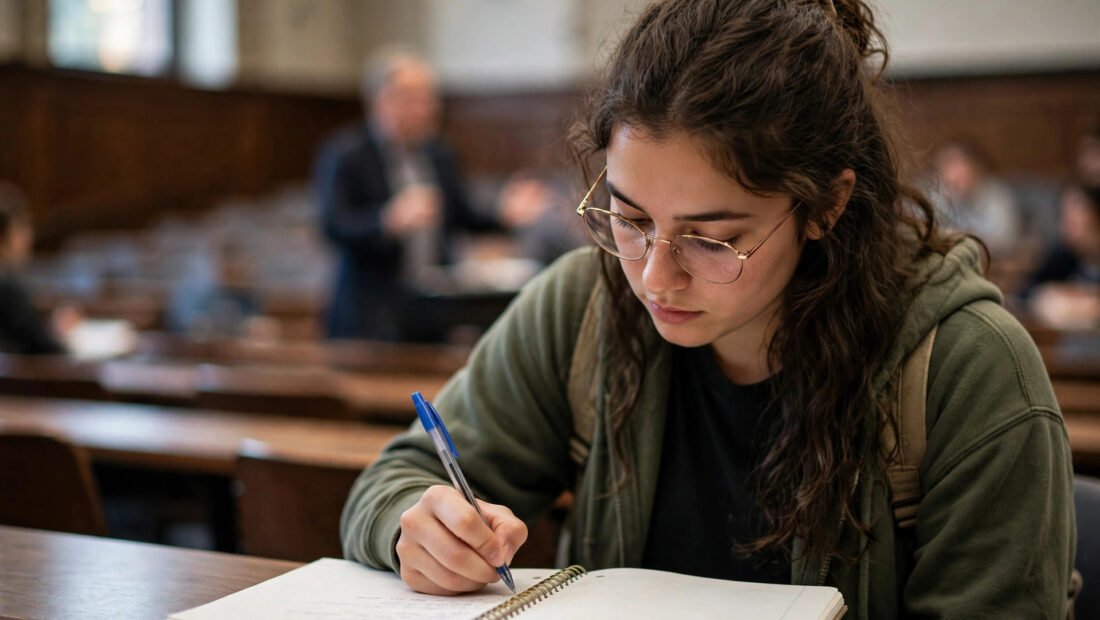
Most college students take notes the same way they did in high school: transcribe everything the professor says, as fast as possible, and hope it sticks. It does not. Cognitive science has spent decades studying what actually works, and the findings are both surprising and practical — the best note-taking methods have less to do with speed and more to do with how your brain processes information in real time. Whether you are at UT Austin, Texas A&M, or a community college in El Paso, these nine methods will change how much you retain from every lecture.
1. The Cornell Method: The Research Favorite
Divide your page into three sections: a wide right column for notes, a narrow left column for cues, and a bottom strip for summary. During lecture, take notes in the right column. Within 24 hours — this timing matters — fill the left column with questions, key terms, and prompts, then write a 2–3 sentence summary at the bottom. The magic is in the review step: cover the notes, quiz yourself using only the cues. Studies consistently rank Cornell among the most effective systems because it forces retrieval practice, the single most powerful learning technique known. It works beautifully for dense, fact-heavy lectures in biology, history, and psychology.
2. The Outline Method: For Structured Lecturers
The classic hierarchical format — main topics as Roman numerals or headings, subtopics indented beneath. This shines when professors lecture in clear structures (most do, even the rambling ones have hidden structure). Use bullet points, indent liberally, and leave white space for additions. Its weakness: it captures hierarchy well but discourages connecting ideas across topics. Pair it with a weekly 10-minute session drawing connections between outlines.
3. Mind Mapping: For Visual Thinkers
Put the central concept in the middle of the page and radiate branches for subtopics, sub-branches for details. Mind maps excel for brainstorming-heavy subjects — literature, philosophy, business strategy — where relationships matter more than sequences. Research shows they particularly help with creative synthesis and seeing the big picture. They are terrible for linear, formula-heavy content, so match the method to the material, not just your preference.
4. The Charting Method: For Comparison-Heavy Content
When a lecture compares theories, historical periods, or biological processes, draw a table: categories as columns, items as rows, cells filled during lecture. Charting turns chaotic comparison lectures into organized data you can actually study. Pre-draw the table before class if you know the topic — anticipating structure primes your brain to catch the content.
5. The Sentence Method: For Fast-Talking Professors
Some lecturers deliver facts at machine-gun pace with no discernible structure. For these, abandon organization during class: write each new fact as a separate numbered sentence, one per line. Capture now, organize later — spend 15 minutes after class grouping the sentences into topics. It is ugly but effective, and honesty about a lecture’s chaos beats a pretty outline missing half the content.
6. Guided Notes: Use What Professors Give You
Many professors post slide decks or skeletal outlines before class. Print them (or annotate digitally) and take notes directly on the gaps — this is called guided notes, and research shows it beats blank-page note-taking for most students because it offloads structure and frees attention for understanding. The key discipline: actually engage during lecture rather than passively highlighting. Add your own examples, questions, and connections in the margins.
7. The Zettelkasten-Inspired Method: For Deep Learners
Take “atomic” notes — one idea per note, in your own words, with a link to related ideas. This academic-grade method, borrowed from researchers, builds a personal knowledge web across courses. It is overkill for most freshmen but transformative for upper-division students writing theses or preparing for graduate school. Digital tools make linking effortless; the discipline is writing in your own words, which forces genuine comprehension.
8. Sketch-Noting: For the Artistically Inclined
Combine words with simple drawings, arrows, icons, and visual metaphors. You do not need artistic talent — stick figures and boxes work. The generation effect (creating your own representation) dramatically improves memory versus copying text. Particularly powerful for processes (draw the Krebs cycle as a journey), anatomy, and any spatial content. Photograph your pages for digital backup.
9. The Question Method: Lecture as Interrogation
Instead of recording what the professor says, record it as questions and answers. Every few minutes, write: “Why does X cause Y?” then capture the answer. This converts passive transcription into active inquiry and produces ready-made self-test material. It is cognitively demanding — you will be tired after class — but the retention payoff is among the highest of any method.
Handwriting vs. Typing: The Settled Science
The famous 2014 Mueller and Oppenheimer study found longhand note-takers outperformed laptop users on conceptual questions — because handwriting’s slowness forces you to paraphrase rather than transcribe. Later research nuanced this: the advantage comes from generative processing (rephrasing, summarizing), not the pen itself. Typed notes can match handwritten ones if you deliberately paraphrase instead of transcribing. The real laptop problem is distraction — studies show laptop users (and their neighbors) retain less partly because of multitasking. If you type, close everything else; if you handwrite, you get focus as a free bonus. Either way, a reliable laptop matters — our guide to budget laptops for college students keeps the tech affordable.
The 24-Hour Rule and Spaced Review
Here is the finding most students ignore: notes are nearly worthless without review, and review timing matters enormously. The forgetting curve shows we lose roughly 70 percent of new information within 24 hours — unless we retrieve it. Spend 10–15 minutes reviewing each lecture’s notes within a day, then again at increasing intervals (3 days, 1 week, 2 weeks). This spaced retrieval is the backbone of effective exam preparation, and it matters more than which note-taking method you chose. The method captures; the review retains.
Digital Note-Taking Tools Worth Knowing
Method matters more than medium, but the right tools reduce friction. Notion and Obsidian excel at linked, Zettelkasten-style notes that grow across semesters — ideal for the atomic-note method. OneNote remains the best free option for handwriting-plus-typing hybrid notes on tablets, with excellent organization. RemNote and Anki integrate note-taking with spaced-repetition flashcards, collapsing capture and review into one workflow. Audio-recording apps (with professor permission) rescue fast-talking lectures — but treat recordings as backup, not a substitute for live processing; students who “will listen later” rarely do. Whichever tool you choose, the research principles do not change: paraphrase rather than transcribe, review within 24 hours, and convert notes into self-test material. The What Works Clearinghouse publishes evidence-based study practice guides, and the American Psychological Association maintains accessible summaries of learning science — both worth bookmarking alongside your notes app.
Conclusion
There is no single best method — there is a best method for each lecture type. Use Cornell or the Question method for dense content courses, outlining for structured lecturers, mind maps for conceptual subjects, and charting for comparisons. Write by hand when you can (or type with discipline), review within 24 hours without exception, and remember that notes are a means to understanding, not a transcript of it. Master two or three of these methods and you will walk out of every lecture with more than your classmates who typed twice as many words.
Frequently Asked Questions
Should I take notes by hand or on a laptop?
Handwriting generally wins because its slowness forces paraphrasing, which deepens processing. But disciplined typing (paraphrasing, no multitasking) can match it. The bigger factor is reviewing notes within 24 hours, regardless of medium.
What is the Cornell note-taking method?
A three-section page: notes in the wide right column during class, cue questions in the narrow left column afterward, and a summary at the bottom. Review by covering the notes and quizzing yourself from the cues — this retrieval practice is what makes it so effective.
How can I take notes when the professor talks too fast?
Use the sentence method (numbered facts, organize later), rely on posted slides as guided notes, and develop abbreviations. Most importantly, prioritize capturing key ideas over complete sentences — you can fill gaps from textbooks and office hours.
Do I need to rewrite my notes neatly?
Recopying notes verbatim has weak evidence — it feels productive but is mostly passive. Instead, transform notes: convert them to questions, summaries, or mind maps. Transformation forces the reprocessing that actually builds memory.