Bad knees do not have to mean a sedentary life — they just mean a smarter exercise menu. Whether your knee pain comes from arthritis, an old sports injury, or years of wear, the right low-impact movements can strengthen the muscles around the joint, reduce stiffness, and in many cases actually decrease pain over time. The wrong ones can set you back weeks. This guide covers the best low-impact exercises for bad knees, how to tell productive discomfort from warning signs, and Texas-friendly ways to stay active without pounding your joints.
Why Exercise Helps Arthritic and Achy Knees
It feels counterintuitive: the joint hurts, so rest it. But cartilage — the smooth tissue cushioning your knee — has no blood supply. It receives nutrients through the pumping action of joint movement. Prolonged stillness literally starves it. Meanwhile, weak quadriceps, hamstrings, and glutes force the knee joint itself to absorb forces muscles should handle. Strengthening those muscles is the single most evidence-backed intervention for knee osteoarthritis, recommended by the American College of Rheumatology.
The catch is impact. Running can load the knee with 3–4 times your body weight per step; walking loads it with 1–2 times. Low-impact exercise keeps joint forces near body weight while still building the supporting musculature. That is the entire game: maximum muscle stimulus, minimum joint pounding.
The 7 Best Low-Impact Exercises for Bad Knees
1. Swimming and Water Aerobics
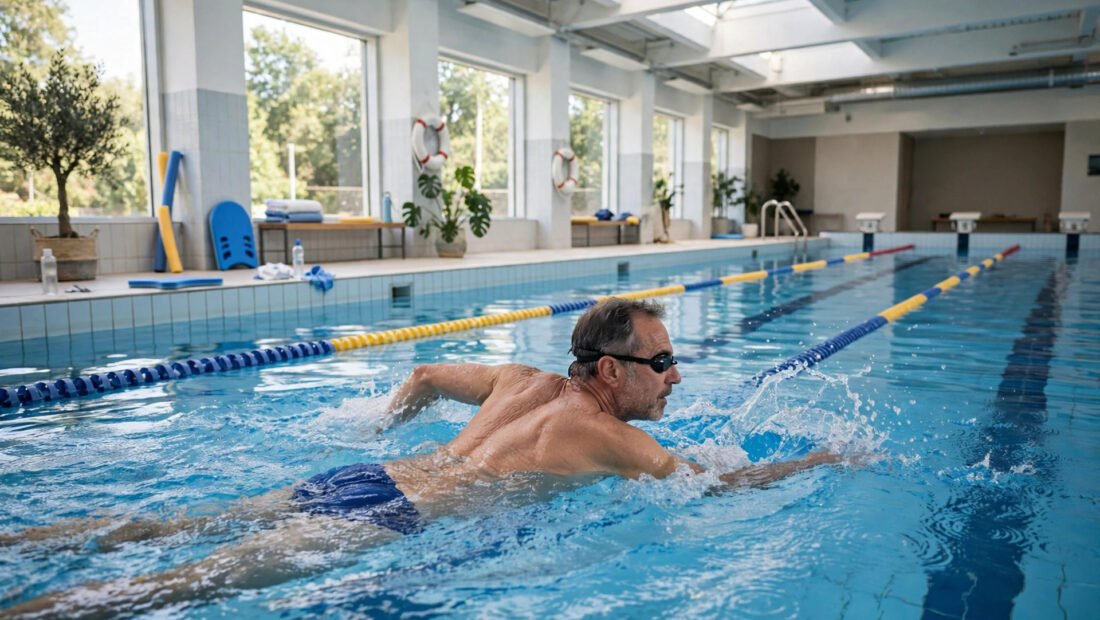
The undisputed champion. Water’s buoyancy unloads up to 90 percent of body weight in chest-deep water, letting you move freely with almost no joint stress. Texas is pool country — most cities have year-round indoor community pools, and HOA and apartment pools sit empty on weekday mornings. Aim for 20–30 minutes of laps, water walking, or a water-aerobics class twice a week. If you are new to the water as an adult, the hardest part is starting; the joints will thank you immediately.
2. Stationary Cycling
Cycling’s smooth, circular motion strengthens quads and hamstrings through a controlled range with minimal impact. Set the seat high enough that your knee has a slight bend at the bottom of the pedal stroke — too low is the classic mistake that aggravates knees. Start with 15 minutes at easy resistance. Recumbent bikes, common in Texas gyms and physical-therapy clinics, offer back support that upright bikes lack.
3. Elliptical Trainer
The elliptical mimics running’s motion while your feet never leave the pedals, eliminating impact forces. Keep resistance moderate and avoid leaning heavily on the moving handles, which offloads the legs. Twenty to thirty minutes at a conversational pace is a solid session.
4. Straight-Leg Raises and Quad Sets
These physical-therapy staples look too easy to matter — they are not. Lying quad sets (tightening the thigh muscle with the leg straight, holding 5 seconds) directly activate the vastus medialis, the teardrop muscle above the inner knee that tracks the kneecap. Straight-leg raises build on this. Three sets of 10–15 daily can measurably reduce knee pain within weeks, and they are safe for nearly everyone.
5. Glute Bridges
Weak glutes let the knee cave inward during movement — a primary driver of knee pain. Lying bridges (hips up, squeeze glutes, 2-second hold) retrain the posterior chain without loading the knee joint. Progress to single-leg bridges as strength builds.
6. Tai Chi
Multiple randomized trials show tai chi reduces knee-osteoarthritis pain as effectively as physical therapy for many patients. The slow, weight-shifting movements build balance, leg strength, and proprioception — your joint’s position sense — which prevents the awkward steps that cause flare-ups. Community centers across Texas offer low-cost classes.
7. Walking on Soft Surfaces
Walking itself is low-impact, and surface choice matters enormously. A rubberized high-school track, a packed-dirt park trail, or a treadmill with cushioning beats concrete sidewalks by a wide margin. Our dedicated guide to low-impact exercise options breaks down more joint-friendly cardio choices. Start with 10–15 minutes and add 5 minutes weekly; supportive shoes with real cushioning are non-negotiable.
Movements to Approach With Caution
Deep squats, lunges, and kneeling put the knee under high flexion loads that irritated joints hate. That does not mean never — it means earn them. Partial-range wall sits (slide down only a few inches) and shallow step-ups build toward deeper movements safely. High-impact activities like running, basketball, and jumping belong in the “only with clearance and progression” category. Stair climbing is fine in moderation; take them one at a time, leading with the stronger leg going up.
Pain Rules: Hurt vs. Harm
Learn the traffic-light system physical therapists use. Green: mild discomfort (3/10 or less) during exercise that fades within an hour — safe to continue. Yellow: pain up to 5/10 that settles by the next morning — acceptable, but do not increase intensity. Red: sharp pain, swelling, locking, buckling, or pain that worsens 24 hours later — stop and get evaluated. Pain that appears the morning after, rather than during, is your most honest feedback signal. The Mayo Clinic’s knee-pain resources offer a solid primer on when self-care suffices and when imaging is warranted.
Support Gear Worth the Money
A few inexpensive tools multiply results: a resistance band set for seated leg exercises, a foam roller for quads and IT bands (tight lateral tissue pulls the kneecap off track), and proper footwear — worn-out shoes are a leading silent cause of knee complaints. Knee sleeves provide warmth and proprioceptive feedback; hinged braces are for specific diagnoses, not general achiness. Topical NSAID gels can take the edge off before activity with fewer systemic effects than oral pills, but check with your doctor about regular use.
When to See a Professional
Self-managed exercise handles most chronic achiness, but get evaluated for: knees that lock, catch, or give way; swelling that does not resolve in 48 hours; inability to bear weight; deformity after injury; or pain that steadily worsens over months despite smart training. A physical therapist can assess your specific mechanics — many Texas PT clinics offer direct access without a referral — and the NIH’s osteoarthritis pages summarize current treatment guidelines if you want to arrive informed.
Putting It Together: A Sample Knee-Friendly Week
Here is what a balanced week looks like: Monday: 20-minute swim or water-walking session. Tuesday: quad sets, straight-leg raises, and glute bridges (15 minutes at home). Wednesday: 25-minute stationary bike ride at easy resistance. Thursday: rest or gentle tai chi video. Friday: repeat the strength routine, adding a set. Saturday: 20-minute walk on a rubberized track or park trail. Sunday: full rest. Total joint impact: near zero. Total benefit: strengthening every muscle that protects your knees, cardiovascular conditioning, and the confidence that comes from a plan. Progress by adding five minutes to cardio sessions weekly and resistance to strength work monthly. Pair the routine with complementary mobility — gentle exercises for lower-back pain address the hip and core stiffness that often accompanies knee issues, since the whole kinetic chain works as one system.
Conclusion
Bad knees ask for adaptation, not surrender. Swimming, cycling, targeted quad and glute work, tai chi, and soft-surface walking give you a full fitness menu that builds the muscles protecting your joints instead of punishing them. Start embarrassingly easy, obey the traffic-light pain rules, and progress in small weekly steps. Most people are surprised how quickly “my knees are bad” stops being the reason they do not move — and starts being the reason they move smarter.
Frequently Asked Questions
Is walking bad for arthritic knees?
No — walking is one of the best exercises for knee arthritis when done on forgiving surfaces with supportive shoes. Start short, progress gradually, and expect mild stiffness at first that eases as the joint warms up.
Should I wear a knee brace while exercising?
Elastic sleeves can provide comfort and confidence during activity, but they do not fix underlying weakness. Use them as a bridge while you build quad and glute strength, not as a permanent substitute for it.
Can exercise actually reverse knee arthritis?
Exercise cannot regrow lost cartilage, but it reliably reduces pain, improves function, and can delay or prevent the need for surgery. Strong muscles around the joint change the biomechanics of every step you take.
How do I know if my knee pain needs a doctor?
See a doctor for locking or buckling, significant swelling, inability to bear weight, pain after a specific injury, or pain that worsens over weeks despite rest and smart activity. Mechanical symptoms (catching, giving way) warrant evaluation sooner than dull achiness.